Tongue Nerve Implant vs CPAP: A Records Study
A 2026 US health records study matched 2,292 tongue nerve implant patients to 2,292 CPAP patients. The implant group had fewer recorded hospital admissions over 2 years, but the groups were not randomised, the study had no usage data and one author consults for the implant maker.
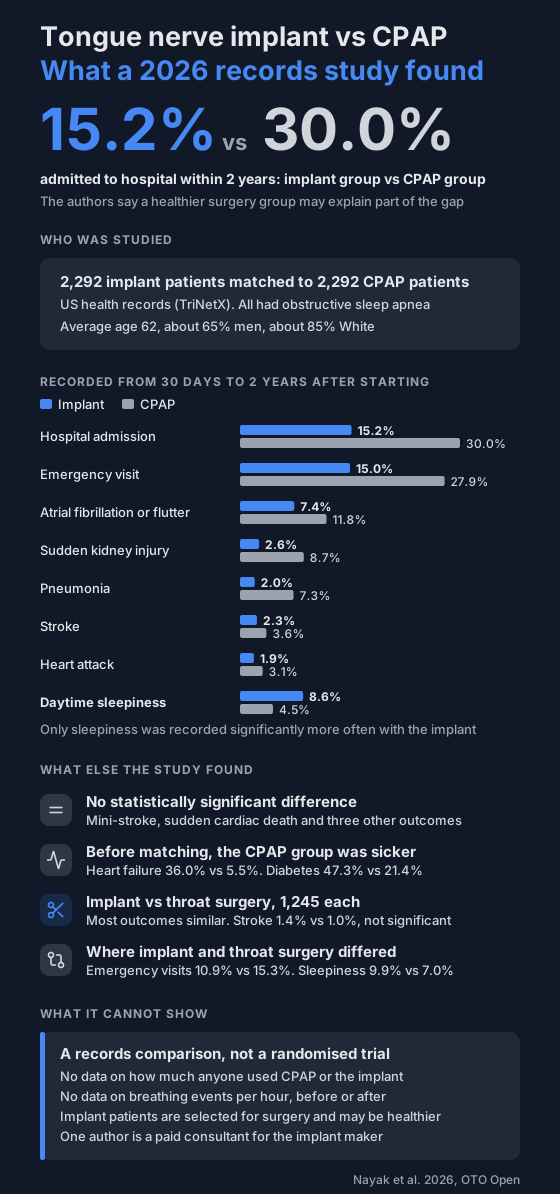
CPAP is the first choice for obstructive sleep apnea. A tongue nerve implant is an option for some people who can't tolerate it. A 2026 trial showed an implant lowering breathing events per hour, but it was too small and short to count heart attacks or strokes.
A 2026 study looked for those in US health records instead. The implant group had lower recorded rates of 14 of the 20 events counted. That is a link in records, not proof the implant was the reason, and the authors say part of the gap may be down to who gets offered surgery.
Who was in the study?
- Adults with obstructive sleep apnea in TriNetX, a database of health records from over 100 US healthcare organisations.
- 2,293 had a tongue nerve implant and 383,658 started CPAP, all with at least 2 years of follow-up.
- People using CPAP at the time of the implant were left out of the implant group.
- Each implant patient was matched to one CPAP patient on age, sex, race, BMI, clinic visits, smoking and existing health conditions.
- That left 2,292 in each group, with an average age of 62. About 65% were men and about 85% were White.
Before matching, the two groups looked very different. In the CPAP group, 36.0% had heart failure and 47.3% had diabetes. In the implant group it was 5.5% and 21.4%.
What did it find?
The study counted health events recorded from 30 days to 2 years after starting.
| Recorded within 2 years | Implant | CPAP | Odds ratio |
|---|---|---|---|
| Hospital admission | 15.2% | 30.0% | 0.419 |
| Emergency department visit | 15.0% | 27.9% | 0.457 |
| Atrial fibrillation or flutter | 7.4% | 11.8% | 0.594 |
| Sudden kidney injury | 2.6% | 8.7% | 0.283 |
| Pneumonia | 2.0% | 7.3% | 0.255 |
| Stroke | 2.3% | 3.6% | 0.626 |
| Heart attack | 1.9% | 3.1% | 0.612 |
| Daytime sleepiness | 8.6% | 4.5% | 2.019 |
The figures are from the paper's results table. An odds ratio below 1 means it was recorded less often in the implant group. All eight differences were statistically significant.
The implant group also had lower odds of a blood clot in the lung, a fast heart rhythm from the lower chambers, sudden heart failure, heart failure flare-ups, COPD flare-ups, sudden breathing failure and a blood pressure crisis.
There was no statistically significant difference for aortic dissection, mini-stroke, sudden cardiac death, ventricular fibrillation or suicide attempt.
Why was sleepiness higher with the implant?
It was the one outcome recorded significantly more often in the implant group. The paper doesn't know why, and offers two guesses:
- Implant patients have more contact with healthcare before and after surgery, so the symptom may get written down more often.
- The implant is tuned over time, so relief may come later than people expect.
Is the gap down to the implant?
The authors aren't sure, and they ran a second comparison to check. They matched 1,245 implant patients to 1,245 people who had throat surgery (UPPP) and no CPAP afterwards. Both of those groups had been picked for an operation.
- Most outcomes were similar, including stroke (1.4% against 1.0%), heart attack (1.0% against 1.2%) and hospital admission (12.6% against 15.1%). None of those differences was statistically significant.
- Emergency visits were lower with the implant: 10.9% against 15.3%.
- Sudden kidney injury was 1.0% against 2.0%, right on the edge of significance (P = .0498, with a confidence interval of 0.262 to 1.011 that crosses 1).
- Daytime sleepiness was recorded more often with the implant: 9.9% against 7.0%.
The authors read this as a sign that the implant against CPAP gap may partly reflect who is chosen for surgery. People with new sleep apnea and serious health problems are often not referred for an operation. The authors also say the two operations differ enough that the comparison has its own confounding.
What can't it tell you?
Limits the authors state:
- No usage data. The database doesn't record how many hours anyone used CPAP or the implant. The authors suggest low CPAP use may explain the gap, but they couldn't measure it.
- No sleep data. There's nothing on breathing events per hour or on how well either therapy worked.
- A records study. Nobody was randomised, and matching only balances what's in the records. The authors say implant patients may have had more money or better health to begin with.
- No history. How long someone had sleep apnea before starting wasn't known.
- Earlier CPAP. An implant is only offered after CPAP hasn't worked out, so the implant group may have had a long spell of poorly controlled sleep apnea first.
- Coding. Hospitals code conditions differently, so some events may be misclassified.
- Timing. They couldn't tell whether an emergency visit came soon after surgery or much later.
Things we noticed:
- Conflict of interest. One of the six authors is a paid consultant for Inspire Medical Systems, which makes the implant studied. The paper gives its funding source as none.
- Group size. The abstract gives 3,525 per group. The tables and results text give 2,292, which is what we've used.
- Two outcomes not in the table. The text reports mini-stroke and sudden cardiac death as not significant, but the results table has no rows for them.
- Small mismatches. The text gives CPAP hospital admissions as 30.11%, and the table gives 688 of 2,292, which is 30.0%.
What can you do with this?
These are our suggestions, not the study's findings.
- Don't read it as a ranking of the two options. Which one suits you is a decision for you and your doctor.
- If you're on CPAP, your machine records your hours. That's the number this study didn't have, and regular use is the hard part for many people.
- You can also track your overnight oxygen alongside CPAP and share the trend at your next appointment.
Not a medical device. Does not diagnose, treat or prevent any condition. Discuss results and changes with a clinician.
References
- Nayak A, Adibi I, Calder A, Saeedi A, Tucker A, Nord R. Clinical Outcomes of Hypoglossal Nerve Stimulation Versus Continuous Positive Airway Pressure in Obstructive Sleep Apnea. OTO Open. 2026;10(2):e70240. doi:10.1002/oto2.70240