Tongue Nerve Implant for Sleep Apnea: A Trial
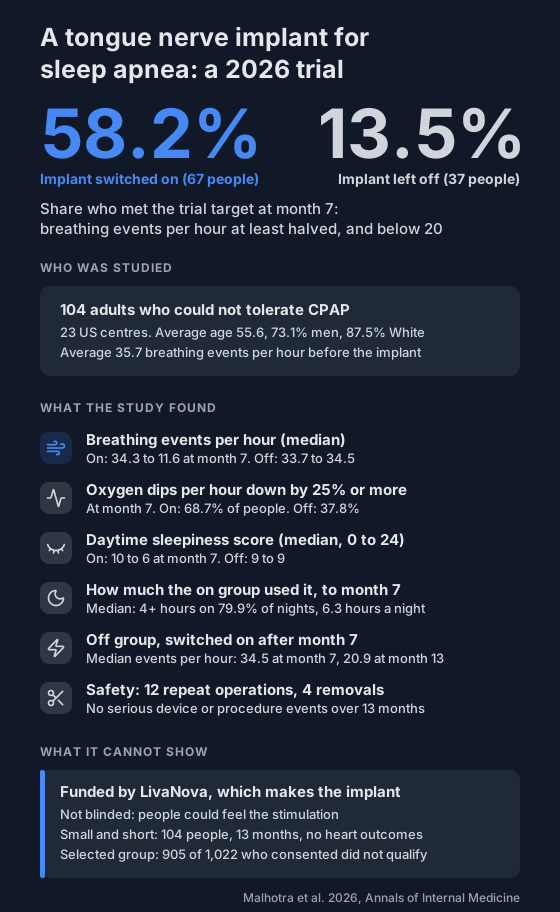
A 2026 randomised trial implanted a tongue nerve stimulator in 104 adults who couldn't tolerate CPAP. 58.2% met the trial target with it switched on, against 13.5% with it off. The maker funded the study.
CPAP is the first choice for obstructive sleep apnea, but not everyone tolerates it. One alternative is an implant that stimulates the nerve that moves the tongue. Much of the evidence for them comes from studies with no comparison group.
A 2026 trial called OSPREY had one. Everyone got the implant, and a random third had it left switched off for 7 months.
Who was in the trial?
- 104 adults at 23 US centres who couldn't tolerate CPAP.
- Average age 55.6, 73.1% men, 87.5% White.
- Before the implant they averaged 35.7 breathing events per hour and 36.7 oxygen dips per hour (ODI).
- 67 had it switched on at month 1, and 37 after month 7.
What did it find at month 7?
The target was breathing events per hour at least halved, and below 20.
- Target met: 58.2% with the implant on, 13.5% with it off.
- Median breathing events per hour: 34.3 to 11.6 with it on, 33.7 to 34.5 with it off.
- Oxygen dips per hour down by 25% or more: 68.7% with it on, 37.8% with it off.
- Median daytime sleepiness score: 10 to 6 with it on, 9 to 9 with it off.
- Use in the on group (medians): 4 hours or more on 79.9% of nights, 6.3 hours a night.
More than a third of the off group had that ODI drop with the implant off. The authors say breathing events per hour vary from night to night, which is why a trial needs a comparison group.
After month 7 the off group's implants were switched on. Their median went from 34.5 events per hour to 20.9 at month 13.
Was it safe?
- No serious problems were tied to the device, operation or stimulation over 13 months.
- There were 12 repeat operations in 11 patients, and 4 implants were taken out.
- 3 others had the implant removed after being ruled ineligible, and aren't in the results.
- 6% of the on group reported disturbed tongue movement in the first 7 months.
What doesn't it tell you?
- Funding. LivaNova makes the implant and paid for the trial, and helped design it, analyse the data and approve the paper.
- No blinding. People could feel the stimulation, which the authors say may have inflated the self-reported scores.
- Small and short. 104 people for 13 months can't show effects on heart attacks or strokes.
- A selected group. 1,022 people consented and 905 didn't pass the entry checks.
Whether an implant suits you is a decision for you and your doctor.
On CPAP? You can track your oxygen alongside it.
Not a medical device. Does not diagnose, treat or prevent any condition. Discuss results and changes with a clinician.
References
- Malhotra A, Schwartz AR, Lovett E, Juran N, Nguyen SA, Barrera JE, Bogan RK, Mickelson SA, Boghara H, Miller M, Jacobowitz O; OSPREY Investigators. Proximal Hypoglossal Nerve Stimulation for Obstructive Sleep Apnea in the OSPREY Study: A Randomized Controlled Trial. Annals of Internal Medicine. 2026;179(6):812-822. doi:10.7326/ANNALS-25-04414