Still Sleepy on CPAP? A 2026 Clinic Review
A London sleep centre reviewed 50 people who used CPAP well and were still sleepy. Their average sleepiness score fell from 17.6 to 14.9 out of 24, and most had other health conditions or medication.
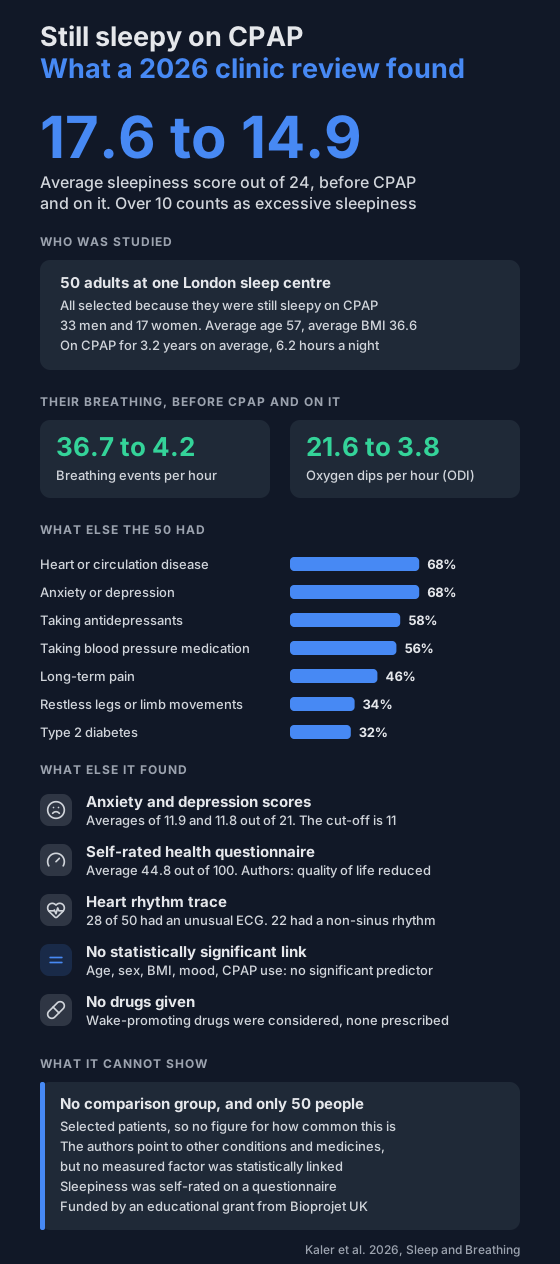
Most people on CPAP feel less sleepy once their breathing settles at night. Some don't. A 2026 review from a London sleep centre looked closely at 50 of them.
It doesn't tell you how common this is. The 50 were chosen because they were still sleepy. The paper quotes earlier estimates of about 15%, and of 11% to 18%, of people on CPAP. For one European database it prints two figures: up to 28.2% in the introduction and up to 25% in the discussion.
Who was in the review?
- 50 adults at the sleep centre at Guy's and St Thomas' in London, picked from 63 who were considered between May and December 2024.
- 33 men and 17 women, average age 57, average BMI 36.6.
- 39 were white, 8 Asian and 3 black.
To be included, each person needed:
- A sleep study showing more than 15 breathing events per hour.
- A sleepiness score above 10 out of 24 before CPAP.
- At least 3 months on CPAP, used for more than 4 hours a night on more than 70% of nights.
- A home sleep test on CPAP showing breathing under control.
On average they had been on CPAP for 3.2 years, used it 6.2 hours a night and on 87% of nights.
Was CPAP doing its job?
By the numbers, yes.
- Breathing events per hour: 36.7 before CPAP, 4.2 on it.
- Oxygen dips per hour (3% ODI): 21.6 before, 3.8 on it.
Not sure what your own machine's numbers mean? See events still showing on CPAP.
How sleepy were they?
- Average sleepiness score before CPAP: 17.6 out of 24.
- Average on CPAP: 14.9.
- That's a fall of 2.7 points. The 95% confidence interval was 2.0 to 3.4.
The paper says a change of more than 2 points is thought to be one a person can notice. So the group was less sleepy on CPAP, but still well above the line of 10.
The authors make two points from this:
- These people started from a very high score, so a real drop still left them over the line.
- Whether someone counts as "still sleepy" depends on where the line is drawn.
They also say people who stay sleepy should be encouraged to keep using CPAP, because they would likely feel worse without it.
What else was going on?
A lot.
- Heart or circulation disease: 68%
- Anxiety or depression: 68%
- Long-term pain: 46%
- Restless legs or periodic limb movements: 34%
- Type 2 diabetes: 32%
And the medication they were taking:
- Antidepressants: 58%
- Blood pressure medication: 56%
- Painkillers: 22%
- Diabetes medication: 22%
- Dopamine-type drugs: 10%
Nobody was on benzodiazepines or Z-drugs. Three people took melatonin.
Other findings:
- 28 of 50 had an unusual ECG. 22 had a non-sinus rhythm, a group that includes atrial fibrillation.
- Anxiety and depression scores averaged 11.9 and 11.8 out of 21. The questionnaire's cut-off is 11.
- A self-rated health questionnaire averaged 44.8 out of 100. The authors describe quality of life as reduced.
- Blood counts, iron and thyroid tests were within the lab's ranges on average.
So what explains the sleepiness?
The review can't say.
The authors think the other conditions and the medication are the likely reasons. They point to pain and limb movements breaking up sleep, and to the drowsy side effects of some antidepressants and painkillers. They also note that obesity is linked to daytime sleepiness on its own.
Their own statistics don't back that up, though. Sleepiness scores had no statistically significant correlation with any of the demographic or sleep measures. A model using age, sex, BMI, breathing events at the start, starting sleepiness, anxiety, depression and CPAP use did not reach statistical significance. The authors note the group was small.
What can't it tell you?
- How common it is. Everyone in it was selected for being sleepy on CPAP.
- Cause. There was no comparison group.
- Much about women or different ethnic groups. The numbers were too small.
- Sleep quality. 14 of the 50 had a first test that recorded breathing only, not sleep stages.
- Sleepiness beyond a questionnaire. It was self-rated. The authors say an objective test would add to the picture.
- Carbon dioxide levels. Shallow breathing at night wasn't measured directly.
The work was funded by a £40,000 unrestricted educational grant from Bioprojet UK. The paper says the sponsor had no role in the design or conduct of the research, and no medication was prescribed during it. The authors declare no conflicts of interest.
What can you do with this?
These are our suggestions, not the study's findings.
If you use CPAP most nights and you're still sleepy, tell your sleep clinic or doctor. This review suggests the conversation should cover more than the machine:
- Your other health conditions, including pain, low mood and restless legs.
- Every medicine you take.
The authors call for sleep clinics, GPs and pharmacists to look at these together. Any change to medication or CPAP is a decision for you and your doctor.
Sleepiness also isn't a reliable guide to what your breathing does at night. See sleep apnea without sleepiness.
An overnight oximeter can't tell you why you're tired. It logs your oxygen and pulse, which you can track alongside CPAP and share with your doctor.
Not a medical device. Does not diagnose, treat or prevent any condition. Discuss results and changes with a clinician.
References
- Kaler JS, Chakrabarti B, Craig S, Steier J. Residual daytime sleepiness in patients with obstructive sleep apnoea syndrome: A service review in a tertiary sleep centre. Sleep and Breathing. 2026;30(2):113. doi:10.1007/s11325-026-03655-6