Heart Failure: 6 Nights of Overnight Oxygen
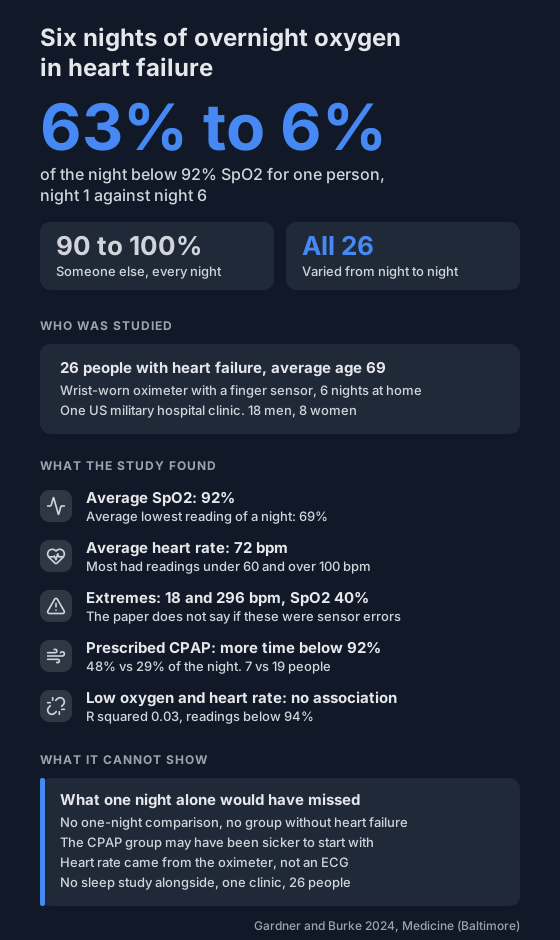
A 2024 study had 26 people with heart failure wear an oximeter at home for 6 nights. Oxygen and heart rate varied widely between people and from night to night, so one night may not show the full picture.
Heart failure checkups usually happen in a clinic, in the daytime. A 2024 study looked at the nights instead.
26 people with heart failure wore an oximeter at home for 6 nights in a row. Their oxygen and heart rate varied a lot between people, and for many, from one night to the next.
For the general question, see how many nights to record.
Who was studied?
- 26 people from the heart failure clinic at Walter Reed, a US military hospital. They were military retirees and their family members.
- Average age 69. 18 men and 8 women.
- Most had other conditions too, most often high blood pressure (21 people).
- 10 had an implanted heart device such as a pacemaker.
- 7 were prescribed CPAP and 7 had sleep apnea on record. 4 people were in both groups.
- 1 used oxygen at night.
Everyone wore a Nonin WristOx2 3150, a wrist-worn oximeter with a finger sensor. It took a reading every second, from getting into bed to getting up. No one reported problems using it and none of the devices failed.
How much did the numbers move?
Across everyone and every night:
- Average SpO2 was 92%.
- The average lowest reading of a night was 69%.
- Average heart rate was 72 beats per minute.
Some people's nights looked very different from each other. One person spent 63% of night 1 below 92% SpO2, and 6% of night 6. Others barely changed: someone else spent 90% to 100% of every night below 92%.
The authors found statistically significant night-to-night differences in oxygen for all 26. For heart rate under 60, 21 people varied significantly across nights, and for heart rate over 100, 18 did.
Our note, not the authors': each night held tens of thousands of readings per person. With that much data, even small differences can reach statistical significance, so look at the size of the change, not just the p-value.
What about the extreme readings?
The paper reports heart rates from 18 to 296 beats per minute and SpO2 readings as low as 40%.
Read those with care.
- The paper doesn't discuss whether any of them were sensor errors.
- Oximeters can give false readings when the hand moves or the signal is weak. See motion and cold fingers.
- The only readings set aside were 138 with a heart rate over 220, and only for one analysis.
- The data was "cleaned", but the paper doesn't say how.
So the highest and lowest values may include artefact. The averages are built from many thousands of readings, so a few bad ones move them less.
What else did it find?
- Heart rate under 60 and over 100. The authors call these arrhythmias and say every patient had both. Their own tables list 2 people with no readings under 60 and 2 with none over 100.
- Low oxygen and heart rate. 61.5% of all readings were below 94%. For those, the authors found no association between how low the oxygen was and the heart rate (R squared 0.03).
- CPAP. The 7 people prescribed CPAP spent more of the night below 92% than the 19 who weren't: 48% against 29%. Their average SpO2 was slightly lower, 91.4% against 92.3%. Time under 60 beats per minute was slightly higher on CPAP, 13.5% against 11.5%, a statistically significant difference. Time over 100 showed no statistically significant difference.
The two groups didn't differ significantly in age, heart failure class or other conditions. The authors still suggest the people on CPAP may have been sicker to start with. The paper doesn't say how many nights they actually used it. A comparison of 7 people with 19 can't show what CPAP did or didn't do.
The authors suggest clinicians record 6 nights, perhaps every 6 months, and when a therapy such as CPAP starts or stops.
What can't it show?
- The authors conclude one night isn't enough, but they didn't compare one night with six. So the study can't say how often one night would have given a different picture.
- There was no group without heart failure, so it can't say how unusual these numbers are.
- No sleep study was done alongside, so breathing events and sleep stages weren't measured.
- Heart rate came from the oximeter's pulse reading, not an ECG, so it can't show the type of heart rhythm.
- 26 people at one clinic.
- It used two cut-offs, 92% and 94%, for low oxygen. Both were the authors' choice.
- The paper has no limitations section. The authors do note that implanted heart devices may have dampened some heart rate changes.
The study was funded by the Uniformed Services University and a Defense Health Agency program. The authors report no conflicts of interest.
What can you take from it?
- One night is one sample. Record several before you read anything into a number. Another study compared one sleep study with months of tracking.
- Before trusting a striking lowest SpO2 or highest heart rate, look at the trace around it in the session viewer. A few seconds of poor signal can set it.
- An oximeter's heart rate is a pulse rate. It can't tell what kind of rhythm you had. See overnight heart rate explained.
- If you have heart failure, your care team decides what your recordings mean. Here's how to share them.
Another study of heart failure looked at time below 90% over a single night.
Not a medical device. Does not diagnose, treat or prevent any condition. Discuss results and changes with a clinician.
References
- Gardner CL, Burke HB. Individual heart failure patient variability in nocturnal hypoxia and arrhythmias. Medicine (Baltimore). 2024;103(41):e40083. doi:10.1097/MD.0000000000040083