Time Below 90% and Heart Failure Outcomes
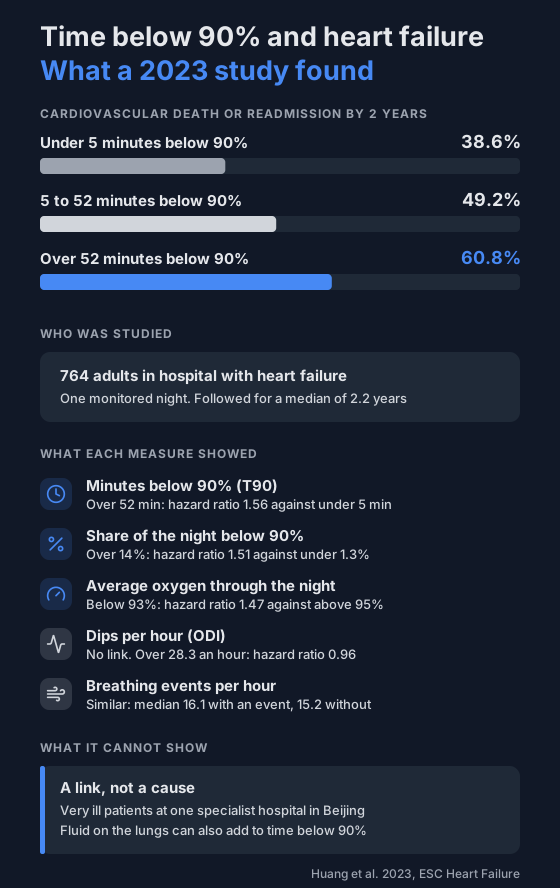
A study of 764 heart failure patients found that time spent below 90% oxygen overnight was linked to cardiovascular death or readmission. The number of dips per hour was not.
Sleep-related breathing problems are usually graded by counting: breathing events per hour, or oxygen dips per hour. A 2023 study of heart failure patients asked whether a count is the best guide to what happens next.
It wasn't. How long oxygen stayed below 90% was linked to cardiovascular death or readmission. How often it dipped was not.
Who was studied?
- 764 adults admitted with heart failure to Fuwai Hospital in Beijing between May 2015 and July 2018.
- Average age 54.7, and 76.2% were men.
- 84.4% were in the two most limiting of the four heart failure symptom classes.
- Nobody with COPD, and nobody who had used home oxygen or positive airway pressure.
Each patient wore a multichannel sleep monitor (ApneaLink Plus) for one night in hospital, without extra oxygen. Only recordings with at least 4 usable hours were kept.
- 36.6% had central sleep apnea and 16.5% had obstructive sleep apnea.
- 46.9% had fewer than 15 breathing events an hour.
- In 10.7% of patients, oxygen never went below 90%.
What did the researchers compare?
Four numbers from the monitor's pulse oximeter:
- T90: minutes with oxygen below 90%. See what is T90.
- TRT90: the same thing as a share of the recording.
- ODI: dips of 3 points or more per hour. See ODI explained.
- Average oxygen over the night.
They split patients into thirds on each number. Then they followed them for a median of 2.2 years, looking for cardiovascular death or a first unplanned admission for worsening heart failure. 410 of the 764 patients (53.7%) had one of the two.
What did time below 90% show?
The estimated chance of cardiovascular death or heart failure readmission by 2 years rose with T90:
- Under 5 minutes: 38.6%
- 5 to 52 minutes: 49.2%
- Over 52 minutes: 60.8%
The link held after adjusting for age, high blood pressure, kidney and heart measures and medication. Against the under 5 minutes group:
- 5 to 52 minutes: hazard ratio 1.32 (95% CI 1.02 to 1.71).
- Over 52 minutes: hazard ratio 1.56 (95% CI 1.21 to 2.02).
As a share of the night, the pattern was the same. Against under 1.3% of the recording below 90%:
- 1.3% to 14%: hazard ratio 1.38.
- Over 14%: hazard ratio 1.51.
One wrinkle: T90 in minutes as a sliding scale, not thirds, was not statistically significant after adjustment (hazard ratio 1.08 per 85 minutes, 95% CI 0.99 to 1.18, P = 0.092). The share-of-recording version was (1.11 per 22 points, P = 0.018).
What about average oxygen?
- Average below 93%: hazard ratio 1.47 against an average above 95%.
- Average of 93% to 95%: no statistically significant difference from above 95%.
The authors read that as a threshold: outcomes differed only once the average fell below a certain level.
And the dips per hour?
No statistically significant link.
- Against an ODI under 14.5, an ODI of 14.5 to 28.3 had a hazard ratio of 0.99, and over 28.3 had 0.96.
- Median ODI was 20.4 in patients who had an event and 19.6 in those who didn't.
- Breathing events per hour were similar too: a median of 16.1 against 15.2.
- The mix of central and obstructive sleep apnea showed no statistically significant difference between the two groups either.
T90 tracked ODI only partly (correlation 0.61), and breathing events per hour less (0.54). The authors say counts of events may not capture how much time oxygen spends low.
Other studies have looked at the same question in different groups. See newer oxygen dip measures vs ODI and sleep apnea beyond event counts.
What can't it show?
- Cause. It's an observational cohort study, and the authors say the link probably runs both ways: fluid build-up in heart failure lowers oxygen, and low oxygen may push heart failure along.
- Where the low oxygen came from. Time below 90% can come from breathing pauses, fluid on the lungs or slow circulation, and the study didn't separate them.
- Whether lowering it helps. No therapy was tested, and the authors say randomised trials are needed to find out whether cutting overnight time below 90% changes outcomes.
- Other people. These were very ill patients, mostly referred to one specialist heart hospital, and those in the highest T90 third also had weaker heart and kidney measures at the start.
- After discharge. The study didn't record who went on to have oxygen or breathing therapy.
- Daytime oxygen. It wasn't measured.
It says nothing about people without heart failure.
What can you do with this?
If you record your nights, look at T90 as well as ODI. They measure different things, and this study is one reason researchers look at both.
Don't read your own T90 against the cut-offs above. They're thirds of one group of hospital patients, not reference ranges, and home oximetry is not a sleep study.
Have heart failure and a recording that shows long stretches below 90%? Share it with your doctor.
Not a medical device. Does not diagnose, treat or prevent any condition. Discuss results and changes with a clinician.
References
- Huang B, Huang Y, Zhai M, Zhou Q, Ji S, Liu H, Zhuang X, Zhang Y, Zhang J. Association of hypoxic burden metrics with cardiovascular outcomes in heart failure and sleep-disordered breathing. ESC Heart Failure. 2023;10(6):3504-3514. doi:10.1002/ehf2.14526