Time Below 90% and Preserved-EF Heart Failure
In 126 people with heart failure with preserved ejection fraction, more overnight time below 90% oxygen on a home recording was linked to more heart failure hospital stays or deaths over about 3 years.
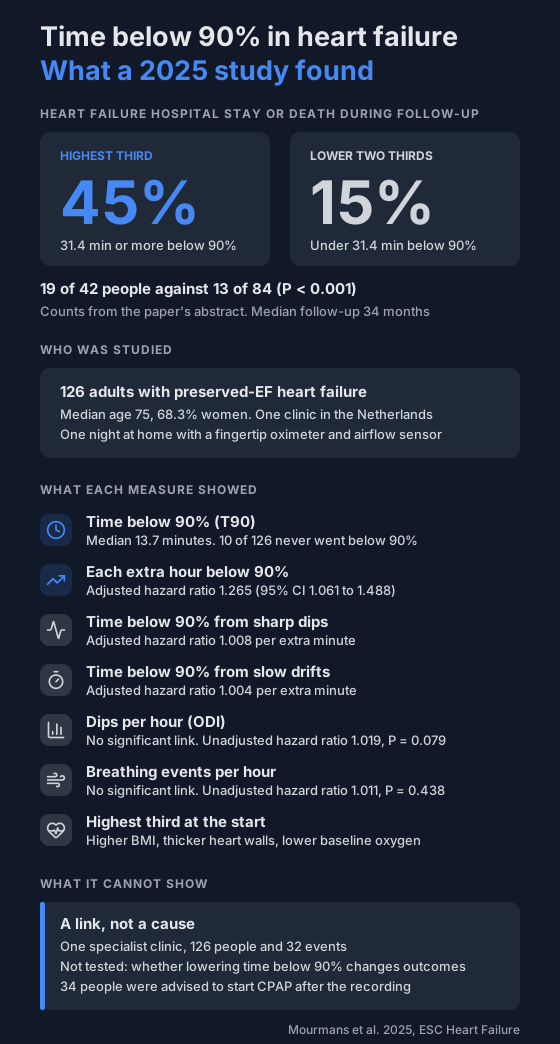
Time below 90% oxygen overnight (T90) has already been linked to worse outcomes in heart failure where the heart pumps weakly. A 2025 study asked the same question about the other main kind: heart failure with preserved ejection fraction, where the heart still pumps out a typical share of its blood with each beat.
It found the same pattern. People with more time below 90% had more heart failure hospital stays or deaths over about 3 years.
An earlier post covers a 2023 study of 764 hospital patients, most of whom had other kinds of heart failure.
Who was studied?
- 126 adults at a specialist heart failure clinic in Maastricht, the Netherlands, enrolled between November 2015 and July 2021.
- Median age 75, and 68.3% were women.
- Their hearts pumped out an average of 59% of their blood with each beat.
- 11 already knew they had a sleep-related breathing problem, and none of them were on therapy for it.
Each person wore a home monitor (ApneaLink) for one night. It recorded airflow at the nose and oxygen from a fingertip oximeter. Recordings shorter than 2 hours were left out.
What did the researchers measure?
- T90: total minutes with oxygen below 90%. See what is T90.
- T90 from sharp dips: the part that came from drops of 4 points or more that recovered most of the way within 150 seconds.
- T90 from slow drifts: the rest, where oxygen sat below 90% without a sharp dip.
- ODI: those sharp dips per hour. See ODI explained.
- Breathing events per hour, from the airflow sensor.
Then they followed everyone for a median of 34 months, looking for a hospital stay for heart failure or death from any cause.
How much time did people spend below 90%?
- The median T90 was 13.7 minutes, and the middle half of the group ranged from 2.6 to 50.1 minutes.
- Only 10 of the 126 (7.9%) never went below 90%.
- 111 (88.1%) had some time below 90% from sharp dips.
- 98 (77.8%) had some from slow drifts.
T90 varied a lot between people who had a similar number of breathing events per hour.
What did time below 90% show?
32 of the 126 people (25.4%) had a heart failure hospital stay or died.
The researchers split the group into thirds by T90 and compared the highest third with the other two together:
- 31.4 minutes or more below 90%: 19 of 42 (45%).
- Under 31.4 minutes: 13 of 84 (15%).
Those counts are printed in the paper's abstract only. The main text reports the same comparison as rates.
Per 100 person-years, the highest thirds of the three T90 measures had 14.8 to 15.9 events, against 5.3 to 5.8 in the lower two thirds.
The link held after adjusting for age, sex, atrial fibrillation, kidney disease and hemoglobin. The hazard ratio was 1.265 for each extra hour below 90% (95% CI 1.061 to 1.488), or 1.004 for each extra minute. It also held in separate analyses that adjusted for BMI or for a blood marker of heart strain (NT-proBNP).
Each part of T90 was also linked in its own adjusted model:
- From sharp dips: hazard ratio 1.008 per extra minute (95% CI 1.000 to 1.016, P = 0.040).
- From slow drifts: hazard ratio 1.004 per extra minute (95% CI 1.001 to 1.007, P = 0.006).
And the counts per hour?
Neither was a statistically significant predictor, even before adjusting for anything else. These hazard ratios are unadjusted:
- ODI: hazard ratio 1.019, P = 0.079.
- Breathing events per hour: hazard ratio 1.011, P = 0.438.
The third of people with the most breathing events (12.2 or more an hour) showed a similar trend, but it was not statistically significant (P = 0.055).
The 2023 study found the same split between time and counts. For more on that, see newer oxygen dip measures vs ODI.
Who was in the highest third?
Compared with the other two thirds, they:
- Had a higher BMI (31.3 against 28.9).
- Had thicker heart walls on ultrasound.
- More often had over 15 breathing events an hour (45.2% against 19.0%).
- Had a lower baseline oxygen level (92% against 95%).
- Had more time below 90% from slow drifts (a median of 65.8 minutes) than from sharp dips (36.5 minutes).
The blood marker of heart strain was similar in both groups.
The authors suggest the low oxygen may have had several sources besides breathing pauses, such as body weight, lung disease and fluid on the lungs. That is their hypothesis, not something the study tested.
Was there a cut-off?
The researchers worked out the T90 value that best separated people who had an event from those who didn't: 33.4 minutes.
- It picked up 59% of the people who went on to have an event.
- It correctly cleared 77% of those who didn't.
So it missed about 4 in 10. A supplementary figure caption in the same paper gives 28 minutes instead. The authors say any cut-off needs checking in other groups, and two earlier studies of other groups used 12 and 22 minutes.
What can't it show?
- Cause. It's an observational cohort study. The authors say it's unclear whether T90 is a marker of risk or something that can be changed.
- Whether lowering it helps. Nothing was tested. The authors say that needs more research.
- Other people. Everyone came from one specialist clinic, and all of them had heart failure.
- Small numbers. With 32 events, the researchers could only adjust for a few other factors.
- What happened afterwards. 93 people were referred to a sleep centre and 55 went. Of those, 52 were found to have sleep apnea, 34 were advised to start CPAP and 48 were advised to lose weight. The authors say this could have affected the outcomes, but they don't think it undermines the findings.
What can you do with this?
If you record your nights, look at T90 as well as ODI. They measure different things.
Don't read your own T90 against 31.4 or 33.4 minutes. Those numbers come from one group of 126 clinic patients, not from a reference range, and home oximetry is not a sleep study.
Have heart failure and a recording that shows long stretches below 90%? Share it with your doctor.
Not a medical device. Does not diagnose, treat or prevent any condition. Discuss results and changes with a clinician.
References
- Mourmans SGJ, Weerts J, Baumert M, Aizpurua AB, Achten A, Knackstedt C, Linz D, van Empel VPM. Prognostic value of hypoxaemic burden from overnight oximetry in heart failure with preserved ejection fraction. ESC Heart Failure. 2025;12(1):622-630. doi:10.1002/ehf2.15116