Time Below 90% and the Heart Transplant Wait
A study of 101 adults with end-stage heart failure found that more overnight time below 90% oxygen was linked to death or a heart pump within 5 years. Counts of breathing events and dips showed no statistically significant link.
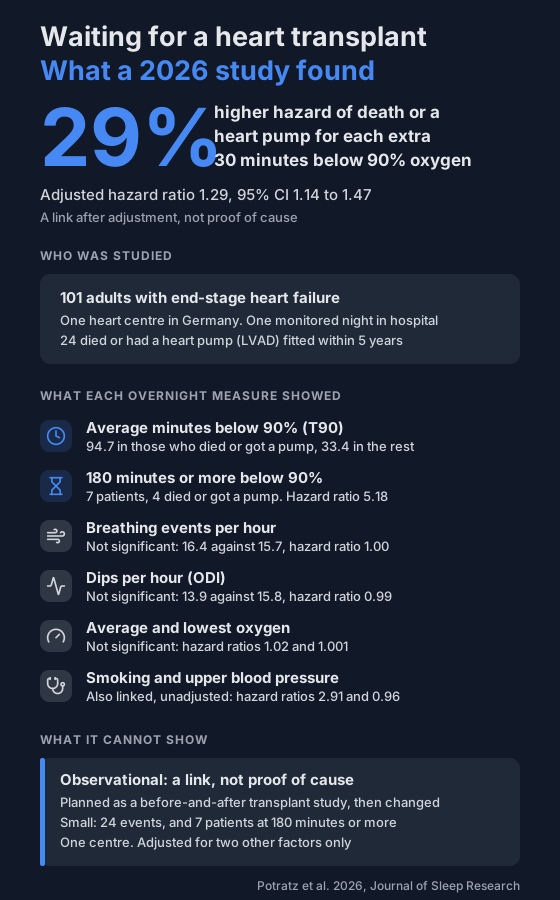
Sleep-related breathing problems are common in heart failure, and they're usually graded by counting breathing events per hour. A study in the Journal of Sleep Research looked at people at the far end of heart failure: those being assessed for a heart transplant.
It found no statistically significant link between that count and what happened next. It did find one for the minutes spent below 90% oxygen.
Who was studied?
- 101 adults with end-stage heart failure, referred for heart transplant assessment at one heart centre in Bad Oeynhausen, Germany.
- They were enrolled between January 2017 and May 2020.
- All had a weakened heart (ejection fraction of 35% or less) and symptoms in the two most limiting of the four heart failure classes, despite medication.
- Each had one night of multichannel breathing and oxygen monitoring in hospital.
- Nobody received therapy for their sleep-related breathing during the study.
The paper describes the breathing events as mostly the central kind, where the brain's signal to breathe pauses, not the obstructive kind. The group averaged 15.9 breathing events an hour.
What did the researchers follow?
One combined outcome over 5 years: death from any cause, or having a left ventricular assist device (LVAD) implanted. An LVAD is a mechanical pump that helps a failing heart.
24 of the 101 patients reached it. The paper doesn't say how many of the 24 died and how many had a pump fitted.
What did time below 90% show?
Time below 90%, or T90, is the number of minutes in the night with oxygen saturation under 90%. See what is T90.
- Patients who died or got a pump averaged 94.7 minutes below 90%.
- The rest averaged 33.4 minutes.
- Each extra 30 minutes went with a 29% higher hazard of death or a pump (hazard ratio 1.29, 95% CI 1.14 to 1.47).
That last figure is after adjusting for kidney function and how well the heart pumped.
The researchers also drew a line at 180 minutes, the point where their risk curve became statistically significant.
- 7 patients spent 180 minutes or more below 90%, going by the counts in the paper's Table 1.
- 4 of the 7 died or got a pump, against 20 of the other 94.
- The adjusted hazard ratio was 5.18 (95% CI 1.69 to 15.81).
That range is wide because 7 patients is a very small group.
What about the other overnight numbers?
None of them showed a statistically significant link to the outcome.
- Breathing events per hour: 16.4 in those who died or got a pump, 15.7 in the rest. Hazard ratio 1.00.
- Dips per hour (ODI): 13.9 against 15.8. Hazard ratio 0.99.
- Average overnight oxygen: hazard ratio 1.02.
- Lowest overnight oxygen: 78.1% against 78.5%. Hazard ratio 1.001.
- Central and obstructive events counted separately showed no statistically significant link either.
The authors give one possible reason. In advanced heart failure, slow circulation can make each breathing event last longer, so the count per hour can fall while the time spent low goes up.
Two things outside the sleep recording were also linked before adjustment: smoking (hazard ratio 2.91) and systolic blood pressure, where a higher reading went with a lower hazard (hazard ratio 0.96).
An earlier study of 764 heart failure patients found a similar split between time below 90% and dips per hour. See time below 90% and heart failure outcomes.
What can't it show?
- Cause. It's an observational study. It shows time below 90% went with worse outcomes, not that it produced them.
- Whether lowering it helps. Nobody's time below 90% was changed. The authors say that needs a trial.
- Much about the 180-minute line. It was picked from this group's own data and rests on 7 patients.
- A full adjustment. The model adjusted for two factors only: kidney function and how well the heart pumped.
- Other hospitals. It was one centre.
The study also changed shape along the way. It was registered as a before-and-after study of breathing 30 days after transplant. Too many follow-up recordings were missing, so the authors switched to this analysis of the first night. The limitations section says 500 patients were planned and 101 enrolled. Their check that the study was large enough was done after the fact.
It was funded by the German Heart Foundation, and the authors declare no conflicts of interest.
What can you do with this?
Not much with your own numbers, and that's worth knowing.
- These were very ill patients measured in hospital. The 29% and the 180 minutes don't carry over to a home recording.
- An overnight oximeter does report time below 90%, alongside ODI. This study is one more reason to look at both, not the dip count alone.
- If you have heart failure and your recordings show long stretches below 90%, share them with your doctor.
The authors' own conclusion is aimed at transplant teams: they suggest measuring time below 90% routinely in people being assessed for a transplant.
Not a medical device. Does not diagnose, treat or prevent any condition. Discuss results and changes with a clinician.
References
- Potratz M, Manukyan T, Schramm R, Costard-Jäckle A, Fuchs U, Morshuis M, Guenther SPW, Rojas SV, Rudolph V, Gummert JF, Fox H. Nocturnal Hypoxemic Burden Predicts Mortality in Patients Awaiting Heart Transplantation. Journal of Sleep Research. 2026;35(3):e70256. doi:10.1111/jsr.70256