Acetazolamide in REM Sleep Apnea: A Trial
A 2026 crossover trial gave 11 adults with REM-predominant sleep apnea acetazolamide and placebo for three nights each. Breathing events and oxygen burden were each about a third lower on the drug, but not for the reason the researchers expected.
Some people with obstructive sleep apnea have most of their breathing events in REM sleep. The same Boston research group had earlier traced this to dips in the brain's drive to breathe during REM.
Acetazolamide is a prescription drug that makes you breathe more. The group tested whether it would prop up that drive in REM.
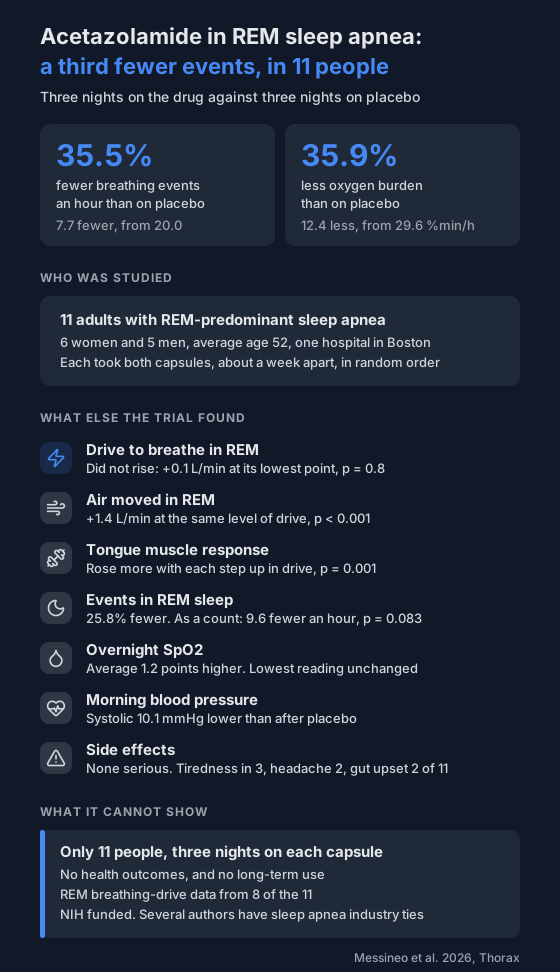
In 11 people, breathing events and oxygen burden were each about a third lower than on placebo. The drive to breathe in REM did not change.
Who was in the trial?
- 11 adults with REM-predominant sleep apnea: at least twice as many breathing events per hour in REM as in non-REM sleep.
- 6 women and 5 men, average age 52, average BMI 29.6.
- At the start they averaged 17.3 events an hour overall: 38.0 in REM and 12.2 in non-REM.
- 13 people enrolled. Two were dropped for too few events in REM, and the other 11 finished.
- It ran at one hospital in Boston.
How did it work?
- Everyone took acetazolamide for three nights and a placebo for three nights, about a week apart, in random order.
- The first acetazolamide night was 250 mg and the next two were 500 mg.
- Neither the participants nor the researchers knew which capsule was which.
- Each block ended with a night in the sleep lab.
- A thin catheter recorded the diaphragm and fine wire electrodes recorded the main tongue muscle, so the team could measure the drive to breathe and how the airway responded.
- People who used CPAP stopped it for at least a week before starting.
What happened to breathing events and oxygen?
Compared with placebo, on acetazolamide:
- Breathing events per hour were 35.5% lower, measured as a share of each person's starting level. A separate analysis of the raw counts put it at 7.7 fewer an hour, from 20.0 on placebo.
- Hypoxic burden was 35.9% lower on the same basis. In raw units it was 12.4 %min/h less, from 29.6. This measures how deep and how long the oxygen dips after events are. More on it in long breathing pauses and hypoxic burden.
These two were the trial's main outcomes, and both passed its significance test.
The other results were secondary or descriptive:
- Events in REM: 25.8% lower (p = 0.008). As a count, 9.6 fewer an hour from 37.5, which was not statistically significant (p = 0.083).
- Events in non-REM: 19.7% lower (p = 0.012). As a count, 5.5 fewer an hour from 14.0, also not statistically significant (p = 0.114).
- ODI at the 3% threshold: 6.9 fewer dips an hour, from 17.3.
- Average SpO2: 1.2 points higher, from 94.4%.
- Lowest SpO2: 84.4% on placebo and 0.2 points higher on the drug, not a significant change.
- Arousals and sleep stages: no significant change.
- Total sleep time: 50.5 minutes longer on the acetazolamide night, from 292 minutes on placebo.
The authors call the effect on events "modest". They say the drug showed no special effect in REM-predominant sleep apnea: some earlier trials in people not picked for the REM pattern found drops in a similar range.
So why did events fall?
Not for the reason the team expected.
- Drive to breathe in REM: unchanged. At its lowest point it was 0.1 L/min higher than on placebo (p = 0.8).
- Air moved: up. At the same level of drive, people moved 1.4 L/min more air in REM, which the authors read as an airway that collapses less easily.
- Muscle response: up. Airflow and tongue muscle activity both rose more steeply as drive rose.
So the dips in drive were still there. The airway just held up better through them.
The authors offer several possible explanations, including stronger throat muscle response, less fluid shifting toward the neck overnight, and other breathing muscles joining in. They did not test which one is right.
What about side effects?
- No serious adverse events linked to the drug.
- Dry mouth: 4 people on acetazolamide and 4 on placebo.
- On acetazolamide, 3 of the 11 reported tiredness or sleepiness, 2 reported headache, and 2 reported constipation or indigestion. The paper doesn't say how far these overlap.
- The authors describe the side effects as infrequent and minor.
- Nobody reported tingling, extra urination or taste changes, the side effects usually linked to this drug.
- Morning systolic blood pressure was 10.1 mmHg lower than after placebo, based on 10 of the 11 people.
The authors note that in longer studies, up to 10% of people stop acetazolamide because of side effects. Three nights can't show that.
What can't it show?
- Much beyond these 11 people. The trial was sized to pick up a change in events per hour. The authors say other effects may have been missed for lack of numbers.
- Long-term effects. Each person took the drug for three nights. No health outcomes were measured, and the authors say longer trials are needed.
- Whether it works in practice. The authors say this was the first time acetazolamide was tried in people picked for REM-predominant sleep apnea.
- The full mechanism. The REM drive and muscle results come from 8 of the 11, and only one throat muscle was recorded.
- Whether the drive finding is solid. The authors say a measurement problem could explain it, though a re-check in raw units gave the same answer.
Funding and conflicts:
- The trial was funded by the US National Institutes of Health.
- Several authors consult for, or have grants from, companies that make sleep apnea drugs and devices.
- One has a financial interest in Apnimed, which is developing drugs and wearable oximetry devices for sleep apnea. We covered Apnimed's own pill in the AD109 trial.
What can you do with this?
Nothing about the drug. This was a three-night mechanism study in 11 people, and acetazolamide is a prescription medicine with its own risks. A different trial looked at acetazolamide and SpO2 at altitude.
What it does show is that sleep apnea can be concentrated in one sleep stage. A sleep study can tell REM from non-REM. An overnight oximeter can't.
It records when your oxygen dipped, and you can share that with your doctor. Sleep position is the other common pattern: see back sleeping vs REM sleep.
If you snore loudly, someone has heard you stop breathing, or you're exhausted during the day, see a doctor. The sleep apnea risk check takes about a minute and helps you decide whether to book that visit.
Not a medical device. Does not diagnose, treat or prevent any condition. Discuss results and changes with a clinician.
References
- Messineo L, Kim M, Azarbarzin A, Vena D, Preuss M, Esmaeili N, Aishah A, Lawrence NV, Gilbertson DC, White DP, Wellman A, Sands SA. Acetazolamide to prevent ventilatory drive withdrawal in REM sleep apnoea: a randomised controlled trial. Thorax. 2026;81(10):969-979. doi:10.1136/thorax-2025-223922