Steroid Cycles and Sleep Apnea: A 2026 Study
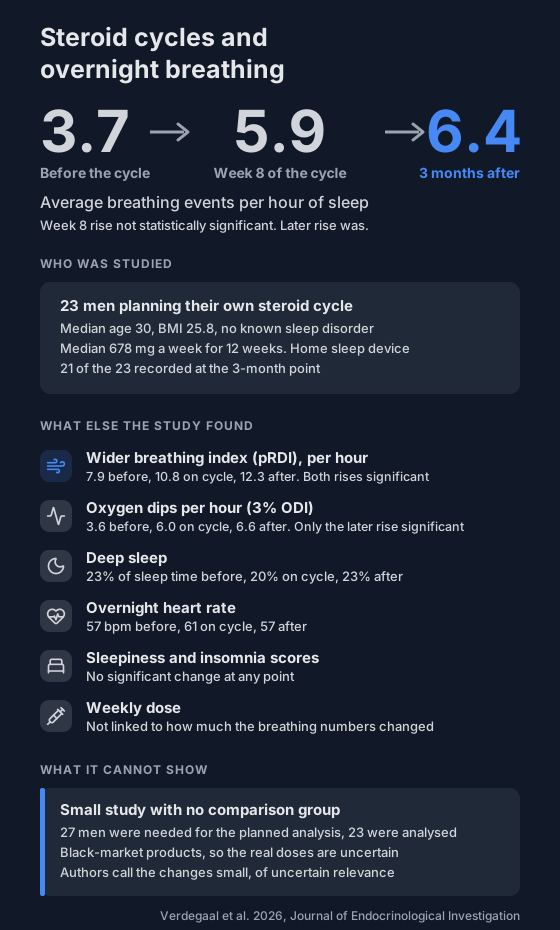
A 2026 study recorded 23 men at home before, during and three months after an anabolic steroid cycle. Breathing events per hour of sleep rose from 3.7 to 6.4, a small change.
Testosterone therapy has long been suspected of making sleep apnea worse. But gym-style steroid cycles use far higher doses, and almost nobody had measured sleep during one.
A Dutch study published in 2026 found small rises in overnight breathing events, clearest three months after the cycle ended.
Who was in the study?
- 23 men, median age 30, median BMI 25.8.
- Each was about to start a steroid cycle of his own choosing.
- Median dose was 678 mg a week for 12 weeks. The authors put that at about eight times a standard therapy dose.
- Nobody with a known sleep disorder was included.
Each man wore a WatchPAT home sleep device for one night at three points: before the cycle, around week 8, and about three months after stopping. The last point has 21 men.
What happened to their breathing?
Average breathing events per hour of sleep (model estimates):
- Before: 3.7
- Week 8: 5.9. Not a statistically significant rise (p = 0.075).
- Three months after: 6.4. A significant rise (p = 0.029).
The oxygen desaturation index went 3.6, 6.0, 6.6 dips per hour, with only the last rise significant.
A wider breathing index, pRDI, went 7.9, 10.8, 12.3 per hour, both rises significant.
Average overnight oxygen barely moved: 95.4%, 95.3%, 95.1%.
What else changed?
- Deep sleep fell from 23% of sleep time to 20% during the cycle, then returned to 23%.
- Average overnight heart rate went from 57 to 61 bpm during the cycle, then back to 57.
- Scores for daytime sleepiness and insomnia didn't change significantly.
Why were the numbers higher after the cycle?
The study can't say. The authors suggest fluid and muscle gained around the neck and airway may take time to go away.
What can't it show?
- It's small. The plan called for 27 men and 23 were analysed.
- There was no comparison group, and one night per time point. Numbers can vary between nights.
- The steroids came from the unregulated market, so the true doses are uncertain.
- Neck size, training and diet weren't measured.
- The results don't carry over to prescribed testosterone therapy, the authors say.
- Three of the six authors co-founded and hold shares in the Android Health Clinic. The authors report a grant from the Dutch Anti-Doping Authority.
The authors conclude the changes are small and unlikely to amount to sleep apnea in most users.
Recording your own nights? You can compare nights and take anything you notice to your doctor.
Not a medical device. Does not diagnose, treat or prevent any condition. Discuss results and changes with a clinician.
References
- Verdegaal TJ, Peeters W, Bond P, Machiels H, de Ronde W, Smit DL. Effect of androgen abuse on sleep apnea in men: a prospective cohort study. Journal of Endocrinological Investigation. 2026;49(10):2785-2793. doi:10.1007/s40618-026-02943-y