A Pill for Sleep Apnea? The AD109 Trial
A company-funded phase 3 trial randomised 646 adults with sleep apnea to a nightly pill or placebo for 26 weeks. Breathing events fell by 4.0 an hour more on the pill, and 21.2% stopped it over side effects.
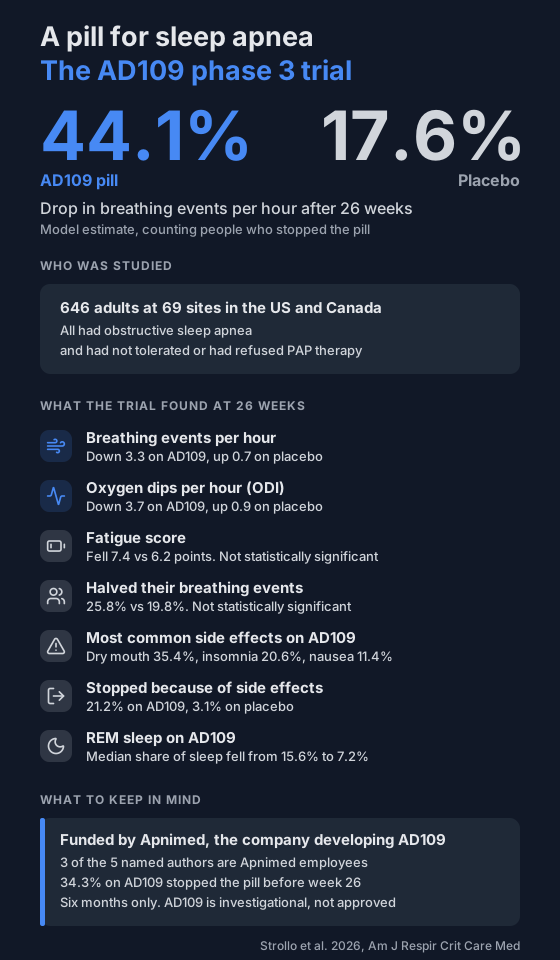
Many people with obstructive sleep apnea can't get on with CPAP. A phase 3 trial published in 2026 tested a once-a-night pill called AD109 on people in that position.
AD109 combines two drugs, aroxybutynin and atomoxetine. It's investigational, not approved, and the company developing it paid for the trial.
Who was in the trial?
- 646 adults at 69 sites in the US and Canada, randomised to AD109 or placebo for 26 weeks.
- All had obstructive sleep apnea and above-average fatigue scores, and had not tolerated or had refused PAP therapy (which includes CPAP).
- 615 were in the main analysis: median age 58, 49.3% women.
- Their median was 19.6 breathing events per hour on an overnight sleep study.
What changed on the pill?
The main analysis kept people who stopped the tablets.
- Breathing events per hour: down 3.3 on AD109, up 0.7 on placebo. The difference was 4.0.
- As a percentage: a model-estimated 44.1% drop on AD109 against 17.6% on placebo.
- Oxygen dips per hour (ODI): down 3.7 on AD109, up 0.9 on placebo.
- Under 5 events per hour at week 26: 17.6% on AD109, 9.3% on placebo, an exploratory result.
What didn't differ from placebo?
- Fatigue. Scores fell 7.4 points on AD109 and 6.2 on placebo. The difference wasn't statistically significant.
- Sleep impairment. Scores fell 7.6 and 6.9 points, also not a significant difference.
- Halving events. 25.8% on AD109 and 19.8% on placebo cut their events by half or more, also not significant.
What about side effects?
- 21.2% on AD109 stopped because of side effects, against 3.1% on placebo.
- The most common on AD109 were dry mouth (35.4%), insomnia (20.6%) and nausea (11.4%).
- 6.3% on AD109 had a heart rate of 100 or more during the trial, against 1.9% on placebo.
- REM sleep fell from a median 15.6% of sleep to 7.2% on AD109 (a post hoc analysis).
- No serious side effects were attributed to the pill.
What can't it tell you?
- Independence. Apnimed funded the trial and its medical writing. Three of the five named authors are employees with stock, and the other two have consulted for it.
- Drop-outs. 34.3% on AD109 and 16.3% on placebo stopped the tablets before week 26. The authors say this likely shrank the measured effect.
- Long term. It ran for six months and didn't measure long-term health.
- Dose and place. No lower dose was allowed, and sites were only in the US and Canada.
What can you do with this?
Any medication is a decision for you and your doctor.
If you record your nights, here's how to share them.
Not a medical device. Does not diagnose, treat or prevent any condition. Discuss results and changes with a clinician.
References
- Strollo PJ Jr, Farkas R, Taranto-Montemurro L, Cronin J, Patel SR; SynAIRgy Investigators. Aroxybutynin and atomoxetine (AD109) for obstructive sleep apnea: a randomized phase 3 trial (SynAIRgy). American Journal of Respiratory and Critical Care Medicine. 2026;212(7):1569-1584. doi:10.1093/ajrccm/aamag215