Oximeter Accuracy: Motion and Cold Fingers
A 2023 lab study tested three hospital pulse oximeters on 28 healthy adults during hand motion and low blood flow to the finger. All three got less accurate in both tests, and the authors say low blood flow did more damage than motion. GE HealthCare paid for it.
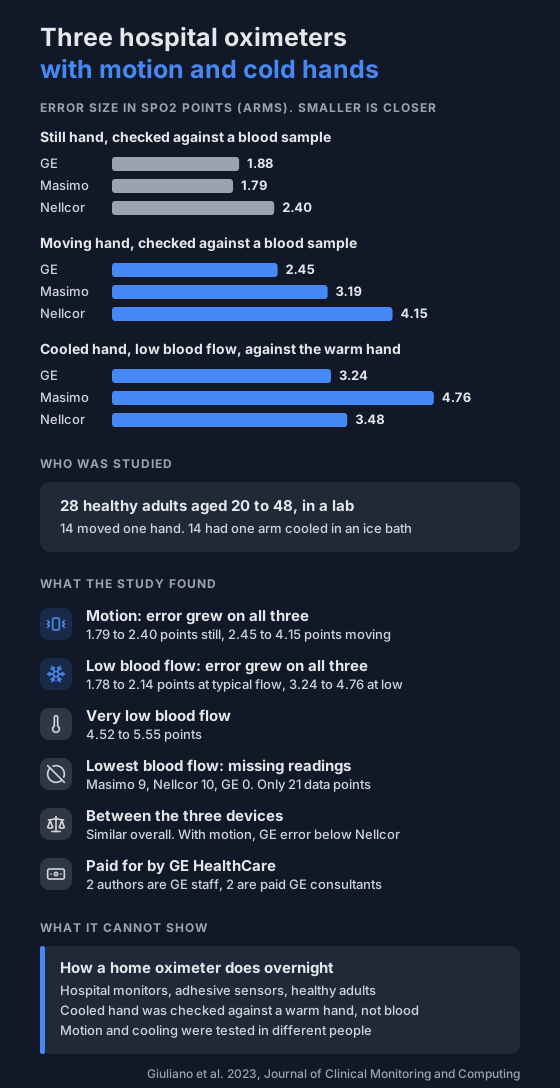
You've probably heard that cold hands and movement can throw off a pulse oximeter reading. A 2023 lab study put numbers on both, using three hospital monitors.
All three got less accurate when the hand moved. All three also got less accurate when blood flow to the finger dropped. The authors say low blood flow did more damage than motion, but the two tests used different people and different references.
Who paid for it?
GE HealthCare, which makes one of the three monitors.
- Two of the four authors work for GE HealthCare full time.
- The other two are paid GE HealthCare consultants. One is at the University of Massachusetts Amherst and one is at a consulting firm.
- The GE monitor had the smallest error in the motion test and at low and very low blood flow.
Read the device-against-device results with that in mind. The result that all three got worse doesn't depend on which brand came out ahead.
Who was in the study?
- 28 healthy, non-smoking adults aged 20 to 48.
- 14 were randomly assigned to the motion test and 14 to the low blood flow test.
- Each wore all three monitors on both hands: one test hand and one control hand.
- The monitors were the GE HealthCare CARESCAPE ONE with TruSignal, the Masimo RADICAL-7 and the Medtronic Nellcor PM1000N, all with disposable adhesive sensors.
Everyone breathed a low-oxygen gas mix so the monitors could be checked across a range of oxygen levels.
How do you read the numbers?
The study reports two things for each monitor:
- Bias: the average gap between the monitor and the reference. A plus figure means the monitor read high.
- Arms: the root mean square error, roughly the size of a typical miss in either direction, in SpO2 points. A smaller figure is closer.
Bias can sit near zero while Arms is large, because high and low misses cancel out in an average.
What did motion do?
Volunteers clenched, rubbed, twitched and tapped the test hand. Readings were checked against 248 to 250 arterial blood samples per monitor.
Arms across blood oxygen of 70% to 100%:
| Monitor | Still hand | Moving hand |
|---|---|---|
| GE | 1.88 | 2.45 |
| Masimo | 1.79 | 3.19 |
| Nellcor | 2.40 | 4.15 |
- Across that range, average bias stayed under 1 point for every monitor, still or moving.
- So the readings scattered more with motion without shifting much in one direction on average.
- On the still hand there was no statistically significant difference in Arms between the monitors.
- On the moving hand there was, and the GE-to-Nellcor gap was the one that reached significance (P = 0.002).
- Single readings on the moving hand were as much as 16.5 to 20.6 points below the blood sample, depending on the monitor.
What did low blood flow do?
Each volunteer's left arm went into an ice bath for up to 60 minutes while the right arm stayed warm. There was no blood sampling in this group. The cooled hand was compared with the same model of monitor on the warm hand.
Results were grouped by perfusion index, a measure of how strong the pulse signal at the finger is.
| Blood flow at the finger | GE | Masimo | Nellcor |
|---|---|---|---|
| Typical (index 1.0 or more) | 2.14 | 1.80 | 1.78 |
| Low (0.3 to under 1.0) | 3.24 | 4.76 | 3.48 |
| Very low (0.1 to under 0.3) | 4.52 | 5.33 | 5.55 |
| Lowest (under 0.1) | 4.29 | 4.01 | 6.42 |
Figures are Arms in SpO2 points.
- The differences in Arms between monitors were not statistically significant at any blood flow level.
- Average bias did differ at low blood flow: Masimo read 1.76 points above the warm hand, GE 0.96 above and Nellcor 0.53 below.
- At the lowest blood flow, Masimo had 9 missing values, Nellcor 10 and GE none.
- The authors say that with only 21 data points at that level, the monitors can't be compared there.
The authors conclude that low blood flow degraded accuracy more than motion did. That compares two different groups of 14, one checked against blood and one against another oximeter. It also doesn't hold for every monitor at every level: Nellcor's Arms was 3.48 at low blood flow and 4.15 with motion.
What doesn't it tell you?
- Anything about home oximeters. These were hospital monitors with adhesive sensors, not rings or fingertip clips.
- Real-life conditions. It was a controlled lab test on healthy volunteers, and the authors say it's unlikely to fully represent real use.
- Skin tone. Each group of 14 had two people in the two darkest skin tone categories, and the study wasn't designed to test this. For that, read pulse oximeters and skin tone.
- True accuracy at low blood flow. The cooled hand was compared with another oximeter, not with blood, and the blood flow index came from the GE monitor.
- A like-for-like comparison of motion and cold. The two tests used different people and different references.
- Which monitor is best. The authors call the three similar overall and say the practical relevance of the differences needs more study.
What can you do with this?
The study didn't test home devices, but the authors' closing point is about the technology itself: pulse oximetry depends on pulsing blood at the finger.
- Be more cautious about a reading taken with a cold or moving hand than one taken warm and still.
- Don't lean on a single low number. With motion or low blood flow, a typical miss was about 2.5 to 6.4 points in these tests, on hospital equipment.
- If your overnight recording has dips that line up with movement, or gaps, read why your O2Ring data has gaps.
- A separate study looked at warming the arm in patients with weak finger blood flow.
If your readings worry you, talk to a doctor. You can share your overnight data with them.
Not a medical device. Does not diagnose, treat or prevent any condition. Discuss results and changes with a clinician.
References
- Giuliano KK, Bilkovski RN, Beard J, Lamminmäki S. Comparative analysis of signal accuracy of three SpO2 monitors during motion and low perfusion conditions. Journal of Clinical Monitoring and Computing. 2023;37(6):1451-1461. doi:10.1007/s10877-023-01029-x