Warming the Arm and Pulse Oximeter Accuracy
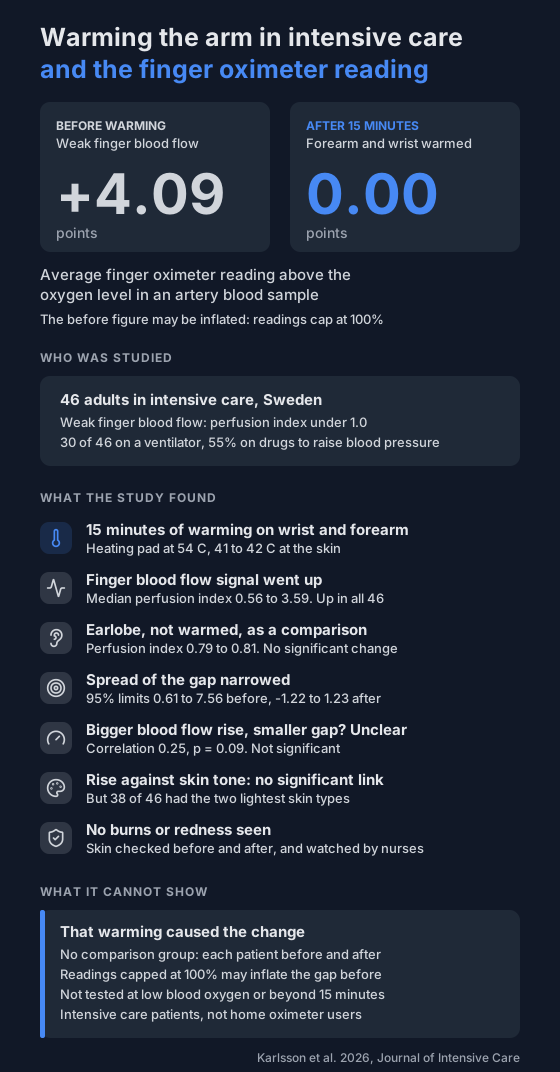
A 2026 study warmed the forearm of 46 intensive care patients with weak finger blood flow for 15 minutes. The average gap between the finger oximeter and a blood sample went from 4.09 points to 0.00, though the authors say the first figure may be inflated.
A pulse oximeter needs a good pulse in the finger to work. When blood flow to the finger is weak, readings are known to get less reliable.
A 2026 study from Sweden tested whether warming the arm changes that. It was done on intensive care patients, not on people using an oximeter at home.
Who was studied?
- 46 adults in three intensive care units at one hospital in Gothenburg, between January and September 2024.
- All had a weak blood flow signal at the finger: a perfusion index (PI) under 1.0.
- All had a line in an artery, so the oximeter could be checked against a blood sample.
- 30 of the 46 were on a ventilator and 55% were on drugs to raise blood pressure.
- 420 patients were checked to find them. About 16% had a weak or absent finger signal.
Perfusion index is the number some oximeters show for pulse strength at the sensor.
What did the researchers do?
- They put a heating pad over the wrist and forearm for 15 minutes.
- The pad was set to 54 C. The temperature measured at the skin, under a protective cover, was 41 to 42 C.
- They took a blood sample and an oximeter reading just before and just after.
- The oximeter was a hospital model (Masimo) and stayed on the same finger.
- A second sensor on the earlobe, which wasn't warmed, acted as a comparison.
The authors call it a quasi-experimental before-and-after study. There was no separate comparison group. Each patient was compared with themselves, before and after.
What did they find?
- Finger blood flow. Median PI went from 0.56 to 3.59, as given in the abstract and results text. It went up in all 46 patients.
- Earlobe. PI was 0.79 before and 0.81 after, with no statistically significant change.
- Oximeter against blood. Before warming, the oximeter read 4.09 points above the blood sample on average. After warming, the average gap was 0.00. The authors say the 4.09 figure may be inflated, because the oximeter display stops at 100%.
- Spread. The 95% limits of agreement went from 0.61 to 7.56 points before, to -1.22 to 1.23 points after.
- Safety. No burns or redness were seen. Nurses watched the skin throughout.
The blood sample values barely moved: the average was 96% before and after. The oximeter average went from 100% to 96%.
The paper prints the starting PI three ways: 0.56 in the results text, 0.55 in its table and 0.40 in its description of the patients.
Blood pressure, body temperature and drug doses stayed about the same. With the unchanged earlobe, the authors say this points to a local effect of the warming.
Did a bigger rise in blood flow mean a smaller gap?
Not clearly. The link between the two was weak and not statistically significant (correlation 0.25, p = 0.09). The authors say the study may have been too small to show it.
The size of the rise in PI had no statistically significant link with skin tone, the change in blood pressure, the change in body temperature or the dose of blood pressure drug. But 38 of the 46 patients had the two lightest skin types, so the study says little about darker skin. For more on that, see pulse oximeters and skin tone.
What can't it show?
The authors list these limits:
- No comparison group. A before-and-after design can't rule out other changes over those 15 minutes. The authors call the result physiologically plausible, not proof of cause.
- Readings capped at 100%. Before warming, the average oximeter reading was 100%, the highest the display goes. The authors say this may have inflated the gap before warming.
- No low oxygen. Patients with low blood oxygen were left out for ethical reasons. Blood values were around 96%.
- 15 minutes only. Nobody measured how long the change lasted.
- Weak signals only. Patients with no finger signal at all were excluded.
- No outcomes. The study didn't test whether patients did any better.
- Safety in a small group. The authors say many intensive care patients can't feel or report heat, and that safety needs confirming in larger studies.
What does this mean for a home oximeter?
Not much directly.
- These were very ill patients on a hospital oximeter, with a medical heating pad and nurses checking the skin.
- The study didn't include healthy people, home devices or overnight recordings.
- It didn't test warming at home, and nothing here is a suggestion to try it.
- The authors say the results should be carried over to other settings with caution.
The paper's background section lists weak blood flow at the finger among the known reasons for a less accurate reading. It cites earlier studies showing readings get less reliable as perfusion index falls. See how accurate pulse oximeters are and which finger to use.
If your readings worry you, talk to your doctor.
Not a medical device. Does not diagnose, treat or prevent any condition. Discuss results and changes with a clinician.
References
- Karlsson N, Lindstrand FO, Johansson L, Sjödin C. Thermal intervention improves pulse oximetry accuracy in critically ill patients with low perfusion: a quasi-experimental study. Journal of Intensive Care. 2026;14(1):8. doi:10.1186/s40560-026-00847-w