Which Finger Is Best for a Pulse Oximeter?
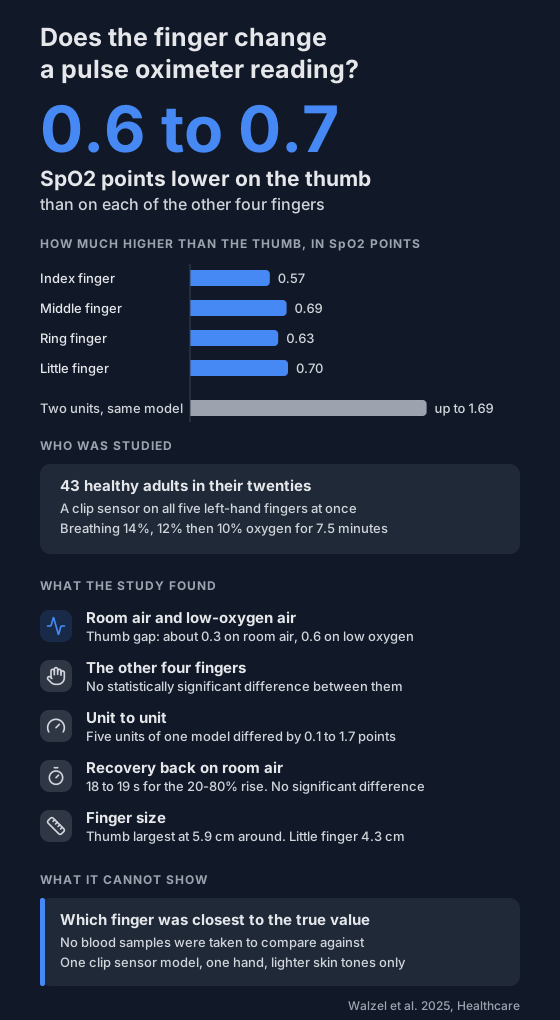
A 2025 study put a sensor on all five fingers of 43 adults at once. The thumb read 0.6 to 0.7 SpO2 points lower than the others, less than the largest gap between two units of the same oximeter model.
Advice on which finger to use for a pulse oximeter varies. A 2025 study from the Czech Technical University tested all five fingers at once.
The thumb read slightly lower. The gap was smaller than the largest gap between two units of the same oximeter model.
Who was studied?
- 45 healthy adults in their twenties took part, and 43 finished.
- Each wore five Masimo Radical-97 clip sensors, one on every finger of the left hand.
- They breathed room air for 2 minutes, then air with 14%, 12% and 10% oxygen for 2.5 minutes each.
- Average SpO2 had fallen to 74% by the end of the low-oxygen phase.
What did it find?
- The thumb read 0.6 to 0.7 SpO2 points lower than each of the other four fingers.
- The thumb's gap was about 0.3 points on room air and about 0.6 during the low-oxygen phase.
- There was no statistically significant difference between the index, middle, ring and little fingers.
- Back on room air, the 20% to 80% stretch of the rise took about 18 to 19 seconds, with no statistically significant difference between fingers.
How does that compare with the oximeter itself?
The five units were the same model and all passed a simulator check. Which unit went on which finger was randomised. Pairs of units still differed by 0.1 to 1.7 points on average. One unit read lower than the other four, and the authors couldn't explain why.
The authors call the thumb gap small next to the accepted accuracy limits for pulse oximeters, which they give as plus or minus 2 to 3 points. See how accurate pulse oximeters are.
Why would the thumb read lower?
The study can't say for sure. The thumb was the largest finger (5.9 cm around) and had the strongest pulse signal. The authors say that could shift the reading through the equipment and its calculation, assuming the blood itself doesn't differ between fingers.
What doesn't it tell you?
- Which finger is right. No blood samples were taken, so there was no true value to compare against.
- Everyone. All participants were young, healthy and had lighter skin tones.
- Other devices. It tested one clip sensor model on one hand, so ring and wrist oximeters weren't tested.
- Overnight use. The test lasted about 12 minutes, with the hand held still.
What can you do with this?
- The authors recommend a finger with a reliable pulse signal and a good sensor fit.
- Our suggestion, not the study's: use the same finger every night, so nights compare like for like.
Wearing a ring oximeter? See O2Ring sizing.
Not a medical device. Does not diagnose, treat or prevent any condition. Discuss results and changes with a clinician.
References
- Walzel S, Rafl-Huttova V, Rozanek M, Kudrna P, Rybar M, Rafl J. Inter-Finger Variability of SpO2 During Hypoxemia and Step Resaturation. Healthcare. 2025;13(20):2648. doi:10.3390/healthcare13202648