Cold Fingers and False Low Oximeter Readings
A 2026 case report: in one woman with Raynaud phenomenon, a fingertip oximeter fell from 96% to 82% during a walking test while a forehead oximeter stayed at 93 to 98%. Her finger cooled and the skin over her finger joints went pale.
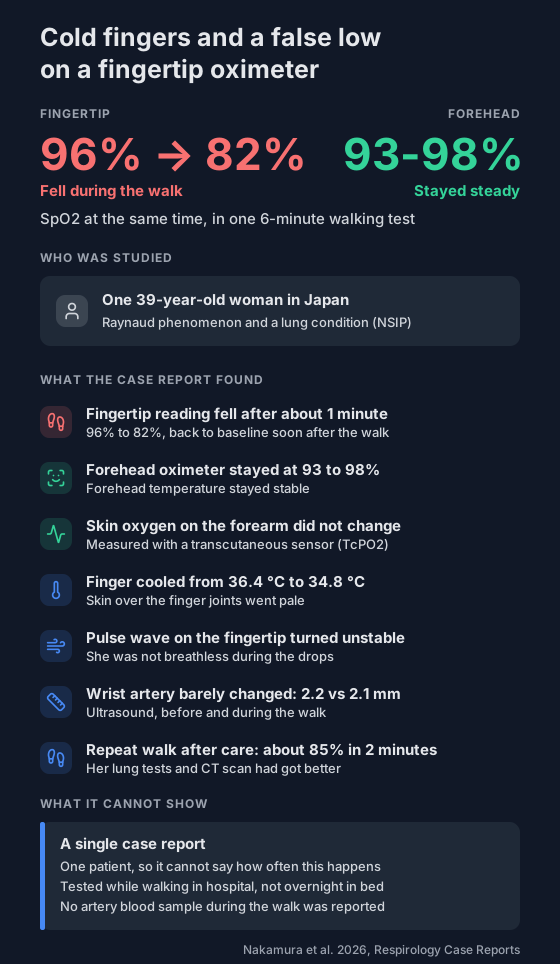
A fingertip oximeter needs a steady pulse in the finger to read well. Cold hands and weak blood flow to the finger are known to throw it off.
A case report published in August 2026 shows how far off it can get. In one woman with Raynaud phenomenon, the fingertip reading dropped to 82% while two other measures stayed steady.
It's one patient, so read it as a story, not a rule.
Who was the patient?
- A 39-year-old woman in Japan with Raynaud phenomenon, where the fingers' blood vessels clamp down in episodes.
- She also had a scarring lung condition called non-specific interstitial pneumonia (NSIP).
- She was referred for breathlessness on exertion and a dry cough.
- At rest her SpO2 was 98%, and an artery blood sample on room air showed a PaO2 of 101.5 mmHg.
What happened on the walking test?
The test was a 6-minute walk, a standard hospital check of oxygen during exercise.
- On her first walk, the fingertip reading fell to 88% after 4 minutes, and staff stopped the test.
- She then had steroid and immune-suppressing drugs for her lungs. After that, her CT scan, breathing tests and breathlessness had all got better.
- On a repeat walk, the fingertip still fell to about 85% within 2 minutes. She wasn't breathless, and the authors say the drop was reproducible.
- During those drops the pulse wave on the oximeter became unstable and her fingers cooled.
How did they check it?
The team ran another walk with three readings at once:
- A fingertip oximeter.
- A forehead oximeter.
- A transcutaneous sensor on the forearm, which measures oxygen through the skin (TcPO2).
The fingertip fell from 96% to 82%, starting after about a minute. The forehead stayed between 93% and 98%, and the forearm reading didn't change. The fingertip went back to its starting value soon after she stopped.
They also saw:
- Her finger cooled from 36.4 °C to 34.8 °C, while her forehead temperature stayed stable.
- The skin over her finger joints went pale, while the fingertips kept their usual colour.
- The artery at her wrist barely changed on ultrasound, 2.2 mm before and 2.1 mm during the walk.
The authors say this suggests the low fingertip readings came from poor blood flow in the fingers, not low oxygen in her blood. They suggest the body's stress response during exercise may have contributed to the drop in finger blood flow.
What can't one case show?
- It's a single patient, so it can't say how often this happens, or to whom.
- She had Raynaud phenomenon and a lung condition, so other people may not behave the same way.
- It was a walking test in hospital, not a night's sleep.
- The paper reports no artery blood sample during the walk, so the forehead and forearm readings were the comparison.
The authors note earlier studies found finger oximeters less reliable in people with systemic sclerosis, a condition where Raynaud is common. They say this case suggests the same caution applies with Raynaud on its own.
What does this mean for your oximeter?
A low reading with cold fingers may be the finger, not your oxygen. Some things you can check in your own data:
- Does the pulse wave look ragged or flat when the number drops?
- Were your hands cold, or the room cool? See bedroom temperature and air.
- Does warming the hand change the reading? A study on warming the arm looked at this in hospital patients.
- Does a different finger read the same?
The authors suggest a forehead oximeter or skin sensor can help when finger readings don't match how someone feels. If you have Raynaud and see low readings, take the recordings to your doctor rather than reading them alone. Here's how to share them.
Not a medical device. Does not diagnose, treat or prevent any condition. Discuss results and changes with a clinician.
References
- Nakamura Y, Takamori M, Sunaga H, Natsume K, Nomura Y, Goto Y, Tsukada N, Tsukada A, Uchida N, Yazawa N, Hoshi H, Shimizu Y, Niho S. Spurious Fingertip Oxygen Desaturation During the 6-Minute Walk Test in a Patient With NSIP and Raynaud Phenomenon: The Value of Forehead Pulse Oximetry and Transcutaneous Oxygen Tension. Respirology Case Reports. 2026;14(8):e70737. doi:10.1002/rcr2.70737