Home Oximeter Readings in Phone Triage
A review of 118 calls to a US lung clinic's triage line found a home oximeter reading under 90% went with far higher odds of being sent for in-person care, and no note recorded how reliable the reading was.
If you ring a clinic about your breathing, you might read out a number from a home oximeter. A 2025 study looked at what clinicians did with those numbers.
It reviewed the notes from every documented call to one US lung clinic's triage line over six months.
Who was studied?
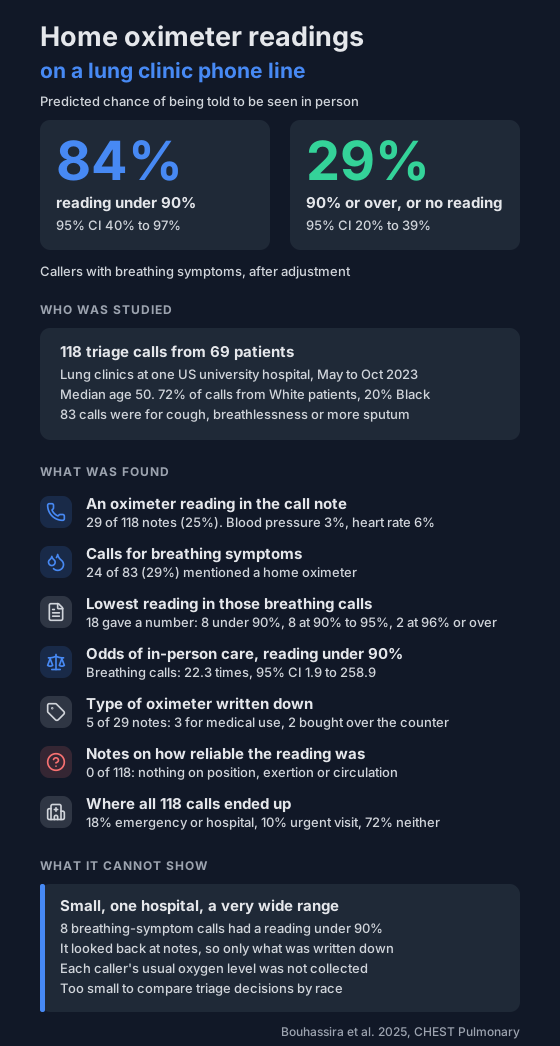
- 118 triage calls, made by or for 69 patients.
- All were patients of the lung clinics at one US university hospital, calling between May and October 2023.
- Median age was 50.
- 72% of calls were from White patients and 20% from Black patients.
- 83 calls (70%) were mainly about breathing symptoms: cough, breathlessness or more sputum.
- Nurses or nurse practitioners took 41 calls and doctors took 77.
Two researchers read each call note and recorded what it said.
How often did an oximeter reading come up?
- 29 of the 118 notes (25%) mentioned a pulse oximeter reading.
- Blood pressure came up in 3% and heart rate in 6%.
- Among the 83 breathing-symptom calls, 24 (29%) mentioned a home oximeter. The paper's summary rounds that to 1 in 3.
- 18 of those 24 gave a number. The lowest reading was under 90% in 8, between 90% and 95% in 8, and 96% or over in 2.
- The other 6 said oxygen had been checked but gave no number.
What went with a reading under 90%?
A much higher chance of being told to come in.
"In-person care" here means being sent to the emergency department, the hospital or an urgent clinic visit. Across all 118 calls, 18% went to the emergency department or hospital and 10% to an urgent visit.
- Across all calls, a noted reading under 90% went with 6.3 times the odds of in-person care, after adjusting for age, race, sex, lung condition and who took the call (95% CI 1.3 to 30.8).
- Among breathing-symptom calls, it was 22.3 times the odds (95% CI 1.9 to 258.9).
- As a predicted chance for those callers: 84% with a reading under 90% (95% CI 40% to 97%), against 29% with a reading of 90% or over or no reading (95% CI 20% to 39%).
Those ranges are very wide. The figure of 22.3 could plausibly be anywhere from about 2 to about 259, because so few calls had a low reading.
Not everyone with a reading under 90% was told to come in. The authors take that as a sign the number was weighed with everything else the caller said.
Did anyone ask how good the reading was?
Not that the notes show.
- The paper's results say no note recorded anything that could affect accuracy, like where the reading was taken, the caller's position, recent exertion or poor circulation.
- 5 of the 29 notes named the type of oximeter: 3 were devices sold for medical use and 2 were bought over the counter.
- Of the notes with a number, half gave 1 reading and 40% gave 2.
The authors point out that over-the-counter oximeters in the US are classed as wellness or sports products. Until February 2024, none had been through formal review by the regulator. They also cite studies where oximeters read too high in people with darker skin, covered in pulse oximeters and skin tone.
Their worry is a reassuring number from a device that reads too high, leading to a caller not being asked to come in. This study did not test whether that happened.
What can't it show?
- It's small and from one hospital's specialist lung clinics, with a limited pool of clinicians.
- Only 8 of the breathing-symptom calls had a number under 90%, which is why the ranges are so wide.
- It looked back at notes, so it only captures what was written down. A clinician may have asked about the device and not recorded it.
- Nobody collected each caller's usual oxygen level, so the analysis could not adjust for it.
- It was too small to compare triage decisions by race.
- It shows a link between a low reading and being sent in, not that the reading was the reason.
- It did not check any reading against a blood test or follow what happened to callers afterwards, apart from noting that nobody died within 30 days.
What can you do with this?
If you give a reading over the phone, give the context with it, because the clinician may not ask:
- Which device you used and where you bought it.
- Whether you were sitting still or had just been moving.
- More than one reading, and what your number usually is.
- Anything that can throw it off, like cold hands or nail polish.
That list is ours, not the study's. For what affects a reading, see how accurate pulse oximeters are and which finger to use. For overnight recordings, here's how to share them with your doctor.
Tell the clinician how you feel as well as what the oximeter shows.
Not a medical device. Does not diagnose, treat or prevent any condition. Discuss results and changes with a clinician.
References
- Bouhassira DC, Bernstein T, Fawzy A, Iwashyna TJ, Robertson ML. Association of Oxygen Saturation on Home Pulse Oximetry With Telephone Triage Decision: A Retrospective Single-Center Study. CHEST Pulmonary. 2025;3(1):100129. doi:10.1016/j.chpulm.2024.100129