Pressurised Rooms and Sleep at Altitude
A 2026 randomised trial had 12 workers living at 3,500 m sleep in a pressurised room set to 2,000 m. Their average overnight SpO2 went from 89.1% to 96.3%, and brief arousals fell from 14.1 to 8.1 an hour.
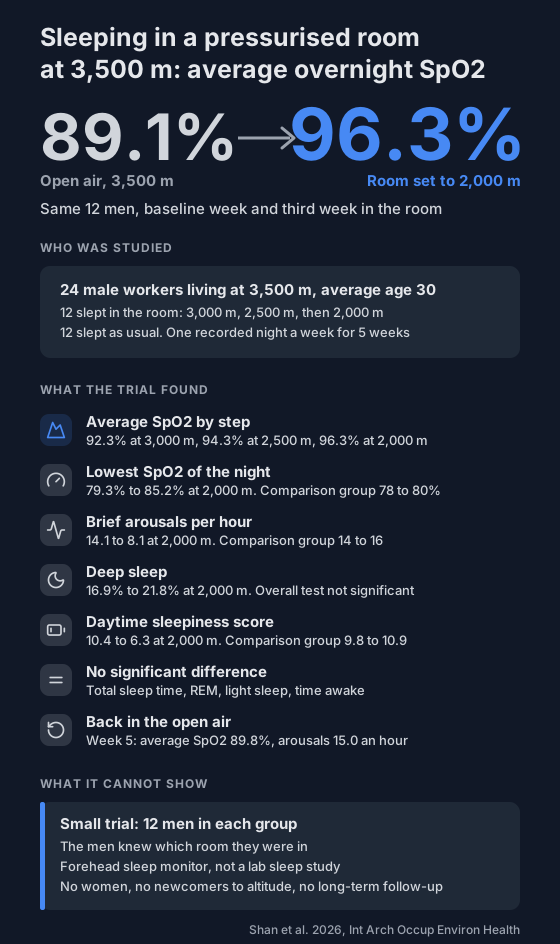
Your overnight oxygen reads lower at altitude, and sleep gets lighter and more broken. A 2026 trial by a team in China tested a bedroom pumped up to the air pressure of a lower height.
Who was in the trial?
- 24 male workers from low-altitude regions who had lived and worked at 3,500 m for at least 3 months.
- Their average age was about 30.
- 12 were randomly assigned to sleep in a pressurised room, 12 slept as usual.
What did they do?
- Week 1: everyone slept in the open air at 3,500 m.
- Weeks 2 to 4: the room was set to 3,000 m, then 2,500 m, then 2,000 m.
- Week 5: everyone back at 3,500 m.
One night at the end of each week was recorded with a forehead sleep monitor that also reads SpO2.
What happened to overnight oxygen?
In the room group, average SpO2 went up at each step:
- 3,500 m: 89.1%
- 3,000 m: 92.3%
- 2,500 m: 94.3%
- 2,000 m: 96.3%
The lowest reading of the night went from 79.3% to 85.2%. The comparison group stayed between 87.9% and 89.1% on average.
And sleep?
At the 2,000 m setting, in the room group:
- Brief arousals fell from 14.1 to 8.1 an hour.
- Deep sleep went from 16.9% to 21.8% of sleep.
- A daytime sleepiness score went from 10.4 to 6.3.
Total sleep time, REM, light sleep and time awake showed no significant difference between the groups. The 3,000 m setting changed oxygen, but not arousals, deep sleep or sleepiness.
Did it last?
No. After a week back in the open air, average SpO2 was 89.8% and arousals were 15.0 an hour.
What doesn't it tell you?
- Much about other people. There were 12 men per group, all already used to the altitude.
- How much was expectation. The men knew which room they were in, and the sleepiness score is self-reported.
- Sleep-study detail. The monitor is not a lab sleep study, and the paper reports no count of breathing pauses.
- How it compares with extra oxygen. The trial had no oxygen group.
- Deep sleep for certain. The overall test for deep sleep was not significant, only the 2,000 m step.
One author is from China State Construction Engineering, and a China Construction research institute developed the room. The authors declare no competing interests.
What can you do with this?
In this trial, average overnight SpO2 rose with each step down in simulated height.
If you track nights on a trip to altitude, record a few at home first. How many nights to record covers that.
Not a medical device. Does not diagnose, treat or prevent any condition. Discuss results and changes with a clinician.
References
- Shan X, Li S, Deng Q, Wen J, Wang Y, Chen S, Lin M, Liu X, Miao X, Huang H. Improving adaptation in male high-altitude workers through pressurization: a randomized controlled trial on sleep architecture. International Archives of Occupational and Environmental Health. 2026;99(8):51. doi:10.1007/s00420-026-02229-z