Overnight Oxygen at Lower Altitude: A Trial
A 2026 Swiss crossover trial had 44 healthy adults who live above 1,000 m sleep at 590 m. Time below 90% oxygen went from 5 minutes a night to 1, and oxygen dips per hour fell from 10.0 to 6.0.
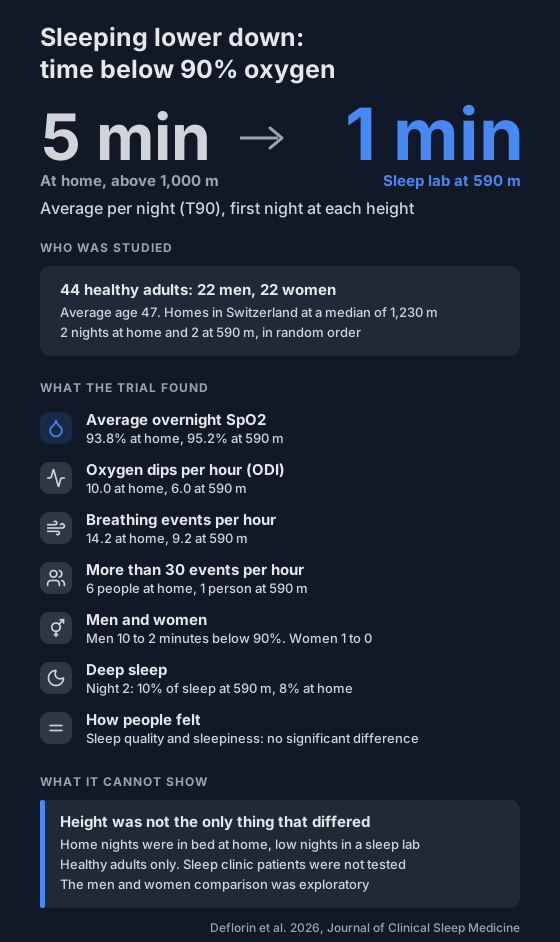
Go up a mountain and your overnight oxygen reads lower. A 2026 Swiss trial asked the reverse question. What happens when people who live above 1,000 m sleep lower down?
Who was in the trial?
- 44 healthy adults, 22 men and 22 women, average age 47.
- All lived above 1,000 m in Switzerland, at a median of 1,230 m.
- Each had two nights of full sleep recording at home and two in a sleep lab at 590 m.
- The order was random, with two weeks above 1,000 m in between.
What changed at 590 m?
These are first-night averages, home against 590 m:
- Time below 90% oxygen (T90): 5 minutes against 1 minute.
- Average SpO2: 93.8% against 95.2%.
- Oxygen dips per hour (ODI): 10.0 against 6.0.
- Breathing events per hour: 14.2 against 9.2.
The second night showed the same pattern. The fall in breathing events was mainly in obstructive events.
On the first night, six people had more than 30 breathing events an hour at home. One did at 590 m.
What didn't change?
There was no statistically significant difference in:
- How well people said they slept, or how sleepy they felt.
- Total sleep time.
Deep sleep was higher on the second night at 590 m: 10% of sleep against 8% at home.
Was it different for men and women?
In an exploratory analysis, for some measures.
- Men: 10 minutes below 90% at home, 2 minutes at 590 m.
- Women: 1 minute at home, 0 at 590 m.
- The falls in oxygen dips and breathing events per hour weren't significantly different between men and women.
- All six people with more than 30 events an hour at home were men.
What can't it show?
- Height alone. The home nights were in the person's own bed and the low nights were in a sleep lab, so height wasn't the only thing that differed.
- Size of the gap. The trial was planned around a 12-minute gap in T90. It found 4 minutes.
- Other people. The authors say it's uncertain whether the results hold for people with other illnesses or people living higher up. Sleep clinic patients weren't tested.
What can you do with this?
The authors' conclusion is for sleep labs: they recommend recording people who live above 1,000 m at their home height.
For your own recordings, where you slept is part of the reading.
- Note the height when you sleep away from home.
- Compare nights from the same place. The compare nights tool puts two recordings side by side.
- One night is thin evidence. See how many nights to record.
Not a medical device. Does not diagnose, treat or prevent any condition. Discuss results and changes with a clinician.
References
- Deflorin N, Furian M, Vontobel J, Niederseer D, Latshang TD. The effect of short-term descent to low altitude in healthy residents at moderate altitude - a randomized crossover trial. Journal of Clinical Sleep Medicine. 2026;22(1):122. doi:10.1007/s44470-026-00128-1