BMI and Overnight Oxygen Dips at Altitude
A 2026 study put an overnight oximeter on 762 Chilean miners sleeping at 3,800 m. Body mass index measured at sea level was the main independent correlate of oxygen dips and of time below 85%.
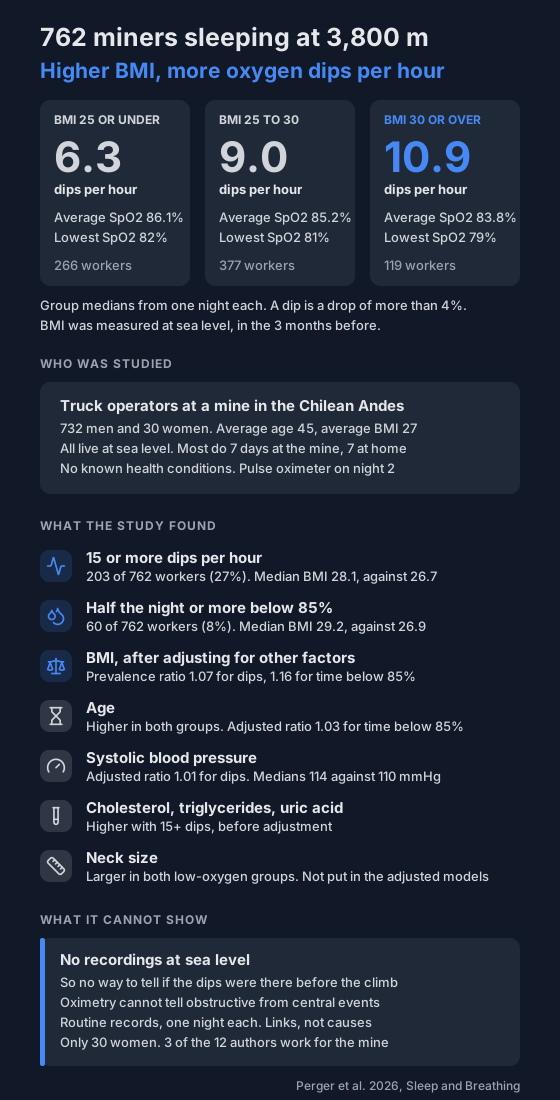
Everyone's overnight oxygen reads lower at altitude. But some people dip a lot more than others on the same mountain.
A 2026 study looked at 762 miners who sleep at 3,800 m every other week. It compared one night of oximetry at altitude with the health checks they'd had at sea level. Body mass index (BMI) was the measure most consistently linked to oxygen dips.
Who was studied?
- 762 truck operators at a mine in the Chilean Andes: 732 men and 30 women.
- Average age 45, average BMI 27.
- They work 12-hour shifts at 4,100 to 4,500 m and sleep at a camp at 3,800 m.
- Most do 7 days at the mine, then 7 days at home, and had been in the job for at least a year.
- All were born and live at sea level.
- The study only included workers with no known health conditions and no blood pressure or cholesterol medication.
The mine already runs overnight oximetry on its workers, to decide who moves to an oxygen-enriched bedroom. The researchers went back through three years of those records, from 2017 to 2019.
What was measured?
- At altitude: one night on a Nonin WristOx2 pulse oximeter, on the second night of the shift, breathing room air.
- At sea level: weight, height, neck size, blood pressure and a fasting blood test, in the 3 months before.
The study counted oxygen dips of more than 4% per hour, the ODI. It then split the workers two ways: 15 or more dips per hour, and half the recording or more spent below 85%.
How did the night look by BMI?
| BMI at sea level | Workers | Dips per hour | Average SpO2 | Lowest SpO2 |
|---|---|---|---|---|
| 25 or under | 266 | 6.3 | 86.1% | 82% |
| Above 25, below 30 | 377 | 9.0 | 85.2% | 81% |
| 30 or over | 119 | 10.9 | 83.8% | 79% |
These are group medians. The differences across the three groups were statistically significant for all three measures.
What else went with more dips?
203 of the 762 workers (27%) had 15 or more dips per hour. Their median was 27.8 dips per hour, against 5.6 for everyone else.
Compared with the other 559, that group had:
- Higher BMI: a median of 28.1 against 26.7.
- Higher age: a median of 48.2 against 46.1.
- Higher blood pressure: a median of 114/67 against 110/66 mmHg, which the authors note is still within the usual range.
- Higher triglycerides (140 against 118 mg/dL), total cholesterol (175 against 168 mg/dL), uric acid (5.8 against 5.5 mg/dL) and the liver enzyme GGT (35 against 31 U/L).
- A larger neck for their height: an average neck-to-height ratio of 0.241 against 0.237.
There was no significant difference in blood sugar, hemoglobin, creatinine, or LDL and HDL cholesterol.
60 workers (8%) spent half the night or more below 85%. They were older (50 against 46), had a higher BMI (29.2 against 26.9) and higher uric acid (6.1 against 5.5 mg/dL). Their blood pressure was not significantly different (113/66 against 111/66 mmHg). Their median lowest reading was 73.1%.
What held up after adjustment?
The researchers put the linked factors into one model for each outcome.
- 15 or more dips per hour: BMI (prevalence ratio 1.07, 95% CI 1.03 to 1.11) and systolic blood pressure (1.01, 95% CI 1.00 to 1.02) stayed significant.
- Half the night below 85%: BMI (1.16, 95% CI 1.08 to 1.24) and age (1.03, 95% CI 1.02 to 1.05) stayed significant.
BMI was the only factor named in both. The main text names only these factors as staying significant. The full adjusted tables are in a supplement that this summary did not have, so it can't say how the other factors came out. The paper also doesn't say what size of step in BMI, age or blood pressure each ratio is for.
What do the authors make of it?
- They say excess weight may mark out workers who are more vulnerable to low overnight oxygen at altitude.
- They think it runs both ways: extra weight may make dips more likely, and repeated low oxygen and broken sleep may add to weight gain. The study didn't test either direction.
- They call for better nutrition and regular physical activity for these workers, and for overnight breathing studies that can tell obstructive from central events.
What can't it show?
- Whether altitude caused the dips. Nobody was recorded at sea level, so the dips may have been there already. The authors say this rules out any causal reading.
- What kind of events they were. An oximeter records oxygen and pulse. It can't tell a blocked airway from the central pauses that are common at altitude.
- Change over time. It's a cross-section from routine records, with one night per worker.
- Women. Only 30 of the 762 were women.
- Sleep itself. There was no measure of how long or how well anyone slept, and no waist measurement.
- Independence. Three of the twelve authors are employed by the mine.
What can you do with this?
If you're recording your own nights at altitude, expect your numbers to differ from your travel partner's. In this study, BMI was one of the things that went with that difference.
- Record a few nights at home first, so you know your own baseline. See how many nights to record.
- Compare altitude nights with that baseline, not with someone else's readings.
- If you get a lot of dips at home too, share the recordings with your doctor.
For a different group of shift workers at altitude, with full sleep recordings, see sleep of high-altitude workers. For the weight side at sea level, see the obesity and sleep apnea study.
Not a medical device. Does not diagnose, treat or prevent any condition. Discuss results and changes with a clinician.
References
- Perger E, Cantuarias J, Ottolenghi S, Lang M, Faini A, Bilo G, Pellizzari M, Bertoli S, Lombardi C, Araya G, Oscar P, Parati G. Intermittent exposure to high-altitude work: nocturnal hypoxemia sea-level anthropometric and biochemical markers. Sleep and Breathing. 2026;30(4):208. doi:10.1007/s11325-026-03751-7