Strength Training and Sleep Apnea: A Trial
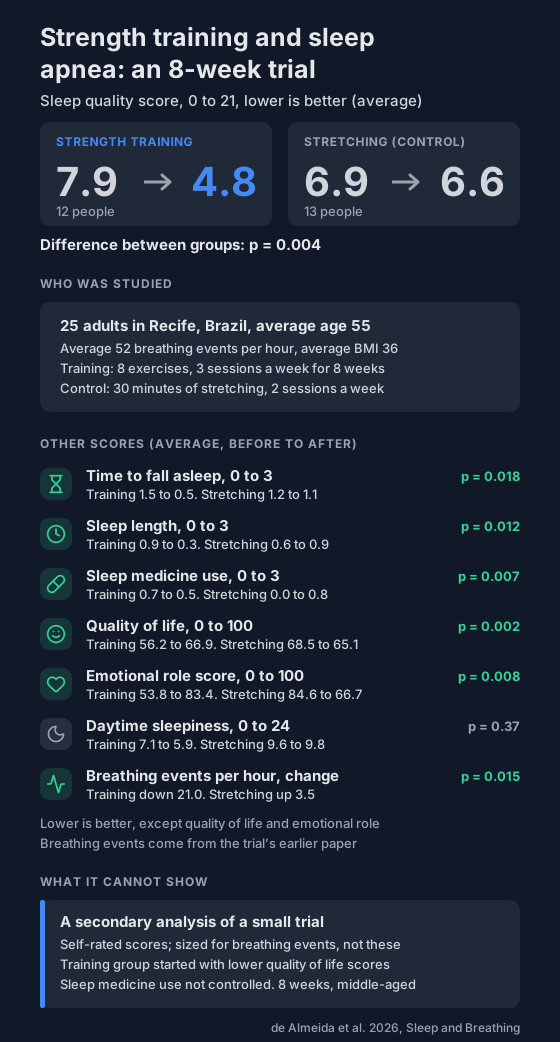
A 2026 trial gave 25 adults with sleep apnea 8 weeks of strength training or stretching. Self-rated sleep quality scores went from 7.9 to 4.8 with training and 6.9 to 6.6 with stretching. Daytime sleepiness showed no statistically significant difference between groups.
Exercise is often suggested alongside other care for obstructive sleep apnea. Most trials have tested aerobic exercise, or aerobic and strength work combined.
A small Brazilian trial published in October 2026 looked at strength training on its own. After 8 weeks, people who lifted rated their sleep and quality of life better than people who stretched. Their daytime sleepiness scores showed no statistically significant difference.
Who was in the trial?
- 25 adults finished it at the Federal University of Pernambuco in Recife, Brazil: 13 men and 12 women.
- Their average age was 55 and their average BMI was 36.
- All had 15 or more breathing events per hour on a full overnight sleep study. The average was 52.
- None had had any therapy for sleep apnea before, and anyone who started one during the trial was excluded.
- Anyone who missed more than 1 in 5 sessions was excluded too.
What did each group do?
- Strength training (12 people): 8 exercises for the upper and lower body, 3 sessions a week for 8 weeks.
- Control (13 people): 30 minutes of stretching, 2 sessions a week for 8 weeks.
So the control group still exercised, just less and more gently.
How was it measured?
Everything in this paper is self-rated, on three standard questionnaires:
- Sleep quality: the Pittsburgh Sleep Quality Index, scored 0 to 21, lower is better. It has 7 parts, each scored 0 to 3.
- Daytime sleepiness: the Epworth Sleepiness Scale, scored 0 to 24, lower is better.
- Quality of life: the SF-36, with 8 parts, each scored 0 to 100, higher is better.
What did it find?
Figures are group averages, before and after.
- Overall sleep quality: 7.9 to 4.8 with training, 6.9 to 6.6 with stretching (p = 0.004). The training group ended under 5; the authors count 0 to 5 as good sleep quality.
- Time to fall asleep score: 1.5 to 0.5 with training, 1.2 to 1.1 with stretching (p = 0.018).
- Sleep length score: 0.9 to 0.3 with training, 0.6 to 0.9 with stretching (p = 0.012). Lower means people reported sleeping longer.
- Sleep medicine score: 0.7 to 0.5 with training, 0.0 to 0.8 with stretching (p = 0.007). The authors say this gap came from the stretching group taking more sleep medicine, not the training group taking less.
- Overall quality of life: 56.2 to 66.9 with training, 68.5 to 65.1 with stretching (p = 0.002).
- Emotional role score, how much emotional problems get in the way of daily life: 53.8 to 83.4 with training, 84.6 to 66.7 with stretching (p = 0.008).
The other sleep parts (how good people rated their sleep, sleep efficiency, sleep disturbances, daytime functioning) and the other quality-of-life parts showed no statistically significant difference between groups.
What about daytime sleepiness?
- 7.1 to 5.9 with training, 9.6 to 9.8 with stretching.
- No statistically significant difference between groups (p = 0.37).
- Both groups started under 10, the score the authors use for excessive sleepiness.
The authors note daytime sleepiness often doesn't track the number of breathing events. Plenty of people with sleep apnea aren't sleepy at all, and other factors go with it.
What about breathing events?
That was the trial's main question, reported in an earlier paper by the same group (reference 2).
- Breathing events per hour fell by 21.0 on average with training and rose by 3.5 with stretching (p = 0.015).
- Arousals from sleep fell by 7.9 an hour with training and rose by 7.4 with stretching (p = 0.028).
- This paper restates the stretching group's figures differently, as 51.9 to 48.5 events per hour.
The authors suggest fewer breathing events and fewer arousals from sleep may partly explain why sleep quality scores moved. They say they can't confirm that.
What can't it tell you?
- Much, on its own. It's a secondary analysis: the trial was sized to find a change in breathing events per hour, not in these scores. The authors say it may have had too few people for them.
- Objective sleep. Every result here is a questionnaire score, and people with sleep apnea often misjudge their own sleep.
- A fair start. The training group began with lower quality of life (56.2 against 68.5) and a lower emotional role score (53.8 against 84.6), so it had more room to rise. The paper doesn't test or discuss this gap; it's our reading of its table.
- Other medicines. Over 40% of the training group took diuretics, which the authors say could have played a part in the quality of life result.
- Sleep medicine. The authors didn't control for its use.
- The long term. It ran for 8 weeks.
- Other people. It was 25 middle-aged adults at one site, with an average BMI of 36. The authors say the results can't be extended to older adults.
A Brazilian government research agency (CAPES) funded the trial, and the authors declare no conflicts of interest.
How does it fit with other research?
- A 2026 review found aerobic, mind-body and combined exercise went with better sleep quality scores, with no clear change in daytime sleepiness either.
- A 2026 meta-analysis compared aerobic exercise with GLP-1 and SGLT2 drugs for breathing events per hour.
- A trial of throat and neck exercises found no difference against sleep advice alone.
What can you do with this?
If you have sleep apnea, talk to your doctor before starting a new exercise programme, and about which therapy options suit you.
If you're running a self-experiment of your own:
- Log when you train, not only how you slept.
- Record several nights before and after, because one night can mislead.
- Watch oxygen dips per hour alongside how rested you feel, since the two don't always move together.
An overnight oximeter can't tell you whether you have sleep apnea. It records what your oxygen and pulse did, and you can share that with your doctor.
Not a medical device. Does not diagnose, treat or prevent any condition. Discuss results and changes with a clinician.
References
- de Almeida JRV, da Silva Ferreira DK, de Arantes Lima VD, Dos Santos ENN, Dos Santos de Oliveira Silva NS, Aguiar JLP, Dos Santos ECF, Germano-Soares AH, Pedrosa RP, Esteves AM, Farah BQ, de Lima Lins-Filho O. Effects of resistance training on subjective sleep quality, excessive daytime sleepiness, and quality of life in patients with obstructive sleep apnea: a secondary analysis from a randomized controlled trial. Sleep and Breathing. 2026;30(6):296. doi:10.1007/s11325-026-03842-5
- de Almeida JRV, Farah BQ, Aguiar JLP, Dos Santos ECF, de Arantes Lima VD, Dos Santos ENN, Dos Santos de Oliveira Silva NS, Germano-Soares AH, Saavedra JM, Pedrosa RP, da Silva Ferreira DK, de Lima Lins-Filho O. Effects of resistance training on obstructive sleep apnea severity: a randomized controlled trial. Sleep Medicine. 2026;142:108879. doi:10.1016/j.sleep.2026.108879