Do Throat Exercises Help Sleep Apnea? A Trial
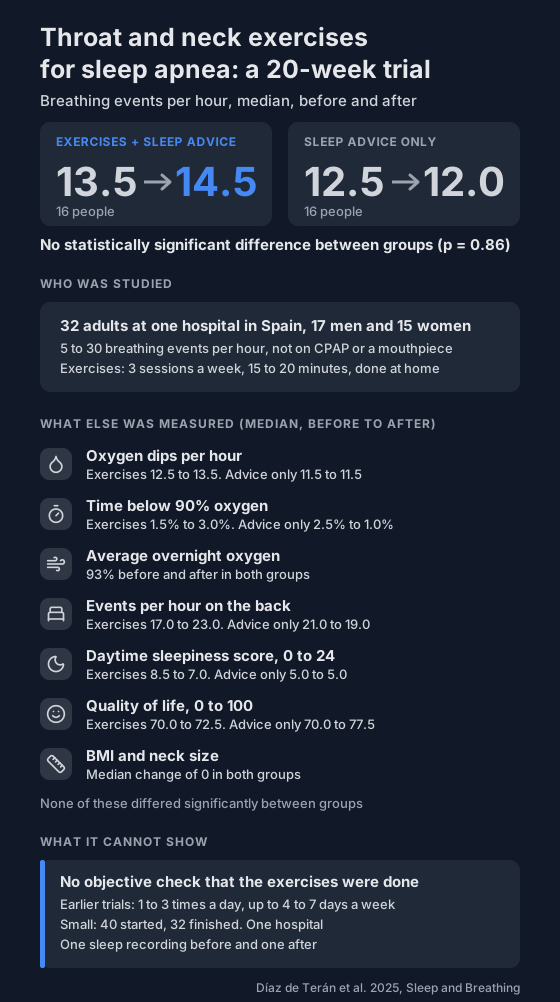
A 2025 randomised trial gave 16 adults with sleep apnea 20 weeks of throat and neck exercises, and 16 got sleep advice only. Breathing events, oxygen dips and sleepiness showed no statistically significant difference between the groups.
Tongue and throat exercises are often suggested for obstructive sleep apnea. The idea is that stronger throat muscles hold the airway open at night, and some earlier reviews reported breathing events per hour falling by up to 50%.
A Spanish trial published in November 2025 tested a 20-week programme against sleep advice alone. It found no statistically significant difference on anything it measured.
Who was in the trial?
- 32 adults finished it, 17 men and 15 women, at one hospital sleep unit in Santander, Spain.
- 65 people were assessed and 40 joined, 20 in each group. 8 dropped out, leaving 16 in each.
- They were aged 18 to 70 and had 5 to 30 breathing events per hour on a sleep recording that tracks breathing and oxygen (respiratory polygraphy).
- None was on CPAP or a mouthpiece: they didn't meet the criteria, had refused, or couldn't use one.
- Most were 41 or older, and about three quarters were overweight or had class I obesity.
- People with a BMI of 35 or more, or who took sleeping pills regularly, were left out.
What did the exercise group do?
Both groups got the same advice by phone: keep a regular sleep schedule, avoid daytime naps, avoid electronic devices, and keep healthy habits.
The exercise group also learned a routine in person and did it at home:
- Throat: raising the soft palate, sliding the tongue along the roof of the mouth, sucking it against the roof, pressing its tip against the lower front teeth, pushing it against a tongue depressor, blowing up a balloon, and chewing and swallowing with the tongue on the palate.
- Neck: chin tucks and head retractions.
- 3 sessions a week, 15 to 20 minutes each, for 20 weeks.
Everyone got a follow-up call every four weeks. The staff who scored the sleep recordings didn't know who was in which group.
What did it find?
Breathing events per hour was the main measure. Figures are medians, before and after.
- Exercises: 13.5 to 14.5.
- Advice only: 12.5 to 12.0.
- The difference between groups was not statistically significant (p = 0.86).
The other overnight measures went the same way:
- Oxygen dips per hour: 12.5 to 13.5 with exercises, 11.5 to 11.5 without (p = 0.72).
- Time below 90% oxygen: 1.5% to 3.0% with exercises, 2.5% to 1.0% without (p = 0.10).
- Average overnight oxygen: 93% before and after in both groups (p = 0.43).
- Breathing events per hour while lying on the back: 17.0 to 23.0 with exercises, 21.0 to 19.0 without (p = 0.38).
The authors note that several of these moved slightly more in the advice-only group's favour, without reaching statistical significance.
What about sleepiness and quality of life?
- Daytime sleepiness, on a 0 to 24 questionnaire: 8.5 to 7.0 with exercises, 5.0 to 5.0 without (p = 0.83).
- Quality of life, on a 0 to 100 scale: 70.0 to 72.5 with exercises, 70.0 to 77.5 without (p = 0.08).
- BMI and neck size: a median change of 0 in both groups.
The authors call the sleepiness drop in the exercise group clinically relevant. It was not statistically significant, and the exercise group started with a higher median score (8.5 against 5.0). They suggest the quality-of-life rise in both groups may come from the sleep advice.
Why might it have found nothing?
The authors give two reasons.
- How often. Earlier trials that reported a benefit had people exercising 1 to 3 times a day, up to 4 to 7 days a week. This one used 3 sessions a week to keep people from dropping out. The authors think frequency may matter more than how many weeks the programme runs.
- Whether people did them. The exercises were done at home, with a phone call every four weeks but no objective record such as a digital log or supervision. The authors say they can't tell a programme that doesn't work from one that wasn't followed.
They also point to a similar 6-week trial, with exercises 4 days a week, that found no change in breathing events but less daytime sleepiness. And they cite a more recent review that found throat exercises may lower daytime sleepiness in the short term but might even raise breathing events per hour, with too little evidence to recommend them as a standard therapy.
What can't it tell you?
- Whether throat exercises work in general. It tested one low-frequency programme. The authors say the results don't support that programme as tested.
- Much about small effects. The trial was sized to pick up a 30% drop in breathing events per hour. With 16 people per group, a smaller change could be missed.
- Night-to-night change. There was one recording before and one after. The first was done in the sleep lab, for some people up to three months before joining, and the second at home. Breathing events vary from night to night, which is why several nights tell you more than one.
- Other people. It was one hospital, and nobody had more than 30 events per hour or a BMI of 35 or more.
- What the dropouts would have shown. 8 of the 40 who started didn't finish and only the 32 who finished were analysed. The authors say the loss of participants may have affected the results.
The Spanish Sleep Society funded the trial, and the authors declare no financial conflicts of interest.
What can you do with this?
If you have sleep apnea, your doctor is the person to talk to about therapy options. For what larger reviews found, read CPAP vs a mouthpiece.
If you're tracking a change of your own, this trial is a reminder of what makes a comparison fair:
- Log whether you did the thing, not only the result.
- Record more than one night before and after.
- Compare the nights side by side.
An overnight oximeter can't tell you whether you have sleep apnea. It records oxygen dips per hour and time below 90%, two of the measures this trial used, and you can share them with your doctor.
Not a medical device. Does not diagnose, treat or prevent any condition. Discuss results and changes with a clinician.
References
- Díaz de Terán T, Bolado J, Palomo P, Muñoz P, de Labra C, González M. Effectiveness of strenghtning oropharyngeal myofunctional therapy combined with cervical spine exercises in mild to moderate obstructive sleep apnoea. Sleep and Breathing. 2025;29(6):348. doi:10.1007/s11325-025-03487-w