Exercise and Sleep in Veterans With PTSD
A 2026 pilot trial put older US veterans with PTSD on 12 weeks of supervised group exercise or a waitlist, with sleep data for 48. Self-rated sleep held steady or got a little better with exercise and got a little worse on the waitlist, but no gap was statistically significant.
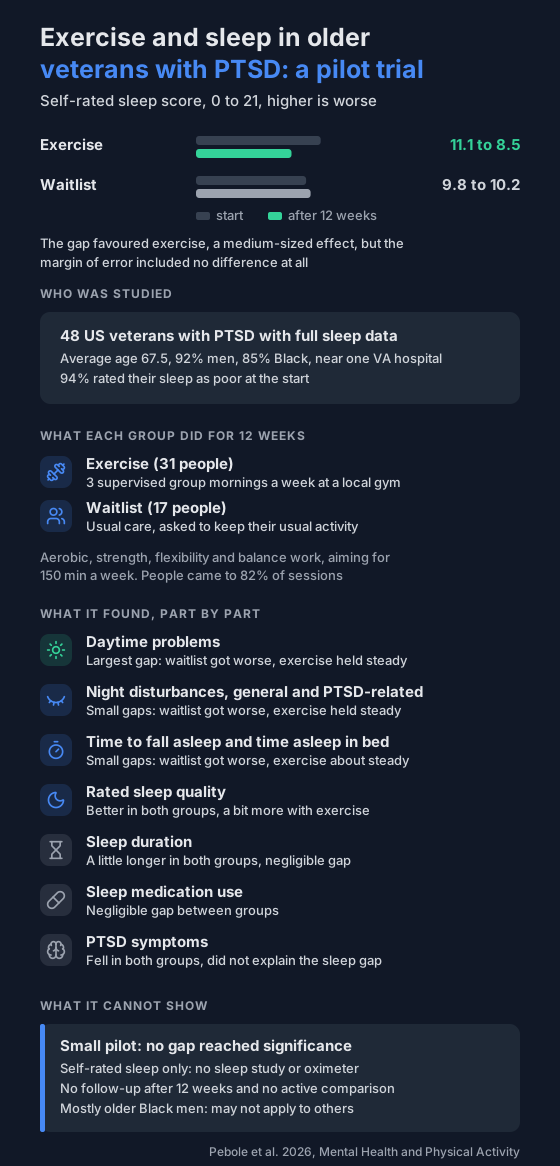
Poor sleep and nightmares are common in PTSD, and they often hang on even when other symptoms ease. Exercise is linked with better sleep in general, but few trials have looked at older veterans.
This pilot trial, published in October 2026, compared supervised exercise with a waitlist and broke self-rated sleep down part by part.
Who was in the trial?
- US veterans aged 60 and over with PTSD confirmed by a clinician interview, average age 67.5.
- 92% were men and 85% were Black.
- All lived within 50 miles of one VA hospital.
- Anyone already doing more than 150 minutes a week of brisk aerobic exercise was left out.
- 94% scored above 5 on the Pittsburgh Sleep Quality Index, a 0 to 21 questionnaire where higher means worse sleep and above 5 counts as poor sleep.
54 people took part. The analysis covers the 48 with sleep scores at both the start and 12 weeks: 31 in the exercise group and 17 on the waitlist.
What did the exercise involve?
- Supervised group sessions three mornings a week, for example Monday, Wednesday and Friday.
- At an independent community gym within 5 miles from the VA hospital, alongside other members and classes.
- A mix of aerobic, strength, flexibility and balance training.
- The aim was at least 150 minutes a week of brisk exercise, in line with current activity guidelines.
- People came to 82% of their sessions, and 86% stayed in the program.
The waitlist group kept their usual care and were asked to keep their usual activity.
What did it find?
The overall sleep score, group average from the start to 12 weeks:
- Exercise: 11.1 to 8.5.
- Waitlist: 9.8 to 10.2.
After allowing for starting scores, the gap favoured exercise with a medium-sized effect. But the range of likely values included no difference, and no result was statistically significant. The authors focused on the size of effects rather than significance because the trial was small.
Within each group, the changes were small. The authors say the gap may come partly from the waitlist getting worse, not from a big gain with exercise.
Part by part:
- Daytime problems: the largest gap. Steady with exercise, worse on the waitlist.
- Night disturbances: a small gap. Worse on the waitlist; the paper's table shows no change with exercise, while its text reports a very small gain.
- PTSD-related night disturbances, from 7 extra trauma-focused questions: a small gap. Steady with exercise, worse on the waitlist.
- Time to fall asleep: a small gap. A very small gain with exercise, worse on the waitlist.
- Share of time in bed spent asleep: a small gap. Steady with exercise, a little worse on the waitlist.
- Rated sleep quality: a little better in both groups, a bit more with exercise.
- Sleep duration: a little longer in both groups, with a negligible gap.
- Sleep medication use: a negligible gap. Steady with exercise, a little more use on the waitlist.
PTSD symptom scores fell in both groups, from 44 to 37 with exercise and 40 to 36 on the waitlist. An exploratory analysis found no sign that this drop explained the sleep gap.
What can't it tell you?
- Whether the effect is real. It's a small pilot, and the sleep results are a secondary analysis of a trial built mainly to test feasibility, activity and PTSD symptoms. An earlier paper from the same trial reported the overall sleep score with different numbers from this one.
- Anything measured. Sleep was self-rated. There was no sleep study, wrist tracker or oximeter.
- Whether it lasts. There was no follow-up after 12 weeks.
- What did the work. There was no active comparison group, so the exercise can't be separated from the social contact, the routine and simply being more active.
- Who else it applies to. Mostly older Black men near one VA hospital.
- What drove the sleep change. PTSD symptoms and sleep were measured on the same day, and the analysis of that link was too small to be more than exploratory.
- Fair starting points. The exercise group started with worse sleep scores, 11.1 against 9.8. The groups were uneven in size, and the waitlist had more women (18% against 3%) and fewer Black veterans (71% against 94%).
The trial was funded by the US Department of Veterans Affairs, and the authors report no conflicts of interest.
What can you do with this?
In this group, regular supervised exercise went with sleep that held steady or got a little better, while sleep on the waitlist slipped. It's one small trial, so it shows what happened here, not what to expect for you.
For the wider picture, see which exercise goes with better sleep and whether the time of day matters. For what nightmares look like in a sleep lab, see nightmares and sleep study results.
If you want to watch your own nights as you get more active:
- Record a few nights before you change anything, because one night tells you little.
- Log your activity and how you felt each day, not only the night.
- An overnight oximeter adds what this trial didn't measure: your oxygen and pulse through the night.
If your sleep stays poor, share your recordings with your doctor.
Not a medical device. Does not diagnose, treat or prevent any condition. Discuss results and changes with a clinician.
References
- Pebole MM, Browne J, Kunicki ZJ, Gregg JJ, Hall KS. Sleep quality improvements and maintenance with exercise in older veterans with PTSD: Results from a pilot randomized trial. Mental Health and Physical Activity. 2026;31:100794. doi:10.1016/j.mhpa.2026.100794