Which Exercise Helps Sleep Quality Most?
A 2026 review of 23 trials and 1,478 adults aged 45 to 77 with sleep problems found sleep quality scores went in the better direction with aerobic, mind-body and combined exercise, with a dose curve that peaked near 539 MET-minutes a week, while daytime sleepiness scores showed no statistically significant change.
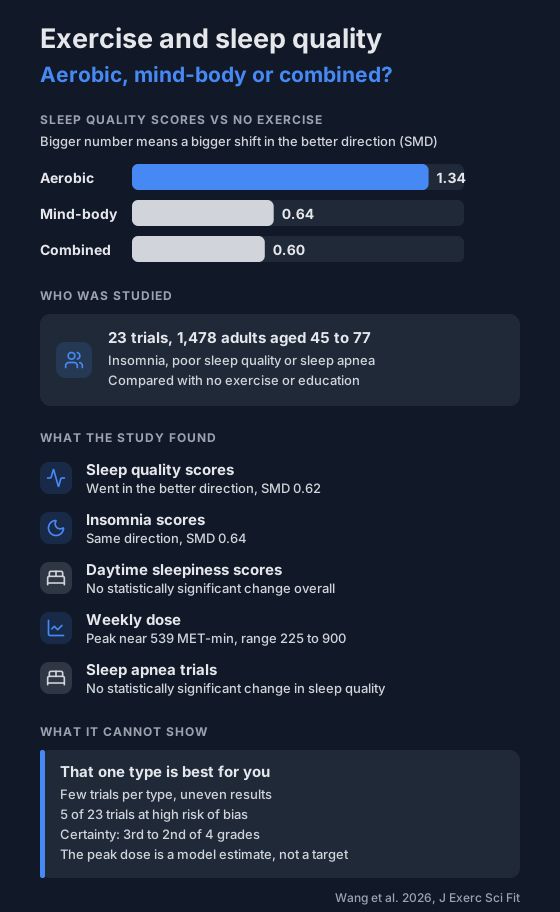
"Exercise helps sleep" is common advice. It leaves out which kind of exercise, and how much. A 2026 review pooled 23 randomized trials to compare types and to draw a dose curve.
Aerobic exercise came out with the biggest shift in sleep quality scores, but the evidence behind that ranking is thin. Daytime sleepiness scores showed no statistically significant change.
Who was studied?
- 23 randomized trials with 1,478 adults aged 45 to 77, with sleep problems.
- The trials covered insomnia, poor sleep quality (a questionnaire score at or above a cut-off) and sleep apnea. Some were in people with another condition, such as rheumatoid arthritis or cognitive impairment.
- The comparison group did no structured exercise. Some had health education or usual care.
- Exercise types across the 24 exercise groups: mind-body (9, such as Tai Chi or yoga), aerobic (7), combined (5), walking (2) and high-intensity intervals (1).
- The searches ran to May 2026. The review was registered in advance, was unfunded, and the authors declared no competing interests.
What was measured?
- Sleep quality: the Pittsburgh Sleep Quality Index (PSQI), a questionnaire you fill in yourself. This was the main outcome.
- Insomnia symptoms: the ISI, a questionnaire on how much insomnia bothers you.
- Daytime sleepiness: the Epworth Sleepiness Scale (ESS).
- Results are given as standardized mean differences (SMD): the gap between the exercise and comparison groups, measured in standard deviations. On all three questionnaires a lower score is better, so the paper flipped the sign: a positive SMD means scores moved in the better direction, and a bigger number means a bigger shift.
What did it find?
- All exercise combined: PSQI scores went in the better direction (SMD 0.62) and so did ISI scores (SMD 0.64).
- Daytime sleepiness: no statistically significant change overall (SMD 0.70, 95% CI -0.05 to 1.46), and the trials disagreed a lot. Mind-body exercise alone did show a statistically significant change (SMD 0.48, CI 0.01 to 0.96).
- Compared with no exercise, in the network analysis of PSQI scores: aerobic 1.34, mind-body 0.64, combined 0.60.
- Between types: aerobic was ahead of mind-body (0.70) and combined (0.74). Mind-body and combined were not statistically different (0.04).
- Sleep apnea trials: the subgroup didn't show a statistically significant PSQI change. The authors point to few trials and say exercise may have only a modest effect on breathing events during sleep.
- Disorder type: the test for differences between groups was not statistically significant, so there was no evidence the effect differed by type of sleep problem.
The aerobic result comes with a caution. In the direct comparison with no exercise, aerobic came out at 1.52, with results that varied a lot between trials. That figure shrank, but stayed in the same direction, when the authors reran it without the most extreme trial. The authors say the ranking is uncertain and rule out a firm claim that aerobic beats the rest.
What about how much?
The authors converted each trial's programme into MET-minutes a week: the activity's MET value, times minutes per session, times sessions per week. A MET is a way to rate how hard an activity is, with sitting at rest as 1. They could do this for 14 of the 24 exercise groups.
- Shape of the curve: an inverted U. Predicted benefit rose with weekly dose, peaked, then eased off.
- Peak: about 539 MET-minutes a week (predicted SMD 1.09), with a credible interval for the peak of 449 to 900.
- Range where the predicted effect was statistically significant: from about 225 up to about 900 MET-minutes a week.
- Other analyses: other models gave broadly similar ranges. Two earlier reviews had put the peak near 440 and 527.
The paper doesn't translate this into walking time. For scale only, as our own arithmetic and not from the paper: at 3.5 METs, roughly walking on the flat at about 3 mph (5 km/h), 539 MET-minutes is about 155 minutes a week. The 225 to 900 range is about 65 to 260 minutes. This is not a target, and the authors say the peak dose should not be read as a prescription.
For when in the day, see exercise timing and sleep.
What can't it show?
- Certainty of the evidence ranged from the third to the second of four grades, never the top. 5 of the 23 trials were at high risk of bias, and the other 18 had some concerns.
- Sleep quality was self-reported, and people can't be blinded to whether they exercise, so expectations may have played a part.
- Few trials per type, and results varied a lot between them. The authors say the data can't settle which type is best.
- The peak dose is a model estimate. The authors call it exploratory and not a target to aim for, given its wide interval.
- The trials differed in people, programme and comparison group. Several details that might matter, such as medication and other health conditions, weren't reported well enough to adjust for.
- Exercise type was partly tied to who was studied and where, so other differences may explain some of the gaps between types.
- There was no dose curve for each type, and no long-term follow-up.
- Pooled results describe groups, not you.
What can you do with it?
If you track your sleep, you can run your own comparison.
- Log what you do each week and how long you do it, with the type and the rough hard-or-easy level.
- Watch your own sleep scores and overnight oxygen alongside it over several weeks.
- Change one thing at a time so you can see what moved.
You can look at your own nights in the session viewer. If you have a health condition or a limit on what exercise suits you, talk to a clinician before changing what you do.
Not a medical device. Does not diagnose, treat or prevent any condition. Discuss results and changes with a clinician.
References
- Wang T, Ma Z, Zhu B, Tang Y. Comparative effects of exercise modalities on sleep quality in middle-aged and older adults with sleep disorders: A systematic review with pairwise, network, and dose-response meta-analyses. J Exerc Sci Fit. 2026;24(4):200526. doi:10.1016/j.jesf.2026.200526