Weekly Alcohol and Broken Sleep
A 2026 study of 500 randomly picked adults in Spain found that people drinking over 180 g of alcohol a week had more awakenings and more fragmented sleep on a wrist monitor than non-drinkers.
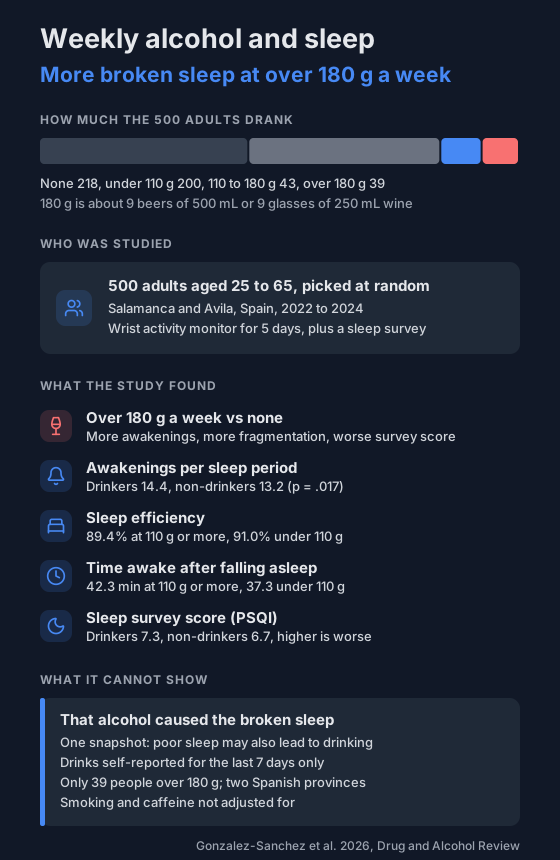
Plenty of people know alcohol can make them drowsy at bedtime. A 2026 study from Spain asked what heavier weekly drinking looks like on a wrist sleep monitor.
People who drank over 180 g of alcohol a week had more awakenings, more fragmented sleep and worse sleep survey scores than people who didn't drink. It's a snapshot of 500 adults, so it shows a link, not a cause.
How much is 180 g a week?
The paper uses the Spanish Ministry of Health's way of counting. 10 g of alcohol is one of these:
- A 250 mL beer.
- A 125 mL glass of wine, which is half of a 250 mL glass.
- A 30 mL shot of spirits.
20 g is a 500 mL beer, a 250 mL glass of wine or two 30 mL shots. So 180 g a week is 18 of the 10 g drinks. In the paper's examples that's about 9 beers of 500 mL, or 9 glasses of 250 mL wine, in the past 7 days.
The Ministry bands used in the study:
- None: 0 g a week.
- Low risk: under 110 g.
- Hazardous: 110 to 180 g.
- High risk: over 180 g.
Who was studied?
- 500 adults aged 25 to 65 in Salamanca and Avila, Spain, between May 2022 and April 2024.
- Picked at random from the regional health service's database, with 50 men and 50 women at each of the ages 25, 35, 45, 55 and 65.
- Drinking was self-reported for the previous 7 days, and was converted to grams a week.
- Sleep was recorded with an ActiGraph GT3X+ wrist monitor for five days in a row, always including at least one weekend day.
- Sleep quality was also scored with the Pittsburgh Sleep Quality Index (PSQI), a self-report survey where higher means worse sleep.
By drinking band:
- 218 people (43.6%) drank no alcohol.
- 200 (40.0%) were low risk.
- 43 (8.6%) were in the hazardous band.
- 39 (7.8%) were in the high-risk band, 28 men and 11 women.
Men were more likely than women to be in the two heavier bands.
What did it find?
The authors compared the bands, allowing for age group, sex, education and depression and anxiety survey scores.
- Over 180 g a week vs none: the heaviest group had a higher PSQI score, more awakenings and a higher sleep fragmentation index (p < 0.05 for each). The paper gives these group averages only in charts, so there are no exact figures here.
- Any drinking vs none: drinkers had more awakenings, 14.4 against 13.2 (p = 0.017). Their PSQI was higher too, 7.3 against 6.7 (p = 0.047). Sleep efficiency (90.7% vs 90.9%) and time awake after falling asleep (38.0 vs 36.9 minutes) didn't differ significantly.
- 110 g or more vs under 110 g, among drinkers:
- Sleep efficiency was lower, 89.4% against 91.0% (p = 0.002).
- Time awake after falling asleep was longer, 42.3 against 37.3 minutes (p = 0.028).
- Awakenings were higher, 15.6 against 14.2 (p = 0.044).
- The fragmentation index was higher, 12.0 against 10.7 (p = 0.049).
- PSQI (7.3 vs 6.9, p = 0.44), total sleep time and the combined sleep fragmentation index were not significantly different.
The authors say sleep efficiency and time awake after falling asleep differed between all four bands. Awakenings and the combined sleep fragmentation index differed only between none and over 180 g.
What can't it show?
- It's a cross-section. It can't show that alcohol caused the broken sleep, and the authors say the link could run both ways, for example if people with poor sleep drink more.
- Drinking was self-reported for the last 7 days, which can be misremembered or under-reported, and a single week can miss binge nights.
- Only 39 people were in the over 180 g band, and they were mostly men.
- Smoking, cannabis, cocaine, coffee and energy drinks were recorded but not allowed for in the adjusted results, so other factors may play a part.
- A wrist monitor estimates sleep from movement. It doesn't record sleep stages the way a lab study does.
- Everyone came from two provinces. The authors say the sample isn't representative of Spain as a whole.
- Funding came from the Castilla y León regional health management and the University of Salamanca. The authors reported no conflicts of interest.
The paper is inconsistent in one place. The text says time awake after falling asleep differed across all bands, but the caption for the chart of it says p > 0.05 between groups. The two-group figures above come from the paper's table.
Does this match other findings?
The authors cite earlier work where evening alcohol shortened the time to fall asleep but made sleep more broken later in the night. Not every study agrees, and some found higher sleep efficiency in heavy drinkers, which the authors put down to short-term sedation or differences in design.
For more on drinking and your own night, see alcohol and your overnight oxygen and alcohol, heart rate and sleep in wearable data.
What can you do with it?
This study can't tell you what any one drink does to your sleep. You can look at your own data.
- Log how much you drank each evening, in the same units each time.
- Compare awakenings and restless time on drinking nights and dry nights over a few weeks.
- If you wear an oximeter, check whether your overnight oxygen or pulse looks different on those nights.
- Take what you see to a clinician if sleep is bothering you or you're worried about how much you drink.
Not a medical device. Does not diagnose, treat or prevent any condition. Discuss results and changes with a clinician.
References
- Gonzalez-Sanchez J, Jimenez-Vaquero C, Alonso-Dominguez R, Garcia-Yu IA, Sanchez-Aguadero N, Crespo-Sedano A, Rihuete-Galve MI, Mesas AE, Recio-Rodriguez JI. Relationship between alcohol consumption and sleep quality in a community-based adult sample from central-western Spain. Drug and Alcohol Review. 2026;45(6):e70269. doi:10.1111/dar.70269