Does Your Day Affect How You Sleep?
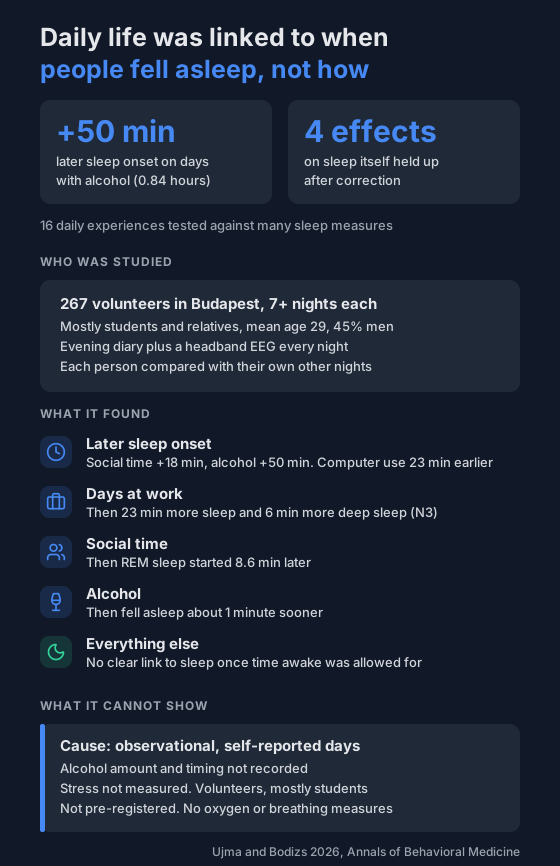
A 2026 study followed 267 volunteers for a week or more with a headband EEG. Social time, alcohol and eventful days were mostly linked to later sleep onset. Only 4 links to sleep itself held up.
Most sleep advice says your day shapes your night. Be more social, get outside, cut back on devices, and sleep follows.
A 2026 study in Budapest tested that with a headband EEG worn every night for a week or more. Ordinary days were mostly linked to when people fell asleep. They had very little link to how people slept once asleep.
Who was studied?
- 267 volunteers took part, recruited mostly from students at Semmelweis University and their relatives.
- Sleep-stage data were available for 258 of them.
- The abstract counts 1,901 nights in total, while the paper's Table 1 lists about 1,718 nights with sleep-stage data.
- Mean age was 29 (median 22), and 45% were men.
- They lived as usual for at least 7 days, with no instructions about sleep or waking.
- Each evening they logged 10 yes/no experiences, such as time with other people, time at work, alcohol, a conflict, or sex.
- They also logged time outside and time on devices, and rated the day on 10-point scales: physically exhausting, mentally exhausting, interesting, happy.
- That made 16 daily experiences in all.
- A Dreem2 EEG headband recorded each night, and a morning questionnaire rated sleep quality.
About a quarter scored above the usual cutoff on an insomnia questionnaire.
What changed when people fell asleep?
The same person was compared with their own other nights, and weekday against weekend was accounted for. Sleep onset was later after:
- Time with other people: about 18 minutes (0.30 hours).
- Alcohol: about 50 minutes (0.84 hours in the results; the abstract gives a range up to 0.89 hours).
- Each extra point on the "interesting day" scale: about 7 minutes.
- Each extra point on the "happy day" scale: about 5 minutes.
- Each extra point on the "physically exhausting day" scale: about 3 minutes.
It was earlier after desktop computer use, by about 23 minutes (0.38 hours). Sleep onset was also later after sex, but that didn't hold up after correcting for the number of tests.
The authors suggest pleasant evening activities push bedtime back. The effect varied from person to person. It was bigger for later chronotypes after a happy day, and bigger for people who napped more after alcohol.
What about sleep itself?
The authors also allowed for how long each person had been awake, because a longer day alone makes the next sleep deeper. Without that step, eventful days seemed to bring faster, deeper sleep. With it, those effects disappeared.
Only 4 effects on sleep survived the correction for running many tests:
- After a day at work, people slept 23 minutes longer and had 6 more minutes of deep sleep (N3).
- After time with other people, REM sleep started 8.6 minutes later.
- After alcohol, people fell asleep about 1 minute sooner (the abstract's figure).
Work counts twice, since it went with both longer total sleep and more deep sleep. Most alcohol was drunk socially and in modest amounts, according to the diaries, and it didn't change how broken the sleep was.
A conflict was followed by a later start of REM sleep too, but that didn't hold up after correction.
What showed no clear link?
- School, computer use and mentally exhausting days showed no clear effect on sleep structure.
- Sex showed no effect on how fast people fell asleep, despite the popular belief.
- Time outside and device time showed no effect that survived correction.
- Comparing people with each other, only 2 links appeared, and neither survived correction.
What can't it show?
- Cause. It's observational, and the days were self-reported. The authors say the design is consistent with cause and effect only with limits.
- Dose and timing. Alcohol amount and the time of day weren't recorded, only yes or no.
- Stress. It wasn't recorded, the authors note. The closest items were conflicts and how mentally exhausting the day was.
- Big changes. The study covers everyday swings. It doesn't rule out that larger changes would matter.
- Who. Volunteers were recruited mostly from one Budapest university's students and their relatives.
- Method. It wasn't pre-registered, and the paper reports a looser threshold (P below .01) alongside the corrected one.
- Funding. Public Hungarian research grants and a university alliance paid for it. The authors declare no conflicts of interest.
What can you do with this?
If you track your sleep, the clearest pattern to expect is a shifted bedtime after a big day, not a different kind of sleep. Look at when you fell asleep before judging the night.
A fingertip oximeter doesn't record sleep stages. It does record overnight oxygen and pulse, which you can compare across ordinary and unusual days in the session viewer.
For related reading, see alcohol and overnight oxygen and irregular sleep timing.
Not a medical device. Does not diagnose, treat or prevent any condition. Discuss results and changes with a clinician.
References
- Ujma PP, Bódizs R. Daily experiences affect the timing rather than the structure of sleep. Annals of Behavioral Medicine. 2026;60(1):kaag003. doi:10.1093/abm/kaag003