Forest vs City Walks and Sleep Scores
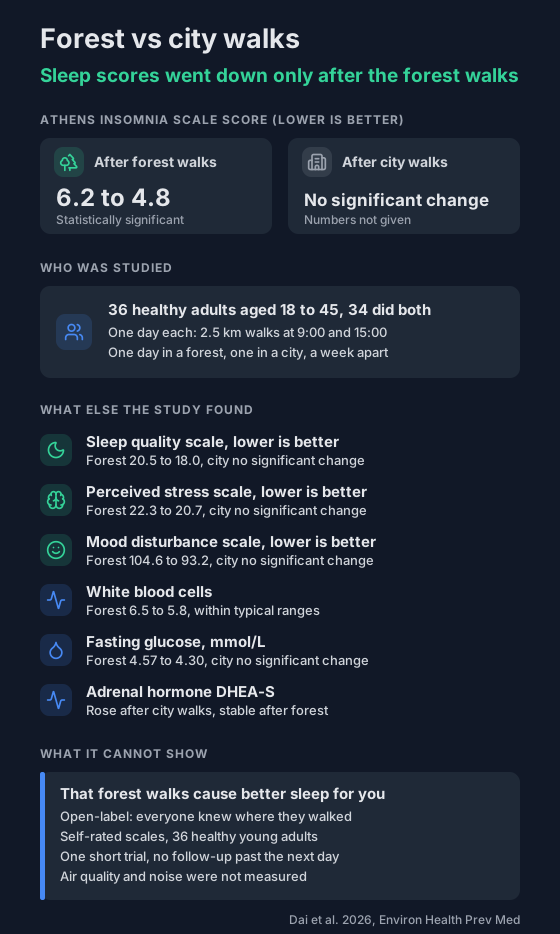
A 2026 crossover trial had 36 healthy young adults spend one day walking 2.5 km twice in a forest and another day doing the same in a city. The Athens Insomnia Scale score went from 6.2 to 4.8 after the forest day, with no significant change after the city day.
"Forest bathing" means spending unhurried time in a forest, often walking. It's often said to help sleep. A 2026 trial from China sent 36 young adults on matched walks in a forest and in a city, one day each, and compared their questionnaire scores before and after.
Sleep and insomnia scores went down, meaning better, after the forest day. They didn't change significantly after the city day. It was a short, open-label trial, so here's what it can and can't tell you.
Who was studied?
- 36 healthy adults aged 18 to 45, recruited in Shaoguan, China.
- Never-smokers with a BMI of 19 to 26, and no active or chronic medical conditions.
- The paper gives no average age or sex split in the text. Those are in a supplementary table.
- Two people dropped out, both from the group that did the city walk first. One left before the trial started, and one after the first walk day to care for a sick relative. The paper says data for everyone remaining were complete, but doesn't give the number in each analysis.
What did they do?
It was a randomised 2 x 2 crossover trial. Each person did both conditions, in random order, one walking day each with a one-week gap between.
- The walks: 2.5 km at 9:00 and again at 15:00, so 5 km in the day, at the same pace in both places.
- Forest: recreational trails at the Tianjingshan Forest Farm, with 96.7% forest cover.
- City: Walking Street Road in the Zhenjiang district of Shaoguan.
- Measures: four questionnaires and fasting blood tests, taken the day before and the morning after each walking day.
- Primary outcome: the total scores on the psychological scales, registered in advance.
What happened to sleep?
Lower scores are better on both sleep scales.
| Before forest | After forest | City walks | |
|---|---|---|---|
| Athens Insomnia Scale (0 to 24) | 6.2 | 4.8 | No significant change |
| Self-Rating Scale of Sleep (10 to 50) | 20.5 | 18.0 | No significant change |
- The insomnia scale change was reported as p < 0.01 and the sleep scale change as p < 0.001.
- The paper reports the city scores as "no significant change" and doesn't give the numbers in the text.
- These are before-and-after changes within each condition. The paper doesn't report a direct forest-versus-city test for either sleep scale.
What about stress and mood?
- Perceived stress scale: 22.3 to 20.7 after forest (p < 0.05), no significant change after city.
- Mood disturbance scale: 104.6 to 93.2 after forest (p < 0.0001), largely unchanged after city.
What did the blood tests show?
The authors say most of these changes were small and stayed within typical ranges, and that their clinical relevance is uncertain.
- White blood cells: 6.5 to 5.8 x 10^9/L after forest (p < 0.0001), no change after city. Monocytes, lymphocytes and neutrophils also fell after forest.
- Fasting glucose: 4.57 to 4.30 mmol/L after forest (p < 0.0001), no change after city.
- Triglycerides: lower after forest than after city, after a log transformation.
- HDL cholesterol: it went down after forest, from 1.30 to 1.25 mmol/L. The authors call that inconsistent with what's usually expected of a good change.
- DHEA-S, an adrenal hormone: it rose after the city walks, from 9.44 to 10.11 (p < 0.01), and stayed stable after forest. The paper prints the unit as mmol/L, which looks like an error, so it's left out here.
- Other results: the paper also lists small shifts in red cell indices and basophils after forest. It found no significant changes in total cholesterol or LDL cholesterol.
Why might forest and city differ?
The authors suggest a mix of natural sights and sounds, plant-released compounds and less traffic noise, acting on stress pathways. They didn't measure any of those, nor cortisol, heart rate variability or inflammation markers, so this is a hypothesis. They also note that heavier breathing during walking could mean more exposure to traffic pollution in the city.
What can't it show?
- Open-label: participants knew which place they were in, and the scales are self-rated. Expecting the forest to help could shift the answers.
- Small and healthy: 36 healthy young adults. It says little about people who sleep badly, or about other ages.
- Short: the questionnaires were taken the morning after one day of walking. Whether the changes last is unknown.
- Place, not just trees: the forest and the city also differed in air, noise and scenery, and none of those was measured.
- Washout: the authors checked that baselines were similar across the two weeks, but the paper notes a few measures did differ.
- Many tests: dozens of measures were compared, so some of the smaller blood results could be chance.
- Funding: a Shaoguan science and technology program. The authors reported no conflicts of interest, though four of them work at the forest farm where the forest walks took place.
- The authors conclude forest walking is a complement to established care, not a substitute for it.
For a similar design with oxygen readings, see forest bathing and SpO2.
What can you do with it?
If you track sleep, this is a prompt for a self-experiment, not a result to expect.
- Pick two similar walks a week apart, one green and one in town, at the same times and pace.
- Note your sleep and how rested you feel afterwards, along with your overnight SpO2 and heart rate if you wear an oximeter.
- Compare your own weeks with each other, and keep in mind you'll know which was which.
- Discuss any change to your routine, and any persistent sleep trouble, with a clinician.
Not a medical device. Does not diagnose, treat or prevent any condition. Discuss results and changes with a clinician.
References
- Dai X, Liao D, Ouyang J, Xiao H, Tian Z, Qiu L, Yang J, Wang H, Gong D, Li Z, Wang X, Xu Y, Fang X, Tan J, et al. Short-term effects of urban versus forest bathing on stress, mood, sleep, immune function, and metabolic health: a randomized, open-label, 2 x 2 crossover trial. Environmental Health and Preventive Medicine. 2026;31:55. doi:10.1265/ehpm.26-00092