Forest Bathing and SpO2: A Small Trial
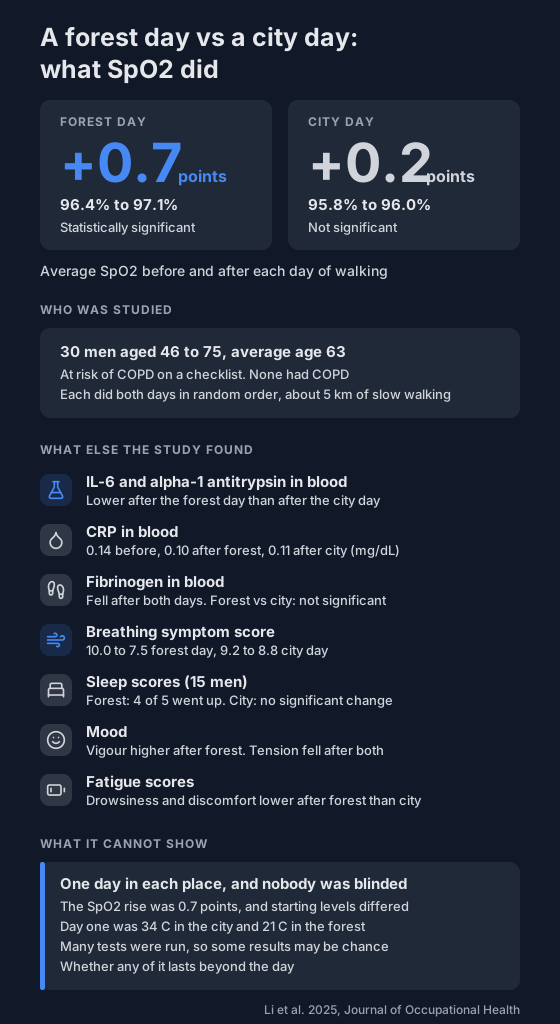
A randomised crossover trial sent 30 men on a forest day trip and a city day trip. Average SpO2 went from 96.4% to 97.1% after the forest day and from 95.8% to 96.0% after the city day.
"Forest bathing" is the Japanese practice of walking slowly in a forest and taking it in. It's often said to be good for your breathing.
A 2025 trial from Japan compared a day of forest walking with a day of city walking in the same 30 men. Average SpO2 rose 0.7 points after the forest day and 0.2 points after the city day. That's a small difference from a small study, so here's what it does and doesn't show.
Who was in the study?
- 30 men aged 46 to 75, average age 63.
- All scored 4 or more on a COPD risk checklist. None of them had COPD.
- They all stayed in the same hotel, ate the same meals and drank no alcohol during the trip.
What did they do?
It was a randomised crossover trial, so every man did both walks.
- The men were split into two groups of 15.
- One group walked in the city on the first day and the forest on the second. The other group did the reverse.
- The forest was Akasawa Natural Recreation Forest in Nagano Prefecture, mostly cypress. The city route was in Ina City, with almost no trees.
- Each day had two slow guided walks of about 90 minutes, around 5 km in total, with two breaks and no talking.
- On the forest walk the guide had them stop now and then to take in the surroundings and breathe deeply. The paper describes this only for the forest walk.
SpO2 and the symptom checklists were taken before and after each day's walking. Blood was drawn at 4 pm the day before the walks and at 4 pm after each one.
What happened to SpO2?
| Before | After | Change | |
|---|---|---|---|
| Forest day | 96.4% | 97.1% | +0.7 points |
| City day | 95.8% | 96.0% | +0.2 points |
- The forest-day rise was statistically significant. The city-day rise wasn't.
- SpO2 after the forest day was also significantly higher than after the city day.
- The paper doesn't comment on it, but in its table the men started the forest day 0.6 points higher than they started the city day, before any walking. That gap is almost as big as the forest-day rise.
Most fingertip oximeters show whole numbers, so 0.7 points is less than one step on the display. You'd only see it as an average across many people or many readings. For how much a single reading can be off, read how accurate pulse oximeters are.
We also couldn't find some basics in the paper. It doesn't say which oximeter was used, how long each reading took or whether the men were resting. It doesn't give the altitude of either site.
What about the blood tests?
The study measured seven things in blood, most of them markers of inflammation.
- IL-6: 2.37 pg/mL after the forest day and 2.91 after the city day. That difference was significant.
- Alpha-1 antitrypsin: 131.0 mg/dL after the forest day and 143.5 after the city day. Also significant.
- CRP: 0.14 mg/dL before, 0.10 after the forest day and 0.11 after the city day. Only the forest-day figure was significantly lower than before. The paper marks no significant difference between the two days.
- Fibrinogen: fell after both days, from 288 mg/dL to 271. No statistically significant difference between forest and city. The authors put this down to the walking.
- TNF-alpha and white blood cells: no significant change.
- Lactate: no significant difference between the two days, which the authors take to mean the men did about the same amount of exercise.
Average IL-6 started at 3.11 pg/mL, above the reference value of 2.60 the paper gives. The other averages with a stated range started inside it.
And how did the men feel?
All of these came from checklists the men filled in themselves.
- Breathing symptoms: the score went from 10.0 to 7.5 on the forest day, which was significant, and from 9.2 to 8.8 on the city day, which wasn't. The paper marks no significant difference between the two days.
- Sleep: four of five sleep scores went up after the forest day. None changed significantly after the city day. Only 15 men are in the sleep figures.
- Mood: anger, confusion and tension scores fell after both days. Low mood fell after the forest day only. Vigour was higher after the forest day than after the city day.
- Fatigue: all three fatigue scores fell after the forest day. Drowsiness and physical discomfort were lower than after the city day.
What doesn't it tell you?
- That a forest raises your SpO2. One group average moved 0.7 points on one day.
- What caused the differences. Nobody was blinded, the men knew which walk was the forest, and the paper mentions deep breathing only for the forest walk.
- Whether it was the weather. On the first day it was 34.2°C in the city and 21.1°C in the forest. The second day was rainy in both. The authors list weather as a limitation.
- Whether the results are chance. The authors ran many separate tests without correcting for it, and say false positives can't be ruled out.
- Whether it lasts. Each place got one day, on back-to-back days, with no follow-up.
- Anything about COPD or women. The men didn't have COPD, and no women took part.
The study was funded by the Vehicle Racing Commemorative Foundation of Japan. The authors declare no conflicts of interest. One author is listed at the International Society of Nature and Forest Medicine.
What can you do with this?
If you like walking in the woods, this study is no reason to stop. It isn't evidence that a forest trip will change your oxygen readings.
If you want to see what your own readings do, compare like with like:
- Sit still for a few minutes before each reading.
- Take several readings over several days, not one before and one after.
- Expect a point or two of movement between readings anyway.
What SpO2 is and how it's measured covers the basics.
If you get breathless, cough most days or have a low reading that worries you, see a doctor.
Not a medical device. Does not diagnose, treat or prevent any condition. Discuss results and changes with a clinician.
References
- Li Q, Takayama N, Kimura Y, Takayama H, Kumeda S, Miura T, Kitagawa T, Aoyagi Y, Imai M. Forest bathing improves inflammatory markers, SpO2, and subjective symptoms related to chronic obstructive pulmonary disease (COPD) in male subjects at risk of developing COPD. Journal of Occupational Health. 2025;67(1):uiaf041. doi:10.1093/joccuh/uiaf041