Daytime Light Lamp Trial in Older Adults
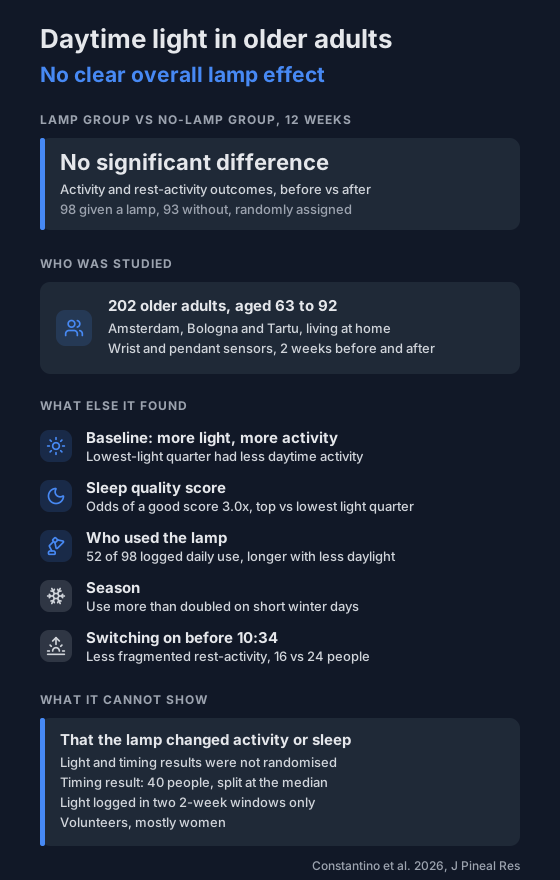
A 2026 trial gave 98 of 202 older adults a bright lamp for 12 weeks. The lamp and no-lamp groups did not differ significantly overall, but lamp users who switched it on earlier had less fragmented activity.
Bright light in the morning is often suggested for older adults, who tend to get little daylight indoors. Most of the evidence comes from lab studies or care homes. The ENLIGHTENme study asked what happens when people set up a lamp at home and use it as they like.
The randomised comparison found no significant overall difference between people given a lamp and people who weren't. The more interesting results came from how the light was used.
Who was studied?
- 202 older adults aged 63 to 92 (mean 74.7), living independently in Amsterdam, Bologna and Tartu.
- Most were women: 146 of 202 in the methods, though the paper also prints 74% and 68% in other places.
- No one reported a neurodegenerative disorder.
- Recruited from districts with lots of night-time electric light and below-average socio-economic status.
- 11 withdrew before being assigned. The rest were randomly assigned: 98 to a lamp, 93 to no lamp.
What did the lamp group do?
- They got a HALO lamp rated at 10,000 lux at 20 cm, and put it at head height in the room they used most.
- Instructions: switch it on within an hour of waking but not before sunrise, keep it on bright all day, switch it off at least 4 hours before usual bedtime, and use it at least 2 hours in total.
- Use wasn't supervised, and no distance from the lamp was set.
- Everyone wore a wrist activity watch and a pendant light sensor for 2 weeks before the 12 weeks, and again for 2 weeks after.
- Everyone also kept diaries and answered a sleep quality questionnaire.
Did the lamp change anything overall?
- No. The paper reports no significant overall differences between baseline and follow-up in either group, or between the groups, when lamp timing isn't taken into account.
- The detailed numbers are in a supplementary table (Table S3) that isn't in the main text.
- In the no-lamp group most activity measures stayed stable over the 16 weeks. Time in very bright light and the stability of light exposure went up at follow-up, which the authors link to the time of year.
- The authors suggest uncontrolled, variable use may have hidden an effect. The study can't tell whether it did.
Who used the lamp, and when?
Only the 52 of 98 people who logged daily use during follow-up were analysed for this.
- People who spent less time in outdoor-level light used the lamp for longer (p = 0.02, in groups of 7, 17 and 11 people).
- Age (p = 0.1) and mobility problems made no significant difference to use.
- Chronotype, meaning morning or evening type, didn't significantly change when people switched it on (p = 0.30).
- Season did. Use was longer in winter and more than doubled between the shortest and longest days.
- As days got longer, people switched on later and off earlier, by about 1.5 hours each across a 6 to 18 hour range of daylength.
Did switching on earlier matter?
This comparison is inside the lamp group only, so people chose their own timing. It isn't a randomised result.
- The median switch-on time was 10:34 and the median switch-off time was 17:45.
- 16 people who switched on before 10:34 had less fragmented rest-activity (lower intradaily variability, p = 0.05) and higher daytime activity (p = 0.04) than the 24 who switched on later.
- After allowing for chronotype, age, sex and season, the fragmentation result held (p = 0.03). The activity result no longer did, so chronotype largely explained it.
- 20 people who switched off before 17:45 also had less fragmented rest-activity than 19 who switched off later (p = 0.05), but that also didn't hold after allowing for chronotype.
- The abstract says "before 10:00". The paper's results split at the 10:34 median, so that is the figure used here.
What about daylight, activity and sleep without a lamp?
These come from the baseline fortnight of all 202 people, before any lamp. People were grouped by total light exposure: lowest quarter (42), middle half (118) and highest quarter (42).
- The lowest-light group had less daytime activity than the highest (p = 0.02) and less consolidated wakefulness (p = 0.04).
- Median sleep quality scores were 7.0 in the lowest, 5.0 in the middle and 4.0 in the highest group (lower is better).
- The highest group had 3.0 times the odds of a good score compared with the lowest group (95% CI 1.16 to 8.11, p = 0.03). The middle group didn't differ significantly.
- Light timing wasn't significantly linked to the sleep quality score.
- People who reported a condition such as high blood pressure, diabetes, obesity or a cardiovascular condition had less light exposure than those who reported none (p = 0.05). More light was still linked to having none of these after allowing for age, sex, chronotype, daylength and city (p = 0.01).
- This was a one-off snapshot of reported conditions, not new cases over time, although the abstract calls it lower incidence.
- Light levels differed by city. Bologna had more daytime light and Tartu earlier light, and Tartu had the least regular sleep.
What can't it show?
- The randomised lamp comparison found no significant overall difference, so the study can't show that the lamp changed activity or sleep.
- The baseline results are associations, and the metabolic data were self-reported. Active people may simply spend more time in bright places.
- Switch-on timing wasn't assigned, and the groups were small (16 vs 24).
- Light was recorded in only two 14-day windows, not across the 12 weeks.
- Melatonin timing was measured before and after, but the paper doesn't report a follow-up result.
- Volunteers may have been more active and educated than older adults generally, and most were women. No menopause data were collected.
- Site sizes were unbalanced: 14 in Amsterdam, 66 in Bologna, 122 in Tartu.
- The authors state that the lamp schedule wasn't tailored to chronotype.
- It was funded by the EU Horizon 2020 programme. One author is a co-inventor on patents and another directs the company that analysed the melatonin samples.
- The authors conclude that light is a beneficial, low-cost option. That goes further than the overall randomised result.
For more on light and sleep, see daylight, evening light and sleep and hospital lighting and snoring. For activity-watch accuracy in the same age group, see EEG headband vs actigraphy in older adults.
What can you do with it?
- If you track sleep, note how much daylight you get and when your day starts, then compare your own weeks with each other.
- Light exposure and lamp use shifted with season in this study, so compare like with like.
- A lamp is not a therapy for any condition, and this study doesn't show it changes sleep. Talk to a clinician before changing your routine because of it.
Not a medical device. Does not diagnose, treat or prevent any condition. Discuss results and changes with a clinician.
References
- Constantino DB, Baccari F, Caporali L, Carelli V, Amore G, Gordijn M, Haller T, La Morgia C, Landvreugd A, Marinelli M, McDaid D, Nõmm M, Nonino F, Romagnoli M, et al. ENLIGHTENme: Translating the Benefits of Self-Administered Daytime Light Supplementation to Older Adults in the Real World. Journal of Pineal Research. 2026;78(5):e70174. doi:10.1111/jpi.70174