Daylight, Evening Light and Sleep: A Study
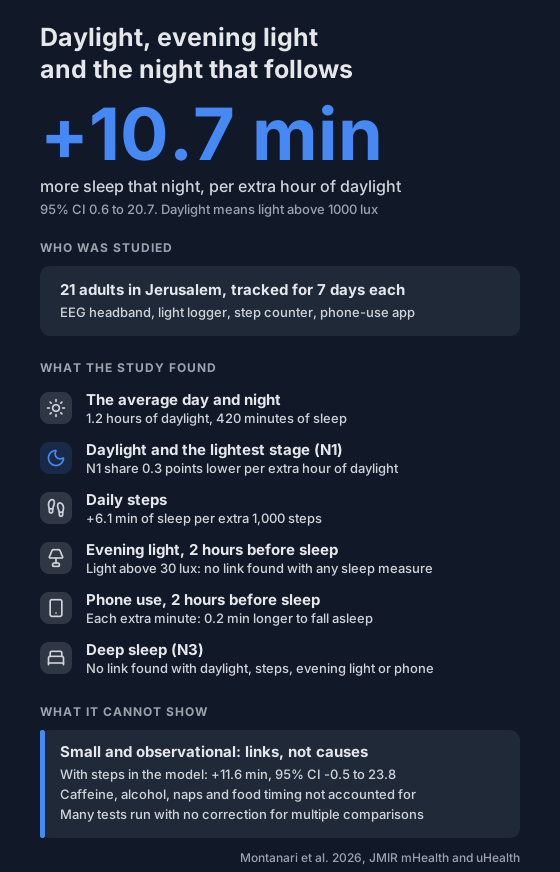
A 2026 study tracked 21 adults for a week with an EEG headband and a light logger. Each extra hour of daylight went with about 10.7 more minutes of sleep that night.
The usual advice is to get daylight during the day and keep the lights and your phone down before bed. Most of the evidence for that comes from sleep labs, questionnaires or movement trackers that can't tell sleep stages apart.
A study published in June 2026 measured it at home instead, with sensors. More daylight went with a longer night's sleep. Evening room light showed no link with any of the four sleep measures.
Who was in the study?
- 21 adults in the Jerusalem area, each tracked for 7 days between May 2023 and July 2024.
- 14 were women. 10 were aged 25 to 29 and 11 were aged 30 to 65.
- Nobody did shift work, and nobody had a known sleep or mental health condition.
What did they wear?
- An EEG headband (Dreem 3) at night, which records sleep stages from brain activity.
- A light logger pinned to the collar.
- A step counter on a hip belt.
- An app that logged time on the phone.
"Daylight" meant time spent in light above 1000 lux. "Evening light" meant minutes in light above 30 lux in the 2 hours before falling asleep.
What did a typical day look like?
- Sleep: 420 minutes on average, about 7 hours.
- Time to fall asleep: 17.6 minutes.
- Daylight: 1.2 hours a day, ranging from 0 to 8.3 hours.
- Evening light above 30 lux: 20.9 minutes of the last 2 hours.
- Phone use in the last 2 hours: 20.3 minutes.
Did daylight go with better sleep?
With longer sleep, yes.
- Each extra hour of daylight went with 10.7 more minutes of sleep that night (95% CI 0.6 to 20.7).
- The share of sleep time in N1, the lightest sleep stage, was 0.3 percentage points lower per extra hour (95% CI -0.55 to -0.03). The average was 6.6%.
- Deep sleep (N3) showed no link with daylight.
That model didn't include steps, and people who are outside more also tend to walk more. The authors ran a second model with daily steps added. It had fewer nights to work with: 76 instead of 116, and 2 people dropped out of it entirely.
- The daylight estimate was about the same, 11.6 minutes per hour, but its range now included zero (95% CI -0.5 to 23.8).
- Each extra 1,000 steps went with 6.1 more minutes of sleep (95% CI 1.0 to 11.1).
- The authors say the link between daylight and less N1 was still there.
- Steps showed no link with N1 or deep sleep.
What about lights and phones before bed?
This model covered 75 nights from 18 people.
- Evening light showed no link with sleep length, time to fall asleep, N1 or deep sleep.
- Each extra minute on the phone went with 0.2 minutes longer to fall asleep (95% CI 0.0 to 0.4). The lower end of that range sits at zero.
- Phone use showed no link with sleep length, N1 or deep sleep.
The phone result held with evening light in the same model. So the authors think it's about being mentally switched on, not the light the phone gives off.
They give four possible reasons for the evening light result:
- The light was too dim or too brief to matter.
- People differ in how sensitive they are to light.
- These participants may have had good sleep habits overall.
- Some may not have worn the light logger properly in the evening.
What can't it show?
- It's observational. It shows what went together, not what caused what.
- 21 people for one week each is small, and the results may not apply to other groups. The authors call it a proof of concept.
- They ran many comparisons with no correction for multiple testing, and the ranges for the main results only just clear zero.
- Caffeine, alcohol, naps, medication and meal timing weren't accounted for, because too much of that data was missing.
- The logger measured brightness only, not the colour of the light.
- Daylight was a daily total. The study couldn't say whether morning light matters more.
- The paper's conclusion still recommends more daylight, more activity and less evening phone use. That goes further than a study this size can support on its own.
What can you do with it?
Use it as something to check for yourself, not a rule.
- Note roughly how long you were outside each day, and your phone time in the last 2 hours before bed.
- Line those up against your own nights over a few weeks. One week gave this study wide ranges, so more nights help.
- Use Compare Nights to put two sets of nights side by side.
A ring oximeter doesn't record sleep stages, so what you'd see is your overnight oxygen and heart rate, not N1 or deep sleep.
For other bedroom factors, see bedroom temperature and air and short sleep, heart rate and oxygen.
Not a medical device. Does not diagnose, treat or prevent any condition. Discuss results and changes with a clinician.
References
- Montanari A, Wang LM, Birenboim A, Chaix B. The Impact of Sunlight and Artificial Light at Night on Sleep Stages: Evidence From a 7-Day Sensor-Based Observational Study. JMIR mHealth and uHealth. 2026;14:e75898. doi:10.2196/75898