Hospital Lighting and Snoring After a Stroke
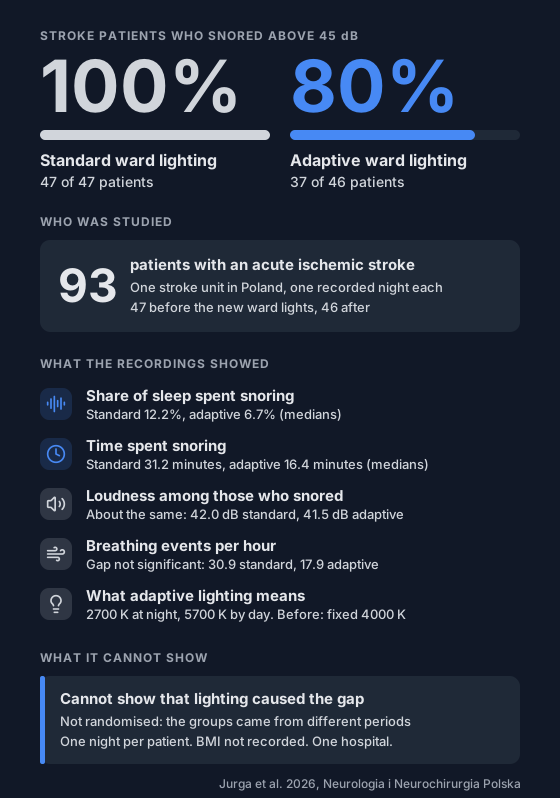
A 2026 study of 93 stroke patients found that all 47 under standard ward lighting snored above 45 dB, against 37 of 46 under lighting that changed through the day. It can't show the lighting was the cause.
Most hospital wards are lit the same way day and night. A study published in September 2026 compared 93 stroke patients in Poland, before and after one ward changed that.
All 47 patients under the old lighting snored above 45 dB. Under the new lighting, 37 of 46 did.
Who was in the study?
- 93 adults on one hospital stroke unit with an acute ischemic stroke, the kind caused by a blocked blood vessel.
- 47 were admitted under the old lighting and 46 under the new. Nobody was recorded under both.
- Average age was 69 and 67, and just over half were men.
- 9 more were enrolled but had no valid recording.
- People using CPAP or taking sleep medication were excluded.
What changed about the lighting?
- Before: fluorescent tubes at a fixed colour temperature of 4000 K, about 300 lux.
- After: LED lights set to 2700 K from 9pm to 6am and 5700 K from 9am to 7pm.
What did the recordings show?
Each patient wore a WatchPAT 300 sleep recorder, with a chest sensor for snoring, for one night.
- Snored above 45 dB: 100% under the old lighting, 80% under the new.
- Share of sleep spent snoring: median 12.2% against 6.7%.
- Time spent snoring: median 31.2 minutes against 16.4.
- Loudness among those who snored: 42.0 dB against 41.5 dB, no significant difference.
Breathing events per hour (median 30.9 against 17.9) and ODI (14.4 against 8.4) didn't differ significantly. Neither did oxygen levels, sleep time, awakenings or sleep stages.
Snoring and breathing events were only partly linked (correlation 0.43). The authors say not to read it as less sleep-disordered breathing.
What doesn't it tell you?
- Cause. Patients weren't randomised. The groups were admitted in different periods, so case mix, staffing or season could explain the gap.
- Night to night. One recorded night each.
- Body weight. BMI wasn't recorded.
- Timing. Nurses switched the lights by hand, so the schedule may have varied.
- Breathing events. The recorder estimates them indirectly and agrees only partly with a lab sleep study.
The study had no external funding. The authors say it shouldn't change practice yet, and call for a randomised trial.
What can you do with this?
This was a hospital ward, so it doesn't say what your lights at home will do.
If you snore loudly, or someone has heard you stop breathing in your sleep, see a doctor. Snoring isn't the same as apnea, so read snoring vs sleep apnea.
An overnight oximeter doesn't record snoring. It records your oxygen and pulse, and you can share that with your doctor.
Not a medical device. Does not diagnose, treat or prevent any condition. Discuss results and changes with a clinician.
References
- Jurga SJ, Brzezicki MA, Bojarski J, Smoleński R, Wojtasz I, Czop F, Słonina G, Stryjewska ES, Zakowicz PT, Towpik I, Kaźmierski R. Snoring prevalence in hospitalized ischemic stroke patients under adaptive versus standard ward lighting: a sequential two-cohort observational study. Neurologia i Neurochirurgia Polska. 2026. Online ahead of print. doi:10.5603/pjnns.113469