Smartphone Use and Sleep: A 10-Day Study
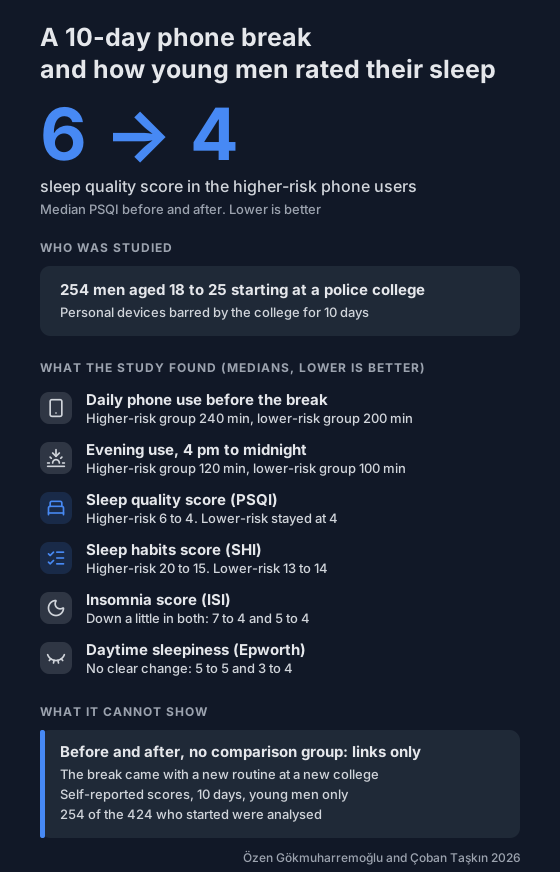
254 young men had their phones taken away for 10 days at a police college. Sleep habit and sleep quality scores shifted most in the higher-risk users, while daytime sleepiness didn't change significantly.
Putting your phone away in the evening is standard sleep advice. Much of the research compares heavy and light users at one point in time, which doesn't show what happens when the phone goes.
A study published in April 2026 caught a natural experiment. A police college in Turkey bars personal devices for 10 days while new students enrol. The researchers measured sleep before and after.
Sleep habits and rated sleep quality shifted, mostly in the higher-risk group. Daytime sleepiness didn't.
Who was in it?
- 254 male students aged 18 to 25 at one police college. The college only takes men.
- People with long-term illness, mental health conditions or a known sleep disorder were left out.
- 424 filled in the first round of forms, but only 254 were analysed. The text doesn't explain the gap.
Everyone did a 10-item phone-use checklist (the SAS-SV) at the start.
- 59 scored 31 or more, which the authors call higher risk of problem phone use.
- 195 scored lower.
The checklist flags a pattern of use, not a condition.
How did the two groups use their phones?
Before the break, by their own estimates (medians):
- Daily use: 240 minutes in the higher-risk group, 200 in the lower-risk group.
- Evening use, 4 pm to midnight: 120 against 100 minutes.
- After midnight: about the same in both, 15 and 20 minutes.
Both differences were statistically significant but small. The authors tried cut-offs of 190 minutes a day and 100 minutes in the evening to sort the groups. Neither did it well.
Browsing, social media and gaming each went with higher risk on their own. None held up once they were analysed together.
What happened after 10 days without phones?
Phones, tablets and computers were all off limits, so this was a full break, not just an evening one. Everyone lived on the same timetable, with set meals, training and sleep times, in similar dormitories.
Each score below is a median, and lower is better on all four.
- Sleep quality (PSQI): 6 to 4 in the higher-risk group, while the lower-risk group stayed at 4. The paper reports the drop over time as statistically significant.
- Sleep habits (SHI): 20 to 15 in the higher-risk group, and 13 to 14 in the lower-risk group. The higher-risk group ended up close to the others, and that difference in change between the groups was statistically significant.
- Insomnia score (ISI): 7 to 4 and 5 to 4. That drop over time was statistically significant but small, with no statistically significant difference between the groups.
- Daytime sleepiness (Epworth): 5 to 5 and 3 to 4. No statistically significant change.
The authors' reading: habits and how you rate your sleep may respond within days. Sleepiness, and maybe insomnia, may need longer to move.
What can't it show?
- Cause. There was no comparison group that kept their phones. The break came at the start of college, with a new routine and set bedtimes, so any of those could explain the change.
- Accuracy. Every score and every phone-use figure was self-reported, and so was keeping off the phone. Nobody's phone or sleep was measured by a device.
- Who it applies to. Young men at one college. The authors say it may not apply to women or mixed groups.
- Length. 10 days is short, and there was no follow-up after the phones came back.
- Size of the effects. The statistical effect sizes were small throughout, and only a little larger for sleep quality.
- Internal consistency. For sleep quality, the paper's text says both groups changed by a similar amount, but its own table shows only the higher-risk group's score moving. The table also prints the same test result three times for sleep quality.
What can you do with it?
If you use your phone a lot in the evening, you can try this on yourself.
- Pick a cut-off time for your phone and keep to it for a week or two.
- Note how you rate each night and how sleepy you feel the next day, before and during.
- Record your nights with your oximeter too, so you have the same measure across both stretches. More nights help when you compare.
A finger or ring oximeter records your overnight oxygen and pulse. It doesn't score sleep quality or sleep habits, so keep a short note of those alongside.
For a sensor study on evening light and phone use, see daylight, evening light and sleep.
Not a medical device. Does not diagnose, treat or prevent any condition. Discuss results and changes with a clinician.
References
- Özen Gökmuharremoğlu Ö, Çoban Taşkın A. Sleep-Related Problems and Problematic Smartphone Use in Young Adult Males: Findings from a Short-Term Behavioral Restriction Study. Neuropsychiatric Disease and Treatment. 2026;22:597802. doi:10.2147/NDT.S597802