Evening Heart Rate, HRV and Melatonin
A 2026 exploratory study of 10 healthy adults found heart rate, HRV and blood pressure switched into night mode around melatonin onset on average, with no significant gap, but with a wide spread between people.
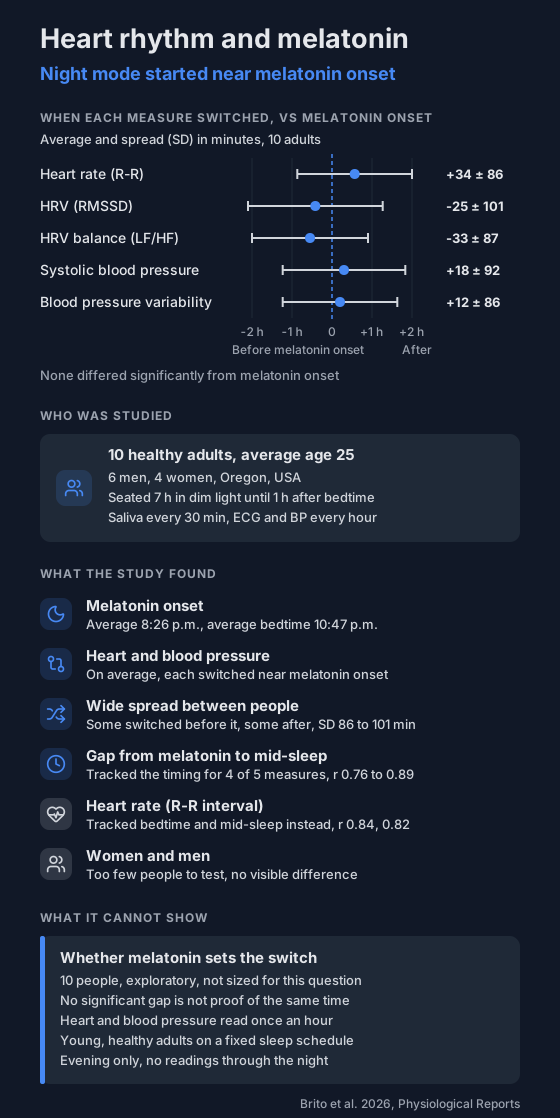
In the evening your heart and blood pressure shift into a resting night mode, and earlier studies show parts of it start before your body clock's night begins. In young adults, melatonin starts to rise about 2 hours before usual bedtime on average. So does melatonin flip the switch?
A small 2026 study timed both in the same people. On average the heart and blood pressure switched around the time melatonin rose, but the spread between people was wide, and 10 people can't settle the question.
Who was studied?
- 10 healthy adults, 6 men and 4 women, average age 25.
- No long-term health conditions, no prescribed medicines, no night shifts or smoking in the past year.
- For 7 days before the visit, each person kept a fixed 8-hour sleep schedule of their own choosing. Average bedtime was 10:47 p.m.
- In the lab they sat in a chair for 7 hours in dim light (under 8 lux), until 1 hour after their usual bedtime. No phones, watches, tablets or laptops.
What was measured?
- Melatonin: a saliva sample every 30 minutes. Melatonin onset was the time it passed 3 pg/mL.
- Heart and blood pressure: a 10-minute ECG and beat-to-beat blood pressure recording every hour, so 7 readings each.
- HRV: mainly RMSSD, a common HRV measure, plus the LF/HF ratio.
- The switch: for each person and each measure, the authors found the point where the trend line bent, and called it the onset time.
- The melatonin-to-sleep gap: the time from melatonin onset to the middle of that person's usual sleep. The authors use it as a marker of how well body clock and sleep schedule line up.
What did it find?
- Average melatonin onset was 8:26 p.m. Against the average bedtime of 10:47 p.m., that's about 2 hours 20 minutes before bed (our calculation from the two averages).
- None of the five measures switched at a time significantly different from melatonin onset.
On average, compared with melatonin onset:
- HRV (RMSSD) switched 25 minutes earlier.
- The HRV balance measure (LF/HF) switched 33 minutes earlier.
- Heart rate (R-R interval) switched 34 minutes later.
- Systolic blood pressure switched 18 minutes later.
- Blood pressure variability switched 12 minutes later.
But the spread was wide, with a standard deviation of 86 to 101 minutes. Some people switched well before melatonin onset and others well after.
So what went with the spread?
The melatonin-to-sleep gap.
- People with a longer gap tended to switch after melatonin onset.
- People with a shorter gap tended to switch before it.
- This held for 4 of the 5 measures, including RMSSD, with correlations of 0.76 to 0.89.
- Heart rate was the exception. Its timing relative to melatonin onset went with bedtime and sleep midpoint instead (0.84 and 0.82), and its link with the gap (0.59) wasn't statistically significant.
- The abstract says all five measures tracked the gap, but the paper's own correlation table shows heart rate didn't. The figures here follow the table.
There were too few people to compare women and men. The authors say the plots didn't suggest a difference.
What can't it show?
A lot, and the authors say so.
- It's an exploratory analysis of extra data from an earlier study, and it wasn't sized to answer this question.
- 10 people is very few. "No significant difference" here doesn't show the switch happens at the same time as melatonin onset.
- It's observational, so it can't show that melatonin, or the melatonin-to-sleep gap, causes anything.
- Heart and blood pressure were read once an hour, which limits how precisely the switch can be timed.
- Everyone was young, healthy and on a fixed schedule. The authors say the results shouldn't be applied to people of other ages or people with health conditions.
- Melatonin wasn't measured through the night, so it only covers the evening.
- The authors call the results hypothesis-generating.
An earlier study the authors cite gave melatonin in the evening, or suppressed it with bright light, and saw no change in how heart rate was controlled.
What can you do with it?
If you log evening heart rate or HRV, the reading can shift over the hours before bed.
- Take it at the same time and in the same position each evening, so you're comparing like with like.
- Compare your own evenings with each other, not with someone else's numbers.
- A regular sleep schedule was part of this study's setup. Its link with HRV is covered in irregular sleep timing and HRV.
- Evening light and bedroom temperature are other things people track: see daylight and evening light and bedroom temperature and HRV.
- For how close wearable HRV is to an ECG, see wearable HRV vs ECG.
Not a medical device. Does not diagnose, treat or prevent any condition. Discuss results and changes with a clinician.
References
- Brito LC, Jones M, Garcês CP, Shea SA, Thosar SS. Is cardiovascular autonomic control during the day-to-night transition dependent on dim light melatonin onset? An exploratory analysis in healthy adults. Physiological Reports. 2026;14(20):e71145. doi:10.14814/phy2.71145