Night Shifts, Glucose and Heart Rate
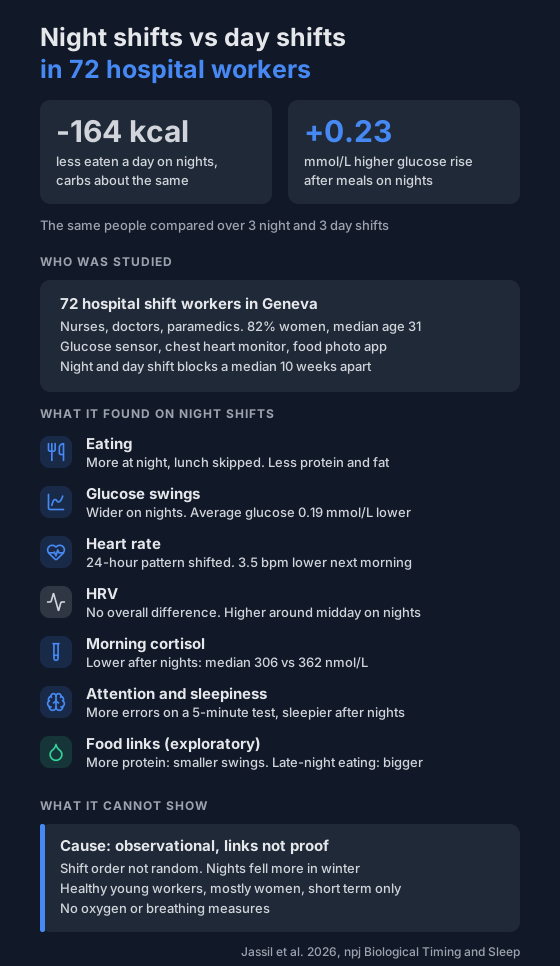
A 2026 study tracked 72 hospital workers over three night and three day shifts. On nights they ate 164 kcal a day less, but glucose rose more after meals, and their 24-hour heart rate pattern shifted.
Night shift work has been linked to obesity, type 2 diabetes and high blood pressure in large population studies. Lab studies that simulate night shifts back up the link, but a lab isn't a hospital ward at 3 a.m.
A 2026 study from Geneva put wearables on real hospital staff and compared the same people across night shifts and day shifts. On nights they ate less, but their glucose swung more and rose higher after meals.
Who was studied?
- 72 shift workers at Geneva University Hospitals: 36 nurses, 20 doctors, 13 paramedics and 3 others.
- 82% were women, median age 31, median BMI 22.7.
- They had worked shifts for a median of 5 years.
- Each person was tracked over 3 night shifts in a row and 3 day shifts in a row, a median of about 10 weeks apart.
- Night shifts ran from about 21:40 to 07:30, day shifts from about 07:00 to 16:30.
Pregnant women, people past menopause and people with a major illness or major mental illness were left out.
What did they wear?
- A glucose sensor reading every 15 minutes.
- A chest monitor for heart rate, heart rate variability (HRV) and movement.
- A food photo app that logged what they ate and when.
- Morning blood tests and blood pressure, and a 5-minute attention test after each block of shifts.
Not everyone had usable data from every device. The meal results cover 66 people, the glucose results 58, the meal and glucose model 55, and the heart monitor 43.
What changed in eating?
On night shifts, compared with day shifts, people:
- Ate more during the night and less at lunchtime, which was often skipped after a night of work.
- Ate 164 kcal a day less on average.
- Ate less protein (9.6 g a day less) and less fat (8.9 g a day less).
- Ate about the same amount of carbohydrate, so carbs made up a bigger share of what they ate.
- Ate a little less fibre, and both shift types were below the Swiss target of 30 g a day.
- Reported less appetite, fewer meals, more irregular mealtimes and less alcohol.
What happened to glucose?
- Average glucose was slightly lower on nights, by 0.19 mmol/L.
- Swings were wider. The coefficient of variation went up by 1.45 percentage points, and the average size of big glucose swings (MAGE) went up by 0.21 mmol/L.
- Rises after meals were bigger. A model that matched glucose to logged meals found the average meal raised glucose 0.23 mmol/L (about 4 mg/dL) more on nights.
- The daily glucose rhythm moved. Its peak came in the afternoon on day shifts and late evening on night shifts.
Blood tests for HbA1c, cholesterol and morning glucose showed no significant difference. Only one person had a fasting glucose in the prediabetes range.
Did what they ate make a difference?
The authors pooled both shift types to look at food and glucose together.
- A bigger share of carbs went with wider glucose swings.
- More protein went with smaller swings.
- Fat share showed no significant link.
- Eating later into the night, up to 05:00, went with wider swings.
The authors call these findings hypothesis-generating. They can't show that eating more protein or stopping earlier would change anyone's glucose. Night shifts and late eating went together so closely that the model couldn't fully separate them.
For more on meal timing, see late dinners and overnight oxygen.
What about heart rate and HRV?
- 24-hour heart rate broadly followed movement: higher at night and lower in the day on night shifts.
- Morning heart rate was 3.5 bpm lower after the last night shift than before the first day shift, measured with an arm cuff. At 08:00 the chest monitor showed lower heart rate on nights even when movement was similar.
- Overall HRV showed no significant difference between shift types.
- Midday HRV was higher on night-shift days.
The authors note that workers spent the day after a night shift sleeping, and that changes in sleep, activity and posture could explain the shifted heart rate and HRV patterns.
A review cited by the authors found lower HRV in shift workers. This study didn't see that. The authors say it's not yet clear whether the changes they saw are the body adapting or a sign of harm.
If you track HRV, see how accurate wearable HRV is.
What else changed?
- Morning cortisol was lower after the night shifts: median 306 against 362 nmol/L. The authors warn that the time between waking and the blood test may have differed, which could explain some of it.
- Thyroid-stimulating hormone was a little higher after nights in the paper's results table, median 1.92 against 1.50 mIU/L.
- Alkaline phosphatase, a liver and bone enzyme, was also slightly higher in that table, median 51.5 against 49.5 U/L.
- The text says no other blood results differed, so read these two with caution.
- Blood pressure was 1.9 mmHg higher after nights, but this didn't hold up after correcting for multiple tests.
- Weight didn't change.
- Attention: after nights, people made more errors on the attention test and rated themselves sleepier, by 2 points on a 7-point scale.
- Sleep: people reported worse sleep, too little sleep, feeling less rested and waking earlier than planned, and they napped more.
- Mood and well-being scores didn't differ.
For more on nurses and sleep, see nurses are sleeping less.
What can't it show?
- Cause. It's an observational study, so it shows what went together, not what caused what.
- Fair order. Night and day shifts weren't in random order, because real rotas don't allow it.
- Season. The two blocks often fell in different seasons. 40 of the night blocks were in winter against 23 of the day blocks, and less daylight can affect sleep and mood.
- Other groups. The workers were young, mostly women and mostly healthy weight, from one hospital.
- The long term. It covers 3 shifts of each kind, with no follow-up after the night shifts.
- Hormone cycles. Menstrual cycle phase wasn't recorded.
- Fasting. Most people didn't fast before the post-night blood test.
- Many tests. It was exploratory, and most results weren't corrected for running many comparisons.
- Oxygen and breathing. No oximeter or sleep study was used.
What can you do with this?
If you work nights and wear a tracker, you can log your own patterns across night and day blocks. The study compared night shifts with day shifts, so compare like with like, not night shifts with days off.
An overnight oximeter records oxygen and pulse while you sleep, whenever that is. You can open a recording in the session viewer and share it with your doctor.
If glucose, weight or tiredness worry you, discuss them with your doctor.
Not a medical device. Does not diagnose, treat or prevent any condition. Discuss results and changes with a clinician.
References
- Jassil FC, Phillips NE, Hemmer A, Joris C, Biancolin AD, Hartmeyer SL, Dorribo V, Perrig S, Genton L, Sterpenich V, Salathé M, Pralong JA, Andersen M, Pichard C, et al. The nutritional and metabolic impact of night shift work in a real-world setting. npj Biological Timing and Sleep. 2026;3(1):44. doi:10.1038/s44323-026-00107-y