Nurses Are Sleeping Less: A 2026 Analysis
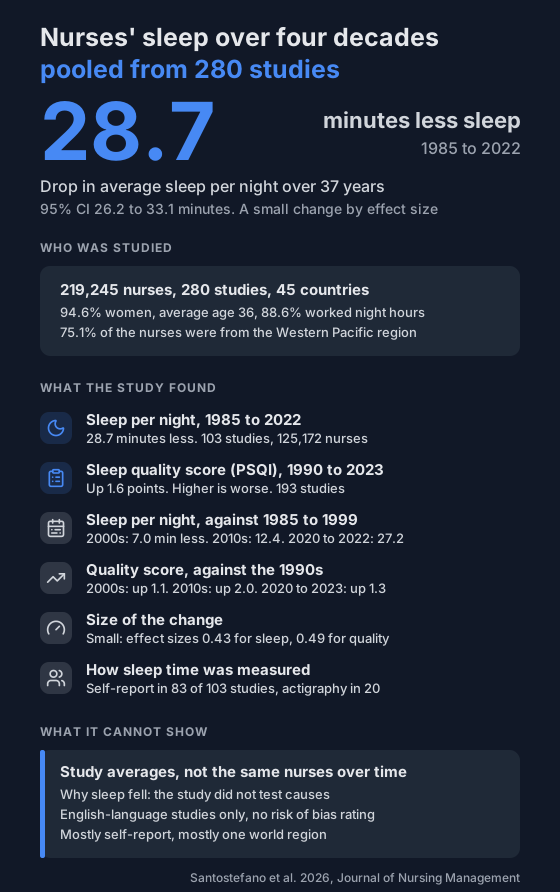
A 2026 analysis pooled 280 studies covering 219,245 nurses. Average sleep fell by 28.7 minutes a night between 1985 and 2022, and sleep quality scores got worse.
It's often said that nurses sleep less than they used to, as shifts get longer and wards get busier. The authors say it had been unclear whether that was actually true.
A 2026 analysis in the Journal of Nursing Management pooled published studies on nurses' sleep going back to 1985. Average sleep fell by about half an hour a night between 1985 and 2022, and sleep quality scores got worse.
Who was in the study?
- 280 studies covering 219,245 nurses in 45 countries.
- 94.6% were women, and their average age was 36.
- 88.6% worked shifts that included night hours.
- 75.1% of the nurses were from the Western Pacific region, which includes China, Japan and Australia.
The authors call it a meta-regression. They took each study's average sleep time or sleep quality score, then looked at how those averages changed with the year the data was collected. The quality score is the Pittsburgh Sleep Quality Index (PSQI), which runs from 0 to 21, where higher means worse sleep.
How much did nurses' sleep change?
- Sleep time: down 28.7 minutes a night from 1985 to 2022 (103 studies, 125,172 nurses).
- Sleep quality score: up 1.6 points from 1990 to 2023, meaning worse sleep (193 studies, 97,232 nurses).
- Both results were adjusted for age, sex, world region and shift type, and the sleep time result also for how sleep was measured.
- By effect size, both changes count as small.
- Studies that measured sleep with actigraphy, a wrist movement recorder, reported more sleep than studies where nurses reported it themselves.
Did it drop every decade?
For sleep time, each period was lower than the one before. Against 1985 to 1999, average sleep was:
- 7.0 minutes shorter in the 2000s.
- 12.4 minutes shorter in the 2010s.
- 27.2 minutes shorter in 2020 to 2022.
The quality score was higher than in the 1990s in every later period, but it peaked in the 2010s. Against the 1990s, it was up 1.1 points in the 2000s, 2.0 in the 2010s and 1.3 in 2020 to 2023.
Did night shifts make a difference?
- In the adjusted model, studies of nurses who worked night hours reported less sleep time.
- Night work wasn't significantly linked to the quality score.
- The authors say studies defined night work in many different ways, which limits how much weight that result can carry.
Why might sleep have dropped?
The study didn't test causes. The authors suggest staff shortages, longer hours, heavier workloads and more stress at work as possible reasons.
They suggest employers look at rosters that allow for sleep, fewer quick turnarounds between shifts, limits on overtime and sleep education. They also say it's not yet known how well those measures work for nurses.
The study had no funding, and the authors declared no conflicts of interest.
What can't it show?
- Individual change. It compares averages from different studies, not the same nurses over time.
- Cause. It shows sleep and year went together, not why.
- Every nurse. Most nurses were from one world region, and only English-language studies were included.
- Study quality. The authors didn't rate each study for risk of bias, and they call that an important limitation.
- Self-report. Most sleep time figures, and all quality scores, came from what nurses reported.
- Exact years. Where a study didn't say when its data was collected, the authors estimated the year.
- Absolute levels. It looked at change over time, so it can't say whether nurses slept less than recommended.
What can you do with this?
A study like this shows a trend across thousands of people. Your own trend only shows up if you record your own nights.
An overnight oximeter logs how long you wore it, your oxygen and your pulse, night after night. Over a few months, you can see whether those numbers shift with your rota. One sleep study vs 3 months of tracking covers why many nights tell you more than one.
For how a smartwatch did at tracking nurses' sleep, see Apple Watch sleep tracking in shift nurses.
If you're tired all the time or your sleep has changed, talk to your doctor.
Not a medical device. Does not diagnose, treat or prevent any condition. Discuss results and changes with a clinician.
References
- Santostefano LG, Lushington K, Banks S, Tomkinson GR, Lang JJ, Graham K, Ruf H, Stewart K, Howland K, Headland M, Musker M, Matricciani L. Trends in Nurses' Sleep: A Meta-Regression Involving 219,245 Nurses From 45 Countries. Journal of Nursing Management. 2026;2026(1):e9051680. doi:10.1155/jonm/9051680