Apple Watch Sleep Tracking in Shift Nurses
A 2026 feasibility study compared Apple Watch sleep tracking with a research actigraph in 5 nurses, then tracked 55 nurses for two weeks. They averaged about 6.4 hours of sleep a night.
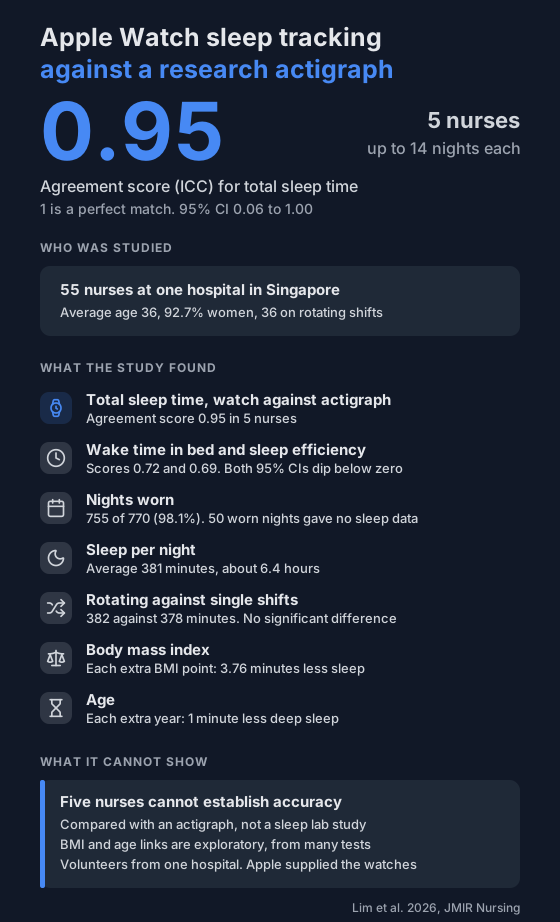
Much of the research on how nurses sleep relies on what they report themselves. A feasibility study published in August 2026 gave nurses an Apple Watch Series 10 for two weeks instead.
It first compared the watch with a research actigraph, a wrist movement recorder, then looked at how the nurses slept.
Who was in the study?
- 55 full-time nurses at one hospital in Singapore.
- Average age 36, and 92.7% were women.
- 36 worked rotating shifts and 19 worked a single shift.
- 5 of them wore the watch and a GENEActiv actigraph together for up to 14 nights.
How close was the watch to the actigraph?
The study used an agreement score (ICC), where 1 is a perfect match.
- Total sleep time: 0.95.
- Time awake in bed: 0.72.
- Sleep efficiency, the share of time in bed spent asleep: 0.69.
With 5 people, those scores are rough. The 95% confidence interval for total sleep time ran from 0.06 to 1.00, and the other two dipped below zero. The authors call this preliminary evidence, not established accuracy.
Did the nurses keep wearing it?
- The watch was worn on 755 of 770 nights (98.1%).
- 50 of the worn nights gave no sleep data, which the authors put down to device or syncing problems.
How did the nurses sleep?
- Average total sleep was 381 minutes, about 6.4 hours. The authors note that's below the 7 to 9 hours recommended for adults.
- Sleep efficiency was 94.77%. The authors say that may reflect short time in bed, not good sleep.
- Rotating-shift nurses averaged 382 minutes and single-shift nurses 378. The difference wasn't statistically significant.
- Each extra BMI point was linked to 3.76 minutes less sleep.
- Each extra year of age was linked to 1 minute less deep sleep.
What can't it show?
- Accuracy. Five nurses is too few, and an actigraph isn't a sleep lab study.
- Cause. The BMI and age links come from many tests on 55 people, with no correction for multiple comparisons. The authors call them exploratory.
- Other groups. The nurses were volunteers at one hospital.
- Independence. Apple supplied the watches. The authors say it had no part in the design or analysis.
What can you do with this?
In this small test, the agreement score was higher for total sleep time than for time awake in bed. The study didn't look at blood oxygen. Smartwatch SpO2 vs a pulse oximeter covers that. Who wearable studies leave out covers who gets tested.
Not a medical device. Does not diagnose, treat or prevent any condition. Discuss results and changes with a clinician.
References
- Lim SH, Aloweni F, Ong P, Ang SY. Validation and Feasibility of a Consumer-Grade Wearable Sleep Monitoring Device and an Exploratory Evaluation of Sleep Characteristics and Associated Factors Among Nurses: Observational Cohort Study. JMIR Nursing. 2026;9:e96912. doi:10.2196/96912