Evening Exercise and Sleep: Home EEG Study
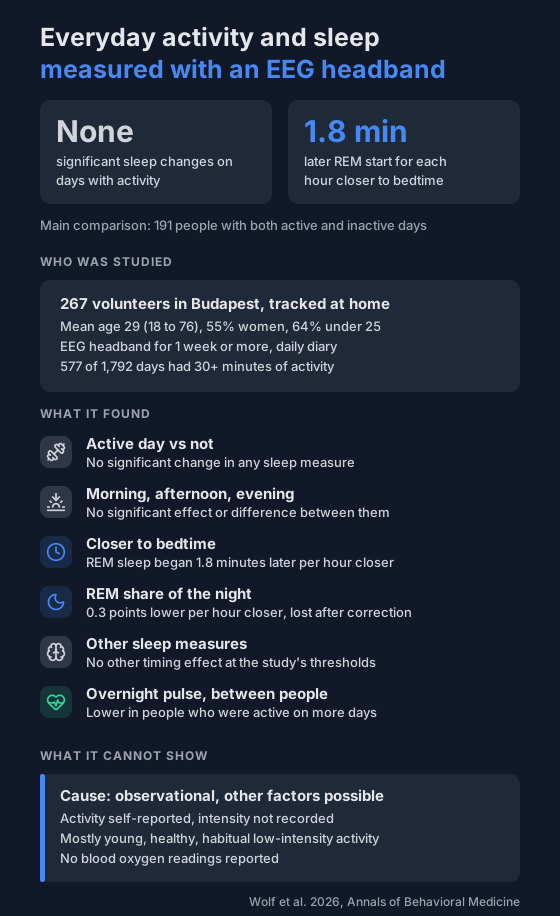
A 2026 study followed 267 people at home with an EEG headband. Days with exercise showed no significant difference in sleep, and exercise closer to bedtime was linked to REM sleep starting about 1.8 minutes later per hour.
"Don't exercise close to bedtime" is standard sleep advice. Studies on the question have given mixed results, and most studies of everyday life measured sleep with a wrist movement tracker or a questionnaire.
A 2026 study from Budapest used an EEG headband, which reads brain waves, to track people's real sleep at home. Activity, including in the evening, made no significant difference to most sleep measures. Activity closer to bedtime was linked to REM sleep starting a little later.
Who was studied?
- 267 volunteers, mostly university students and their relatives, recruited by convenience sampling.
- 257 had activity data. 191 of them had both active and inactive days, and the main comparison uses those 191.
- Mean age 28.9, range 18 to 76. 64% were under 25.
- 55% were women. Mean BMI was 23.1.
- Nobody was recruited from a clinic, and nobody was asked to change their routine.
- Data was collected between May 2021 and April 2023.
How was it measured?
- Sleep: a Dreem 2 headband with 5 dry electrodes, worn for at least a week. Software scored the sleep stages.
- Activity: an evening diary question asked whether they had done at least 30 minutes of "exercise" that day, whatever they counted as exercise. Running, gym, cycling and walking all appear.
- Timing: a free-text diary entry gave the start time, which was worked out for 314 days. The study measured the hours from the start of activity to falling asleep. The mean was 8.7 hours.
- Days: 577 of 1,792 days with valid data included activity.
- Method: the analysis compared each person with themselves, so a night after activity was set against that person's other nights.
What did activity do to sleep?
- No significant effect on any sleep measure. Total sleep, time to fall asleep, time awake, sleep efficiency, sleep stages, deep-sleep brain activity and self-rated sleep quality showed no significant difference on active days (all P at least .19).
- No significant effect by time of day. Dividing the 466 activity days with a known time into morning, afternoon and evening, none had a significant effect, and none differed significantly from the others.
- No significant sleep change after hard days. Days rated more physically exhausting were followed by a higher pulse in the first hour of sleep.
What did closeness to bedtime change?
Only REM sleep, the stage linked to dreaming, passed the study's thresholds. For each extra hour between the start of activity and falling asleep:
- REM sleep started 1.8 minutes sooner, so activity closer to bedtime went with a later start. This held up after the authors' stricter correction for running many tests.
- REM made up 0.3 percentage points more of the night (P = .008). This passed the authors' looser threshold but not the stricter correction, and it weakened to a trend when the end or midpoint of activity was used.
- No other sleep measure showed a timing effect at the study's thresholds.
The hours since activity mattered more than the clock time of the activity. Clock time alone gave weaker results.
The delay to REM was similar across people. The change in REM share varied more from person to person.
Did regular exercisers sleep differently?
The study also compared people with each other. Those who were active on more days had a lower pulse overnight, slept longer and had less light N1 sleep. People whose activity usually fell closer to bedtime rated their own sleep better, though this did not repeat when the end or midpoint of activity was used. Differences between people can have many causes, so read these as links only.
What can't it show?
- Cause. The design rules out reverse causation and fixed traits like age and sex, but other changing factors, such as caffeine, alcohol and what people did between activity and bed, were not controlled.
- Intensity. Activity was self-reported, with no measure of how hard it was. The authors think most of it was relatively low in intensity and habitual.
- Hard or new workouts. The authors say the result may not hold for novel, high-intensity exercise. A very large wrist-device study they cite found late-night high-intensity activity went with shorter, poorer sleep.
- Who was studied. Mostly young, healthy and fit. The authors say it applies less to people with a clinical condition or sleep complaints.
- Missing timing. Timing was only available for part of the activity days, so the timing results use fewer days.
- Pulse. The authors' own method for reading pulse from the headband's light sensor has not been independently checked.
- Oxygen. No blood oxygen readings were reported.
The study was funded by academic research grants, and the authors report no conflicts of interest.
The authors conclude that habitual, fairly easy activity in the evening is a workable choice for healthy young people with no other time for it.
What can you do with this?
If you wear an EEG headband, a ring or a watch, you can compare your own nights after evening activity with your other nights. The study did the same thing, and found the typical effect small. The authors note that movement-based trackers can't separate sleep stages reliably, so read REM figures from a wrist device as rough.
For other work on timing, see exercise timing and sleep in a meta-analysis and morning vs evening exercise and night-time blood pressure. For how well a headband tracks sleep, see EEG headband vs actigraphy in older adults.
If your sleep is poor, discuss it with your doctor.
Not a medical device. Does not diagnose, treat or prevent any condition. Discuss results and changes with a clinician.
References
- Wolf S, Bódizs R, Ujma PP. Effects of physical activity on sleep in an ecologically valid design. Annals of Behavioral Medicine. 2026;60(1):kaag025. doi:10.1093/abm/kaag025