Ashwagandha, Magnesium and Sleep Trial
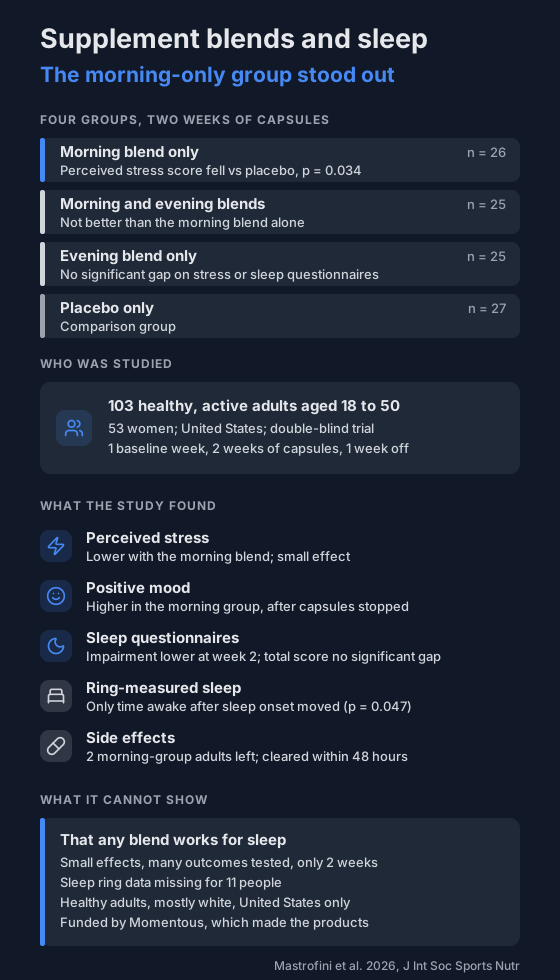
A 2026 trial of 103 healthy active adults compared a morning ashwagandha and rhodiola blend, an evening magnesium blend, both, and placebo for two weeks. Only the morning-only group differed from placebo on perceived stress, with a small effect.
Evening "sleep stacks" with magnesium, L-theanine and apigenin are a popular idea. So are morning stress blends built on ashwagandha. A 2026 trial put both in one study, with a placebo, to compare them.
The morning blend on its own was the only one linked to differences from placebo, and the evening sleep blend showed little. The effects were small, and most outcomes showed no statistically significant difference from placebo. The trial was funded by the company that made the products.
What was tested?
Two blends, taken as capsules, in four combinations:
- Morning blend: 600 mg ashwagandha and 300 mg Rhodiola rosea.
- Evening blend: 2 g magnesium L-threonate (145 mg of magnesium), 200 mg L-theanine and 50 mg apigenin.
- Four groups: morning blend and evening blend (25 people), morning blend and evening placebo (26), morning placebo and evening blend (25), and placebo both times (27).
Neither the researchers nor the participants knew who had what. The placebo was plain cellulose capsules.
Who was studied?
- 103 healthy, physically active adults aged 18 to 50 (53 women), in the United States. 115 were randomised and 103 finished.
- Average age about 35 and average BMI about 24.
- Active meant at least 150 minutes a week for at least 6 months.
- People with a sleep or stress condition were excluded, as was anyone already using a supplement or medicine for stress or sleep.
- 92 of the 103 were white.
- Everything ran remotely over four weeks: a baseline week, two weeks of capsules and a week off.
How was sleep measured?
- Questionnaires: perceived stress, daily stress response, mood, and two sleep scores (sleep disturbance and sleep-related impairment), mostly weekly.
- Pittsburgh Sleep Quality Index: only at the start and after the week off, so it did not cover the capsule weeks.
- A wearable ring: a finger ring that records pulse and estimates sleep from the pulse signal. It gave sleep length, sleep efficiency, time to fall asleep and time awake after sleep onset.
- Time awake after sleep onset is the minutes you are awake between first falling asleep and the final waking.
What did it find?
Compared with placebo:
- Perceived stress: the morning-only group's score went down (p = 0.034). The effect was small: partial eta squared 0.020, about 2% of the variation in scores.
- Daily stress response: no group differed from placebo.
- Mood: negative mood did not differ. Positive mood was higher in the morning-only group at the end of the week off (p = 0.003). That is after the capsules had stopped, and the authors say it cannot be assumed to be entirely due to the product.
- Sleep questionnaires: the morning-only group's sleep-related impairment score was lower at week 2 (p = 0.032). Sleep disturbance did not differ (morning-only p = 0.088).
- Pittsburgh Sleep Quality Index: the total score showed no group, time or interaction effect. One sub-score, subjective sleep quality, was better in the morning-only group than in the morning-and-evening group (p < 0.001). That compares two supplement groups, not one against placebo, and the authors label it exploratory.
- Ring data: no group differed on sleep quality index, sleep efficiency, time to fall asleep, sleep length or average heart rate. The morning-only group had less time awake after sleep onset than placebo across the capsule weeks (p = 0.047, partial eta squared 0.020).
- Evening blend: the evening-only group showed no significant difference from placebo on perceived stress (p = 0.684). Adding it to the morning blend did not beat the morning blend alone.
- Side effects: two men in the morning-only group left the trial. One had diarrhoea after three days. The other had dizziness and muscle weakness after two days. Both recovered within 48 hours of stopping and neither needed medical care.
Why might the evening blend have shown little?
The authors offer ideas, all speculative:
- The sample was healthy, with little sleep disturbance to start with, so there was little room for a change.
- Daytime stress may matter more for how you rate your sleep than a sleep-focused blend does.
- The ingredients may interact. They point to an earlier trial in stressed adults where a blend of magnesium, L-theanine, rhodiola and B vitamins raised one daytime dysfunction score.
- Scores in many groups moved over time, which fits a placebo response.
What can't it show?
- Small effects: the stress, sleep-related impairment and ring results sit near the 0.05 cut-off, and the stress and ring results have a partial eta squared of 0.020. Many outcomes were tested, and the paper does not describe any adjustment across outcomes, so a few near-threshold results can appear by chance.
- Effect sizes vary widely: the Cohen's d values the paper gives for results it calls significant range from 0.003 to 2.74, so the individual figures are hard to interpret.
- How groups were compared: the methods describe a model that tests the morning blend and the evening blend as two factors, while the results describe each group against placebo. This article reports the results as the paper words them.
- Mixed ring result: the results section also reports time awake after sleep onset rising in the morning-only and evening-only groups after week 2, while the discussion describes the evening result as a decrease.
- Short: two weeks of capsules, so nothing about longer use.
- Missing ring data: 11 people were left out of the ring analysis for incomplete device data. The authors call those results exploratory, and so is the Pittsburgh score.
- Compliance records differed: the first 22 people received varying pill counts, so their compliance came from diaries and the rest from pill counts.
- Self-report: stress was measured only by questionnaire, with no blood or saliva markers.
- Healthy adults only: mostly white, aged 18 to 50 and already exercising, in the United States. It says little about people with poor sleep or high stress.
- Funding and conflicts: the trial was funded by Momentous LLC, which also produced the finished products. One author was also supported in part by an NIH grant. The paper reports no conflicts of interest.
- Mood after stopping: the positive mood result came a week after the capsules stopped.
The authors conclude that morning ashwagandha and rhodiola was associated with lower perceived stress, better subjective sleep and higher positive mood. They also write that adding the evening blend may not give extra benefit on these measures. They link the lack of change in other outcomes to the healthy sample and the short trial.
For other supplement and food trials with sleep tracking, see almonds and sleep quality and cannabis and sleep quality in soldiers. For a non-supplement stress trial, see coherent breathing and blue light.
What can you do with it?
This is one trial in healthy adults, so it is not a reason to change anything. Supplements can interact with medicines and conditions, so discuss any change with a clinician.
If you track your own sleep, a ring or oximeter shows what your nights look like. In this trial the ring showed little change in most measures even when questionnaire scores moved.
- Keep a note of anything you change, such as a new supplement, a new bedtime or a stressful week.
- Compare several nights before and after, not one.
- Remember that how rested you feel and what a device records can differ. The session viewer shows your nights side by side.
Not a medical device. Does not diagnose, treat or prevent any condition. Discuss results and changes with a clinician.
References
- Mastrofini GF, Romersi RF, Lombardi MG, Persaud KT, Ryan MM, Hirsch KR, Fraley AL, Dawes JJ, Stray-Gundersen SO, Hardin JW, Arent SM. Modulating stress and sleep through a multi-compound dietary supplement: a randomized, double-blind, placebo-controlled trial. Journal of the International Society of Sports Nutrition. 2026;23(1):2740227. doi:10.1080/15502783.2026.2740227