Cannabis and Sleep Quality in Soldiers
A 2026 study followed 485 Reserve and National Guard soldiers for six annual surveys. Current cannabis use went with worse sleep scores, a longer time to fall asleep, more disturbances and more sleep medication use.
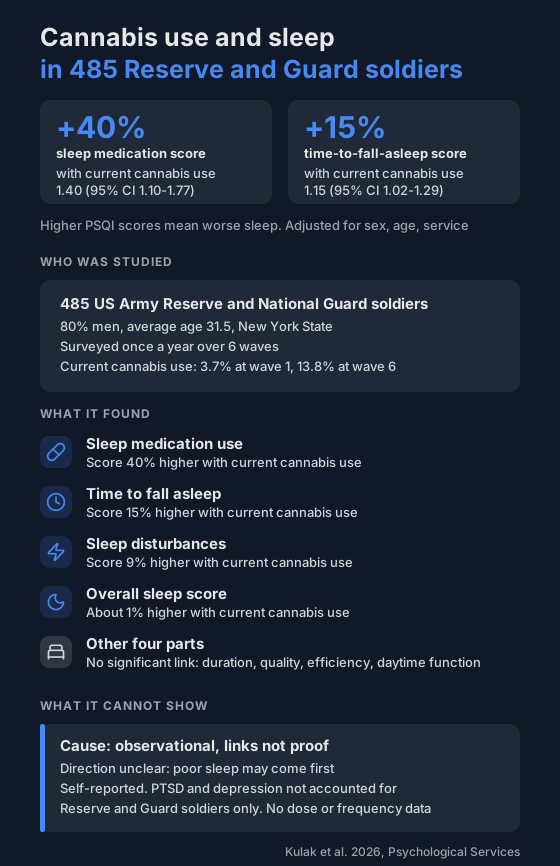
Plenty of people use cannabis to help them sleep, and soldiers say so in surveys. A 2026 study asked what the sleep scores of soldiers who use it actually look like over time. Current use went with worse sleep on several measures.
Who was studied?
- 485 US Army Reserve and National Guard soldiers from New York State.
- 80% men, average age 31.5, about 9 years of service at the start.
- Surveyed once a year over six waves, starting in 2014-2015.
- Some left the military along the way. Current soldiers fell from 92% at wave 1 to 56% at wave 6.
- Funded by the US National Institutes of Health. The authors report no conflicts of interest.
What did they measure?
- Cannabis: whether they had used it in the past 3 months.
- Sleep: the Pittsburgh Sleep Quality Index (PSQI), a self-report questionnaire.
- The PSQI gives an overall score from 0 to 21 and seven parts scored 0 to 3.
- Higher scores mean worse sleep.
Current cannabis use rose from 3.7% of the soldiers at wave 1 to 13.8% at wave 6. At wave 1, about half the soldiers already scored above 5, the PSQI cut-off for poor sleep.
What did they find?
The study compared sleep scores in waves with and without current cannabis use, adjusting for sex, age and whether the person was still serving. Ratios above 1 mean a higher, worse score.
- Overall sleep score: 1.01 (95% CI 1.01 to 1.02), about 1% higher.
- Time to fall asleep: 1.15 (1.02 to 1.29).
- Sleep disturbances: 1.09 (1.01 to 1.18).
- Sleep medication use: 1.40 (1.10 to 1.77).
No statistically significant link showed up for sleep duration, sleep quality, sleep efficiency or daytime function. The overall difference is small. The sleep medication result is the biggest.
The authors say they can't tell whether soldiers used cannabis and sleep medication together or swapped one for the other.
Why might cannabis go with worse sleep?
The authors suggest cannabis may bring relaxation and early drowsiness but still disrupt sleep. They compare it with alcohol, which many people feel helps them sleep while studies link it to poorer sleep. Their data can't test that idea, since sleep was reported on a questionnaire and not measured overnight.
For alcohol's effect on overnight oxygen, see alcohol and overnight oxygen.
What can't this study show?
- Cause. It's observational. It shows a link, not that cannabis made sleep worse.
- The other direction. An earlier study of Reserve and Guard soldiers linked sleep problems over time to higher odds of drug use, cannabis included. People sleeping badly may be the ones reaching for cannabis or sleep medication.
- Missing factors. PTSD and depression weren't accounted for, and both affect sleep.
- Self-report. Cannabis use and sleep both came from surveys.
- No detail on use. Any use in the past 3 months counted. Dose, how often, and how it was taken weren't analysed.
- Many models. The authors ran eight separate models, and the breakdown by sleep part was a secondary, post hoc step.
- Who it covers. Mostly men, all Reserve or National Guard. The authors say it may not apply to active-duty soldiers.
What can you do with it?
- If you use cannabis, or anything else, to get to sleep, log which nights you used it and compare them with the rest.
- An overnight oximeter shows SpO2, pulse and oxygen dips, but not how long it took you to fall asleep.
- If sleep is a problem, or you're using something to manage it, talk to your doctor.
To see how to compare nights, read how many nights to record.
Not a medical device. Does not diagnose, treat or prevent any condition. Discuss results and changes with a clinician.
References
- Kulak JA, Vest BM, Homish DL, Nakamura M, Harrington M, Homish GG. Cannabis use and sleep outcomes among National Guard and Reserve soldiers. Psychological Services. 2026. Online ahead of print, no volume or pages yet. doi:10.1037/ser0001089