Homeopathy for Insomnia: A 2026 Review
A 2026 review of 8 trials and 4 non-randomised studies found the evidence on homeopathy for insomnia too small and uncertain for firm conclusions. Four of its ten authors work as homeopathic doctors.
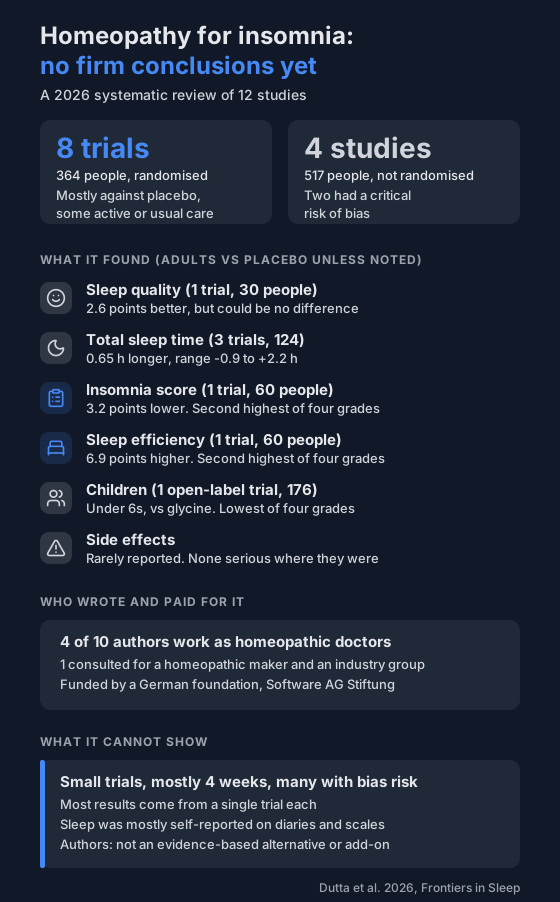
Homeopathy is often suggested for poor sleep, and it's easy to find people who say it worked for them. A 2026 systematic review pulled together every prospective comparison of a homeopathic remedy for insomnia it could find. Its conclusion: the evidence doesn't allow firm conclusions either way.
Who wrote it, and who paid?
Readers often ask this about reviews of complementary therapies, so it comes first.
- Four of the ten authors (Dutta, Wrzałko, Weiermayer and Gaertner) work as homeopathic doctors.
- One author (van Haselen) consulted for Heel, a maker of homeopathic products, and for ECHAMP, a European trade group of homeopathic and anthroposophic medicine companies.
- Dutta is also employed by India's Ministry of Ayush and says the views are his own.
- The remaining authors declared no conflicts.
- The work was supported by the Software AG Stiftung, a German foundation, and one author (Klein) was funded by the Ursimone Wietlisbach Foundation.
The review was registered in advance and followed Cochrane methods, with two reviewers working independently at each stage. Its authors concluded that the current evidence doesn't allow homeopathy to be positioned as an evidence-based alternative or add-on in insomnia care.
What did the review cover?
- It searched 9 databases, 3 trial registries and other sources up to August 2025.
- It found 8 randomised trials (364 people) and 4 non-randomised studies (517 people).
- Most ran for 4 weeks, others for 6 weeks or 3 months, and one followed people for up to 6 months.
- Studies used individualised homeopathy, single remedies or combination products.
- Comparisons were mostly against placebo, and a few against usual care or another active option.
- People were included if insomnia was the reason they took part, but only 3 studies defined their participants against a formal standard.
What did it find in adults?
The adult results were mostly one trial each. Here is each result against placebo, with the review's certainty grade where it gave one.
- Sleep quality: 1 trial of 30 people. The score was 2.6 points better, but the 95% range (-5.5 to 0.26) includes no difference. Low certainty.
- Total sleep time: 3 trials, 124 people, from sleep diaries. 0.65 hours longer, with a range of -0.9 to +2.2 hours. Not statistically significant, low certainty.
- Insomnia score: 1 trial of 60 people. 3.2 points lower, range -5.68 to -0.72. The second highest of four certainty grades.
- Sleep efficiency: 1 trial of 60 people. 6.9 points higher, range 3.99 to 9.81. Also second highest of four grades.
- Time to fall asleep: 1 trial, 5.6 minutes shorter, range -15.35 to 4.15. Low certainty.
The review's own pooled estimate of all sleep outcomes together came out at 0.73 standard deviations in homeopathy's favour (range 0.04 to 1.41). The authors call it exploratory. About half of its weight came from one small pilot study, and it mixes different outcomes.
They also say the possible benefits seen for insomnia score and sleep efficiency are sensitive to methodological choices, differences between studies and the inclusion of lower-quality studies.
What about children?
One open-label trial of 176 children under 6 compared homeopathy with glycine. It reported a large difference in insomnia score, with a standardised difference of 0.82. The review graded that evidence very low certainty. The trial was industry-funded, open-label, and used a measure that wasn't validated and was filled in by parents or carers. The authors say this doesn't allow any clinical recommendation.
What about side effects?
- Few studies tracked side effects: in adults, only 2 studies reported how they did it and what they found.
- One adult trial reported one minor case of rectal bleeding, and one non-randomised study reported one case of slight caffeine intolerance. No serious events were reported.
- In the children's trial, there were 11 non-serious events, 6 on homeopathy and 5 on glycine. One child on homeopathy stopped because of excitability.
- The authors rated the certainty low and said this doesn't allow firm conclusions about safety.
How good were the studies?
- Only 1 of the 8 randomised trials was at low risk of bias on all outcomes.
- 4 of the 8 trials used homeopathy in a way the reviewers rated as matching homeopathic practice. The rest were uncertain.
- Of the 4 non-randomised studies, 2 were at critical risk of bias and 1 at serious risk. The 2 at critical risk were left out of further analyses.
- Sleep was mostly measured by diaries and questionnaires. One study used wrist actigraphy and an in-home sleep recording, and it was only used in a sensitivity analysis.
- 3 of the 12 studies were conference abstracts or a thesis, with limited reporting.
- Some studies were too poorly reported to include in the pooled results.
What can't it show?
- Whether homeopathy works or doesn't. It found too little reliable evidence either way, and says so.
- Long-term effects. Most trials ran 4 weeks.
- Real-world results. The non-randomised studies were too biased to say.
- Safety. Side effects were barely tracked.
What does the review say about other options?
The authors note that insomnia guidelines recommend cognitive behavioural therapy for insomnia (CBT-I) as the first choice, with medication reserved for selected people and usually short-term. They also note that CBT-I is often hard to get, which helps explain interest in other approaches. They suggest a future well-run, independent trial based on the protocol of the one low-risk trial, with proper side-effect tracking.
For other insomnia research, see wearables for insomnia and an insomnia therapy trial in pregnancy.
What can you do with this?
No oximeter or sleep recording was part of the main analysis, and an oximeter doesn't measure insomnia. It records oxygen and pulse, which can help show whether broken sleep comes with oxygen dips. You can open a recording in the session viewer.
If you're thinking about trying anything for sleep, you can log your own sleep and overnight oxygen for a few weeks before and after. One person's log can't tell a real effect from placebo or a change in routine, so share it with your doctor and discuss what you find. If poor sleep persists, talk to your doctor.
Not a medical device. Does not diagnose, treat or prevent any condition. Discuss results and changes with a clinician.
References
- Dutta A, Sumsuzzman DM, Wrzałko D, van Haselen R, Weiermayer P, Gaertner K, Lakshani JADS, Klein S, Baumgartner S, Loef M. Homeopathy for the treatment of insomnia: a systematic review and meta-analysis. Frontiers in Sleep. 2026;5:1922807. doi:10.3389/frsle.2026.1922807