Digital Insomnia Programs Compared
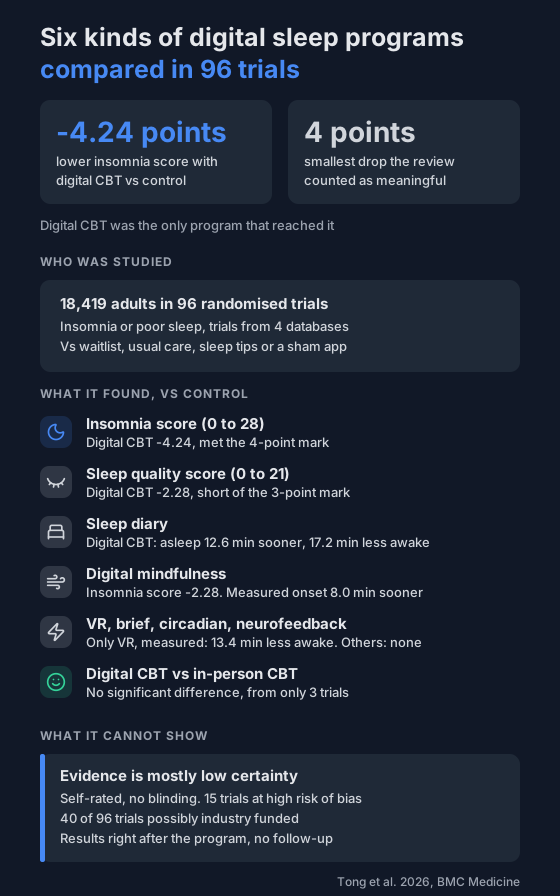
A 2026 analysis of 96 trials (18,419 people) compared six kinds of digital sleep programs. Digital CBT was the only one whose drop in insomnia score, 4.24 points, reached the review's 4-point mark for a meaningful change.
Plenty of apps and websites now offer help with sleep, and they are not all the same thing. Some teach cognitive behavioural therapy (CBT), some teach mindfulness, some use virtual reality or support the body clock. A 2026 analysis pooled randomised trials to compare six kinds side by side.
Digital CBT was the only one whose effect on the insomnia score reached the review's bar for a meaningful change.
What did the review do?
- It searched four databases for randomised trials of digital sleep programs in adults, up to October 2025, with an updated search in March 2026.
- It included 96 trials with 18,419 people in total.
- Participants met the formal criteria for insomnia, scored high on a sleep questionnaire, or reported sleep problems.
- It used a network meta-analysis, which links trials through a shared control group so programs that were never tested head to head can still be compared.
- Control groups were merged into one: waitlist, usual care, sleep education tips or a sham app.
- Trials against in-person CBT were a separate subgroup, with only 3 trials.
The six kinds were digital CBT, digital brief behavioural therapy, digital mindfulness, circadian rhythm support, virtual reality and tele-neurofeedback.
Which one made the biggest difference?
Digital CBT, on most measures. The main outcome was the insomnia score, a 7-question form scored 0 to 28 where higher means worse. It was reported in 72 trials with 14,405 people.
- Digital CBT: 4.24 points lower than control (95% confidence interval 3.65 to 4.83). The review rates this evidence second highest of four grades.
- Digital mindfulness: 2.28 points lower (0.55 to 4.00), rated low certainty.
- Brief behavioural, circadian rhythm support and virtual reality: no statistically significant difference from control.
- Digital CBT was 1.96 points lower than digital mindfulness when the network compared the two.
The authors set the smallest meaningful change at 4 points. Only digital CBT passed it.
What about sleep quality and the sleep diary?
Digital CBT also moved sleep quality and three diary measures against control, but none reached the review's bar for a meaningful change.
| Measure | Digital CBT vs control | Bar for meaningful |
|---|---|---|
| Sleep quality score (0 to 21) | 2.28 points lower | 3 points |
| Time to fall asleep, diary | 12.57 minutes shorter | 20 minutes |
| Time awake in the night, diary | 17.19 minutes shorter | 30 minutes |
| Sleep efficiency, diary | 7.27 points higher | 10 points |
Total sleep time in the diary was not significantly different from control for any program. All four digital CBT results in the table were rated low certainty.
What did devices and sleep labs show?
Only a small set of trials measured sleep objectively, with actigraphy (a wrist movement sensor) or a sleep lab. The authors say these results are exploratory.
- Digital mindfulness: time to fall asleep 7.96 minutes shorter than control, rated second highest of four grades. The bar was 10 minutes.
- Virtual reality: time awake in the night 13.38 minutes shorter, in a network of 11 trials with 757 people. Digital CBT was 4.90 minutes shorter. The bar was 20 minutes, and this outcome failed the review's consistency check, so it needs extra caution.
- Total sleep time and sleep efficiency showed no significant difference for any program.
- Neurofeedback, brief behavioural and circadian rhythm support had no significant effect on any outcome.
How did digital CBT compare with in-person CBT?
In the 3 trials with in-person CBT as the control, digital CBT did not differ significantly on the insomnia score or any diary measure. Three small trials can't show the two are equal.
Did it matter how the program was run?
These were subgroup analyses. The authors set control type and program length in advance and call the others exploratory.
- Therapist guidance: digital CBT lowered the insomnia score by 4.48 points with a therapist and 4.10 without.
- Length: 4.24 points whether the program ran 8 weeks or less, or longer.
- Control type: 5.08 points against waitlist or no program, and 4.16 against active controls such as sleep education.
- Meeting formal criteria or not: 3.92 points in people who met the criteria for insomnia, and 4.53 in people with symptoms who did not.
How strong is the evidence?
Weaker than the headline sounds, and the authors say so.
- Only 2 of the 96 trials had a low risk of bias. 79 had some concerns and 15 had a high risk.
- Most outcomes are self-rated, and people can't be blinded to a digital program, which can inflate the results.
- Estimates varied a lot between trials for the insomnia and sleep quality scores.
- Only five results against control were rated second highest of four grades, including digital CBT on the insomnia score. Everything else was low or very low.
- The networks for neurofeedback, brief behavioural and circadian rhythm support were thin, a few trials each.
- 40 of the 96 trials may have had industry funding.
- Only results right after the program were analysed, so it can't say whether the effect lasts.
- Most head-to-head comparisons between programs were too imprecise to rank them reliably.
- The study was registered after the search began, and the protocol was later revised.
- The review was funded by Tianjin government science and health grants, and the authors declare no competing interests.
What can you do with this?
This is a study about programs delivered by app or website, not about tracking. An overnight oximeter doesn't measure insomnia. It does record oxygen and pulse through the night, so you can see how a night looked alongside how you slept.
Insomnia and sleep apnea can occur together, so poor sleep isn't always one thing. See insomnia and sleep apnea together. If you have trouble sleeping, discuss it with your doctor.
Not a medical device. Does not diagnose, treat or prevent any condition. Discuss results and changes with a clinician.
References
- Tong Z, Ye G, Fan S, Li Y, Zhang J, Zhang H, Chen Q, Wang H, Li H, Wang J. The effectiveness of digital therapeutics in improving sleep quality: a systematic review and network meta-analysis. BMC Medicine. 2026;24(1):526. doi:10.1186/s12916-026-05129-8