CBT vs Bright Light for Insomnia in Chemo
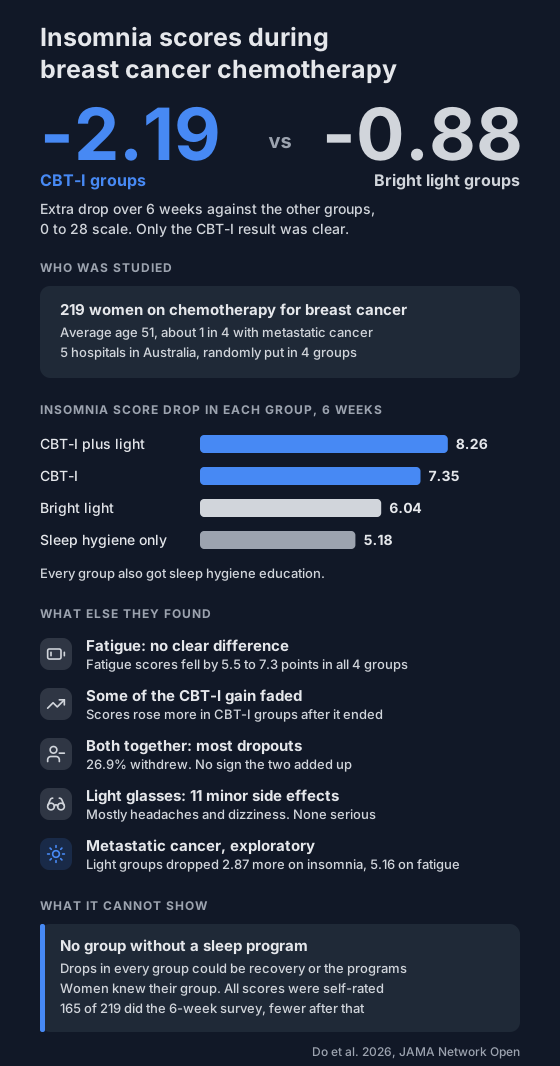
A 2026 trial of 219 women on chemotherapy for breast cancer compared 6 weeks of CBT for insomnia with bright light glasses. Insomnia scores fell 2.19 points more with CBT. Light made no clear difference overall, and neither made a clear difference to fatigue, which fell in every group.
Sleeping badly and feeling worn out are common during chemotherapy for breast cancer. Cognitive behavioural therapy for insomnia (CBT-I) is the first-line option for insomnia, but most studies tested it after cancer care had finished. Bright light in the morning is the other idea, aimed at the body clock.
The SleepCARE trial, published in August 2026, tested both during chemotherapy, alone and together.
Who was in the trial?
- 219 women having chemotherapy for breast cancer at 5 hospitals in Australia, from 2021 to 2024.
- Average age 51.
- About 1 in 4 had metastatic cancer.
- They didn't need a set level of insomnia to join. At the start, the average insomnia score was about 13 on a 0 to 28 scale.
- Women on daily sleep medication, or with another significant sleep disorder, were left out.
What did each group get?
Women were randomly put into one of 4 groups for 6 weeks:
- CBT-I: sleep habit changes, such as only using the bed for sleep and limiting time in bed, plus work on unhelpful thoughts about sleep.
- Bright light: light glasses at 1,500 lux for 20 minutes a day, usually around waking time.
- Both together.
- Sleep hygiene education only: general advice on sleep and the bedroom.
Every group got the sleep hygiene education, a one-to-one session by phone or video, a midpoint call and emails once or twice a week.
What happened to insomnia?
Scores fell in all 4 groups during the 6 weeks, even with chemotherapy still going.
- CBT-I plus light: 8.26 points lower.
- CBT-I alone: 7.35 points lower.
- Bright light alone: 6.04 points lower.
- Sleep hygiene only: 5.18 points lower.
Compared with the groups that didn't get it, CBT-I meant an extra 2.19-point drop, and that was statistically significant. Bright light meant an extra 0.88 points, which wasn't.
As a standardised difference, the CBT-I effect was 0.40. The authors had set 0.5 in advance as the size that matters clinically, so it fell a little short.
After the program ended, insomnia scores crept back up more in the CBT-I groups, by 2.87 points more than in the others. The authors say keeping the gain going needs more work.
What about fatigue?
Women started at about 58 to 60 on a fatigue scale where the general population averages 50. Scores fell by 5.5 to 7.3 points in every group. Neither CBT-I nor bright light made a statistically significant difference.
Did combining them help?
Not clearly. The authors found no sign that CBT-I and light worked better together than you'd expect from each on its own.
The combined group also had the most dropouts, 26.9%, and the fewest women sticking closely to the program, 48.1%. The authors suggest doing both at once may be too much during chemotherapy.
What about women with metastatic cancer?
This was a small, exploratory subgroup of 49 women in the analysis, so it's a lead for future trials, not a firm result.
In this group, insomnia scores fell 2.87 points more and fatigue scores 5.16 points more with light than without it. The authors call it an intriguing possibility that needs more research.
Was it safe?
- No serious side effects were linked to the programs.
- There were 11 minor side effects probably linked to the light glasses, mostly headaches and dizziness.
What can't it show?
- Whether the programs caused the drops. There was no group that got nothing, so the fall seen in every group could be partly natural recovery.
- Blinding. Women knew which program they were on, and every score was self-rated.
- Dropouts. 165 of the 219 did the 6-week survey, and fewer did the 3 and 6-month ones, so the longer-term results are uncertain.
- Adherence. There was no objective check of how much women used the glasses or the CBT-I steps.
- Who it covers. Women with breast cancer only.
What can you do with this?
- If you're sleeping badly during cancer care, tell your oncology team, and mention this trial if it helps.
- For other approaches studied in adults generally, see wearable sleep devices for insomnia and progressive muscle relaxation.
- For how everyday light lines up with sleep, see daylight, evening light and sleep.
An overnight oximeter records oxygen and pulse, not insomnia. Here's what one is useful for.
Not a medical device. Does not diagnose, treat or prevent any condition. Discuss results and changes with a clinician.
References
- Do TT, Maccora J, Wallace R, Aedo-Lopez V, Alexander M, Ancoli-Israel S, Bei B, Blum R, Boyle F, Day D, Diggens J, Francis PA, Ftanou M, Garland SN, et al. Cognitive Behavior vs Bright Light Therapy for Insomnia in Women Undergoing Chemotherapy for Breast Cancer: A Randomized Clinical Trial. JAMA Network Open. 2026;9(8):e2630320. doi:10.1001/jamanetworkopen.2026.30320