Self-Help Book for Shift Work Sleep: A Trial
199 healthcare workers with shift work sleep problems got a self-help book or a one-page sleep hygiene leaflet. After 6 months, knowledge and three fatigue scores moved more with the book, but shift work disorder rates showed no statistically significant difference.
Night shifts and rotating rotas cut into sleep, and a lot of shift workers end up with insomnia or heavy sleepiness because of it. When that lasts three months or more and is tied to the work schedule, it's called shift work disorder.
A randomised trial published in August 2026 tested whether a self-help book written for shift workers did more than a one-page list of sleep hygiene tips. The book moved knowledge and some fatigue scores. It made no statistically significant difference to the main outcome, shift work disorder.
Who was in the trial?
- 199 healthcare workers from two hospitals in western Norway, plus nurses from an ongoing Norwegian shift work survey.
- 87% were women, average age 39.
- 86% worked rotas that included nights.
- All of them met the criteria for shift work disorder on three questions at the start.
- 254 were randomised, and 199 answered the email about getting the material: 100 got the book and 99 got the leaflet.
- 136 (68%) answered the 6-month follow-up.
What did each group get?
- The book: "Shift work and sleep. How to cope with night work and irregular work hours" (English title of a Norwegian book). It covers how sleep and body clocks work, how shift work can affect health, and practical tips for different kinds of shifts.
- The leaflet: six sleep hygiene tips on one page, such as cutting caffeine, nicotine and heavy meals before bed, not using alcohol to sleep, and keeping the bedroom dark and quiet.
What changed?
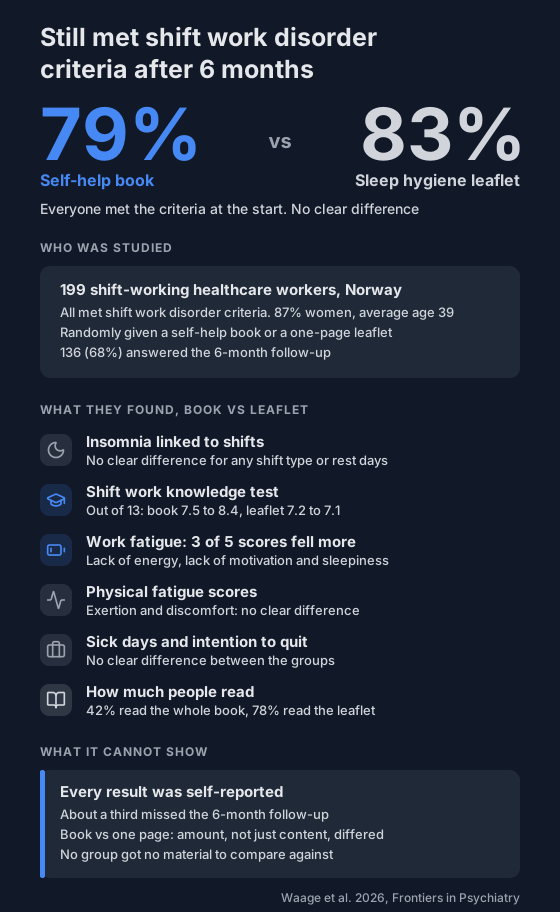
- Shift work disorder: 79.0% still met the criteria with the book and 83.1% with the leaflet. Both groups fell from 100%, but the gap between them wasn't statistically significant.
- Insomnia linked to each shift type and rest days: no significant difference between groups. Day-shift insomnia came closest (p = 0.061).
- Knowledge test, out of 13: went from 7.5 to 8.4 with the book and 7.2 to 7.1 with the leaflet, a statistically significant difference between groups.
- Work fatigue: three of five scores fell more with the book: lack of energy, lack of motivation and sleepiness. Physical exertion and physical discomfort showed no statistically significant difference.
- Sick days and intention to quit: no significant difference between groups.
Did people read it?
- 81.3% in the book group read some or all of it, against 90.3% in the leaflet group.
- 42.2% read the whole book.
- 71.9% were satisfied with the book, against 54.9% with the leaflet (p = 0.04).
- 46.9% said they followed the book's advice, against 54.9% for the leaflet (p = 0.35). The paper prints 54.9% for both leaflet figures.
The practical tips sit in the last part of the book. The authors don't know which parts people read, and speculate that reading the last part may have mattered most.
Why did the rate fall in both groups?
The trial can't say. Meeting the criteria was the entry requirement, so everyone started at 100%. The authors point to regression to the mean: people picked because their problems are bad tend to report fewer of them later, whatever they're given. There was no group that got nothing, so it can't show whether either the book or the leaflet did anything on its own.
What can't it show?
- Self-report only. Shift work disorder, insomnia, fatigue and sick days all came from questionnaires. No sleep was recorded. The authors say lower fatigue scores may reflect how people rated and coped with their tiredness, not actual recovery.
- Drop-outs. About a third didn't answer at 6 months, and the shift work disorder result used only those who did.
- Smaller than planned. The team aimed to recruit 300, and a power calculation called for 164. 136 answered the follow-up.
- Book vs one page. The book was far longer, so the differences may come from the amount of material and attention, not its shift work content.
- Uneven start. In the paper's table of completers, the book group began with lower fatigue scores than the leaflet group on all five measures.
- Who it applies to. Mostly women, all healthcare workers in Norway, recruited by invitation rather than at random.
The authors conclude the book may have value as an educational resource, but that the trial doesn't show it's an effective therapy for shift work disorder.
What can you do with this?
Here, a book that raised shift work knowledge didn't lower shift work disorder rates by a statistically significant margin more than a one-page leaflet did.
If you work shifts and want to see how your rota affects your nights, log your sleep and how you feel on each shift type. An overnight pulse oximeter records your oxygen and pulse whether you sleep at night or after a night shift, and a few weeks of recordings show more than a single night. See how many nights to record.
For more on how nurses sleep, read nurses are sleeping less and Apple Watch sleep tracking in shift nurses.
If insomnia or sleepiness keeps going, talk to your doctor.
Not a medical device. Does not diagnose, treat or prevent any condition. Discuss results and changes with a clinician.
References
- Waage S, Harris A, Vedaa Ø, Pallesen S, Sunde E, Bjorvatn B. The effect of a self-help book for shift work disorder - a randomized controlled trial. Frontiers in Psychiatry. 2026;17:1829148. doi:10.3389/fpsyt.2026.1829148