Insomnia Therapy in Pregnancy: Beyond Sleep
A 2026 trial gave 64 pregnant women with insomnia 6 weeks of CBT-I, a mindfulness programme or sleep hygiene emails. Both therapies were linked to less bedtime procrastination and more positive mood, and to less anxiety in women who started with some.
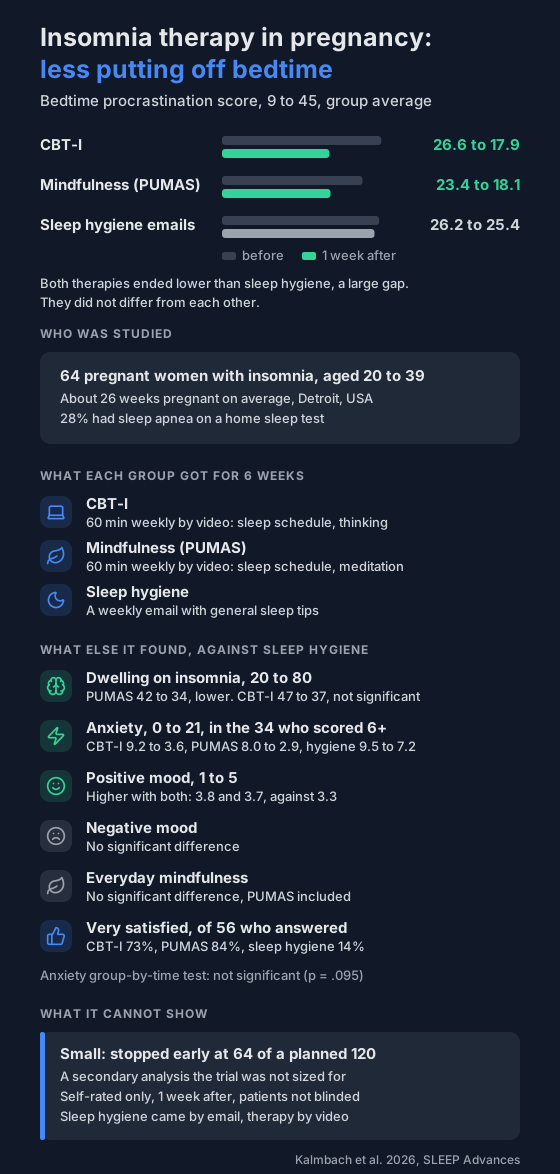
The paper says about half of pregnant women have insomnia symptoms, and they're often brushed off as part of being pregnant. Cognitive behavioural therapy for insomnia (CBT-I) is a well-studied talking therapy for it. This 2026 trial from Detroit asked what else changes when pregnant women get insomnia therapy, beyond sleep itself.
Both therapies it tested were linked to less putting off bedtime and more positive mood than sleep hygiene tips. In women who started with some anxiety, they were also linked to less anxiety.
Who was in the trial?
- 64 pregnant women aged 20 to 39, all scoring 11 or more on a 0 to 28 insomnia checklist.
- All were 28 weeks pregnant or less when they joined, about 26 weeks on average.
- They were patients at one health system, Henry Ford Health in Detroit, and joined between 2021 and 2022.
- 28% had sleep apnea on a home sleep test (5 or more breathing events per hour), which the paper says ranged from lower to middle grade.
- Women with pregnancy complications posing a high risk to mother or baby, twins, shift work, bipolar disorder, seizure disorder or current substance use were left out.
What did each group get?
They were split at random into three groups for 6 weeks.
- CBT-I (20 women): a weekly 60-minute video session with a therapist. It covered a set sleep schedule with limited time in bed, only using the bed for sleep, working on unhelpful thoughts about sleep, and muscle relaxation.
- PUMAS (22 women): a mindfulness programme built for pregnancy, also 6 weekly 60-minute video sessions. It used the same sleep schedule and bed rules, plus meditations, acceptance exercises and diaries of pleasant and unpleasant moments.
- Sleep hygiene (22 women): a weekly email with general sleep tips on light, caffeine, diet, exercise and the bedroom.
Everything was measured by online questionnaires, a week before and a week after.
What did it find?
Putting off bedtime dropped the most. The score runs from 9 to 45, and higher means more often going to bed later than planned.
- CBT-I: 26.6 to 17.9.
- PUMAS: 23.4 to 18.1.
- Sleep hygiene: 26.2 to 25.4.
Both therapies ended lower than sleep hygiene, a large gap by the paper's measure. They didn't differ from each other.
Dwelling on insomnia, like thinking over and over about how tired you feel, scored 20 to 80:
- PUMAS: 42 to 34, lower than sleep hygiene.
- CBT-I: 47 to 37, but the gap with sleep hygiene wasn't statistically significant.
Anxiety was only analysed in the 34 women who scored 6 or more on a 0 to 21 anxiety checklist, since nearly half started with very little.
- CBT-I: 9.2 to 3.6.
- PUMAS: 8.0 to 2.9.
- Sleep hygiene: 9.5 to 7.2.
Both therapies ended lower than sleep hygiene. But the test of how the groups changed over time wasn't statistically significant (p = .095). The authors called it a trend and compared the groups anyway, because the subgroup was small.
Positive mood (feeling cheerful, happy, lively) went up with both therapies and down a little with sleep hygiene, ending at 3.8 and 3.7 against 3.3 on a 1 to 5 scale.
No significant difference showed up for:
- Negative mood (feeling sad, afraid, miserable).
- Everyday mindfulness, even with the mindfulness programme. The authors had predicted PUMAS would raise it.
Having sleep apnea on the home test wasn't linked to the results.
What did the women think?
56 women answered the feedback questions.
- Very satisfied: 73% with CBT-I, 84% with PUMAS, 14% with sleep hygiene.
- Nobody in either therapy group was dissatisfied, against 27% with sleep hygiene.
- Night-time worries got "very much" better: 60% with CBT-I, 84% with PUMAS, 9% with sleep hygiene.
- 17 of 19 PUMAS women named the meditations as helpful. 7 of 15 CBT-I women named the sleep schedule.
- One woman in each therapy group found the set bed and wake times too rigid, and one CBT-I patient said it didn't pay enough attention to pregnancy.
- 33 of 34 in the therapy groups said they'd choose video over in-person therapy in future.
What can't it tell you?
- It's small and preliminary. The trial was planned for 120 women and stopped at 64, once an interim check showed a clear effect on insomnia. Those insomnia results were reported in an earlier paper.
- It wasn't sized for these outcomes. This paper is a secondary analysis. The authors say it could miss medium-sized effects, and they used a less strict test for group comparisons.
- The comparison wasn't equal. The therapy groups got live video sessions with a therapist, while the sleep hygiene group got emails. The authors list this as a limitation: the groups were matched for how often they had contact, not for how it was delivered.
- Patients knew their group, though they weren't told which one was the control, and all the outcomes were self-rated.
- Only a week after. There was no later follow-up, so it can't say whether the changes lasted into the months after birth.
- Who it applies to. One US health system, few Hispanic or lower-income women, and nobody in early pregnancy. Feedback came only from women who finished the final survey.
- Funding. The trial was funded by the authors' own health system. Four authors hold editorial roles at the journal and say they took no part in reviewing the paper.
What can you do with this?
The trial points at habits you can watch for yourself: when you go to bed against when you meant to, and how much time you spend in bed awake and dwelling on it. A simple log of planned and actual bedtimes is enough to see your own pattern.
If you're pregnant and sleeping badly, it's worth raising with your midwife or doctor. Insomnia and sleep apnea often turn up together, as they did in 28% of this group, and here's how a home sleep test copes with insomnia. For why the pair matters, see insomnia plus sleep apnea and heart risk.
If you record your overnight oxygen, record several nights before reading anything into it, and share the recordings with your doctor.
Not a medical device. Does not diagnose, treat or prevent any condition. Discuss results and changes with a clinician.
References
- Kalmbach DA, Reffi AN, Cheng P, Kaliush PR, Jennings MB, Afaneh HA, Yu A, Jaziri M, Drake CL. Treating insomnia during pregnancy improves bedtime procrastination, rumination, anxiety, and positive affect: a randomized controlled trial of cognitive-behavioral and mindfulness-based therapies for prenatal insomnia. SLEEP Advances. 2026;7(2):zpag050. doi:10.1093/sleepadvances/zpag050