Morning Headaches and Sleep Apnea in Women
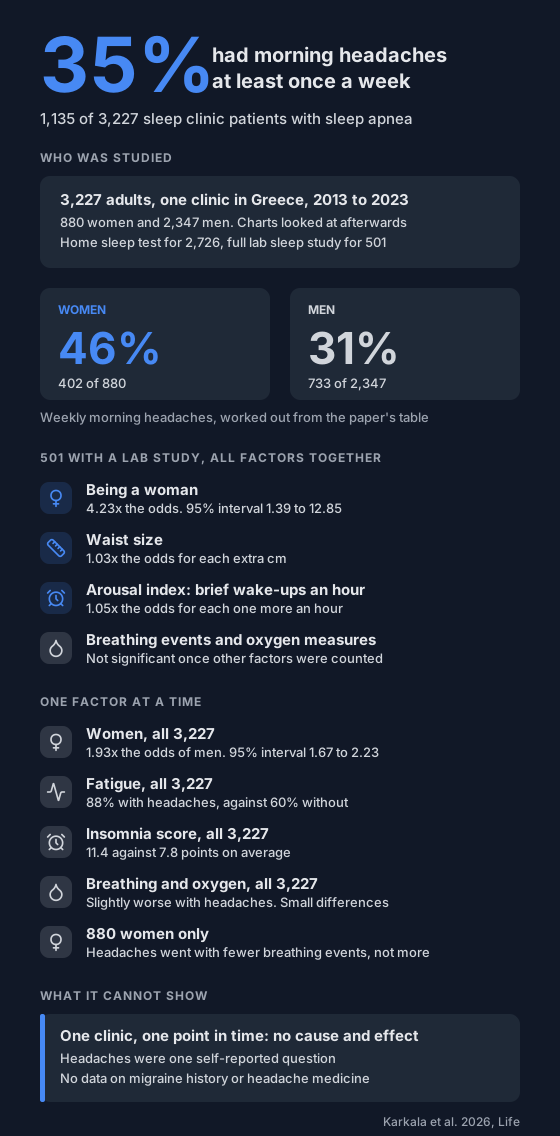
In 3,227 sleep clinic patients with sleep apnea, 35% had morning headaches at least once a week. Being a woman, waist size and brief wake-ups went with them; breathing events and oxygen were not significant once other factors were counted.
Waking up with a headache is a known sign of sleep apnea. Most research has looked at low oxygen and breathing pauses overnight as the cause.
A 2026 study of 3,227 sleep clinic patients points somewhere else. Once other factors were counted, morning headaches went with being a woman, a bigger waist and more brief wake-ups in the night. Breathing events and oxygen measures didn't stay linked.
Who was studied?
- 3,227 adults with sleep apnea seen at one sleep clinic in Thessaloniki, Greece, between 2013 and 2023.
- 880 women and 2,347 men, average age about 58.
- 2,726 had a home sleep test and 501 had a full overnight lab study.
- At their first visit, each one answered a question on how often they woke with a headache.
The researchers went back through these records afterwards. "Frequent" meant at least once a week.
How common were morning headaches?
- 1,135 of the 3,227 (35.2%) had them at least once a week, per the results and Table 1 (the discussion says 1,136).
- Only 5 had them every day.
- From the paper's table, that's 46% of the women (402 of 880) and 31% of the men (733 of 2,347).
Those with headaches also reported more of other things:
- Fatigue: 88% against 60%.
- Insomnia score: 11.4 against 7.8 points on average.
- Epworth sleepiness score: 10.7 against 9.3.
- Waking at night choking, and getting up to urinate.
What about oxygen and breathing events?
Looked at one at a time, the headache group had slightly worse numbers:
- Breathing events per hour: 38.9 against 36.7.
- Oxygen dips per hour (ODI): 38.8 against 36.0.
- Time below 90%: median 15 minutes against 10.3.
The authors call the oxygen differences minimal and of limited clinical relevance. For what time below 90% means, see what is T90.
What stood out once everything was counted together?
This step only used the 501 people with a full lab study. Only a lab study records arousals, the brief wake-ups you usually don't remember.
Three things stayed linked to frequent morning headaches:
- Being a woman: 4.23 times the odds of men (95% interval 1.39 to 12.85).
- Waist size: 1.03 times the odds for each extra cm.
- Arousal index: 1.05 times the odds for each extra brief wake-up an hour.
Breathing events, ODI, average and lowest oxygen and time below 90% weren't statistically significant once these were counted. BMI wasn't either, but waist size was.
For comparison, across all 3,227 looked at one factor at a time, women had 1.93 times the odds of men (95% interval 1.67 to 2.23).
The authors suggest broken sleep may matter more than breathing events and oxygen for these headaches. They add it could also be broken sleep setting off an existing headache problem like migraine, and their data can't tell the two apart.
What did the women's data show?
The authors also looked at the 880 women on their own, one factor at a time.
- Headaches went with fatigue, waking in the night (2.10 times the odds) and memory complaints.
- They went with fewer breathing events and shorter breathing pauses, not more.
So in women, the headaches tracked how they felt more than how many events the sleep test counted. The authors cite earlier studies where women with sleep apnea more often reported tiredness, insomnia and morning headaches than loud snoring. More on that in sleepiness after menopause and women vs men overnight oxygen.
What about CPAP?
This study had no CPAP data. The authors cite earlier studies where morning headaches went away in most patients on CPAP. One reported 72.4% on the first day and 92.1% after a month of regular use.
What can't it show?
- Cause. It's a look back at records from one point in time.
- Everyone. All were patients sent to one sleep clinic, so people with symptoms are over-represented.
- Headache type. One question on how often, with no detail on the pain. Other headache causes couldn't be ruled out.
- Migraine. There was no data on migraine history, headache medicine, mood or hormones.
- The 501. The combined result only covers the people with a lab study. The 4.23 figure has a wide interval, partly because the group was smaller.
What can you do with this?
If you often wake with a headache, note how often in a sleep diary, and take it to your doctor. Morning headaches have many causes, and only a sleep study can say whether sleep apnea is one.
An overnight oximeter records oxygen and pulse, not arousals. You can still log your headache mornings next to your nights and share that with your doctor.
Not sure whether to bring up sleep apnea? The sleep apnea risk check takes about a minute.
Not a medical device. Does not diagnose, treat or prevent any condition. Discuss results and changes with a clinician.
References
- Karkala A, Kalkanis A, Kotoulas SC, Çetindağ ŞK, Testelmans D, Paraschou V, Spyratos D, Raptis DG, Steiropoulos P, Pataka A. Morning Headaches as a Specific Obstructive Sleep Apnea Characteristic in a Large Sleep Clinic Population. Life (Basel). 2026;16(8):1239. doi:10.3390/life16081239