Sleep Apnea by Age and Sex: A Clinic Study
A 2026 study of 3,736 Greek sleep clinic patients found time below 90% oxygen rose with age, women over 45 spent 80% longer below 90% than women under 45, and symptom checklists did poorly in women under 45.
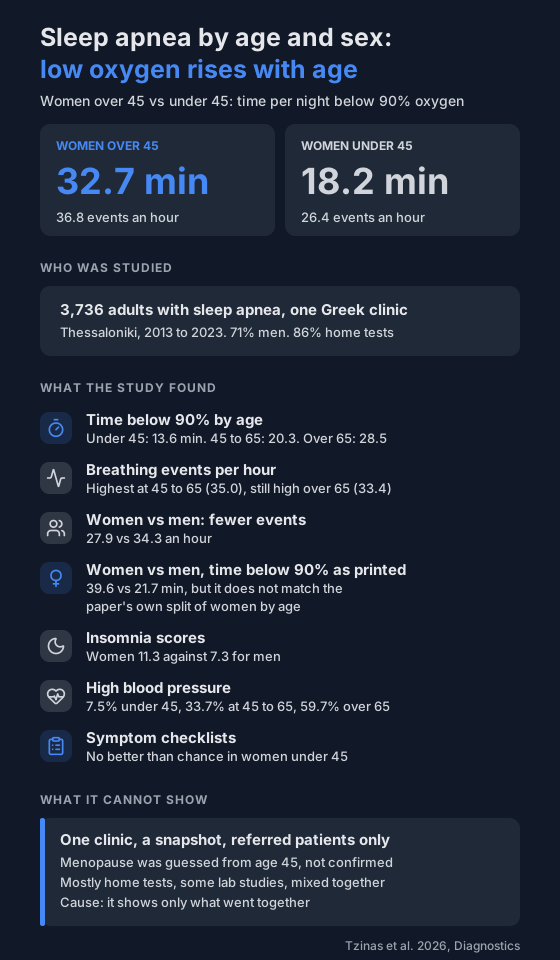
Sleep apnea is usually graded by one number: breathing events per hour. A 2026 study from a Greek sleep clinic suggests that number misses part of the picture for women and for older people.
Time with oxygen below 90% went up with each age group. Women over 45 spent 80% longer below 90% than women under 45. And symptom checklists often used before testing did worst in women under 45.
Who was studied?
- 3,736 adults with confirmed sleep apnea, seen at one hospital sleep clinic in Thessaloniki, Greece, between 2013 and 2023.
- 71% were men.
- 86% had a home sleep test. The rest had a night in the sleep lab, mainly people with heart, lung or nerve-muscle conditions, or who couldn't do a home test.
- The authors split them by age (under 45, 45 to 65, over 65) and by sex.
It's a look back at clinic records, taken at one point in time.
How did women compare with men?
- Age. Women came to the clinic slightly older: 58.3 on average, against 56.5.
- Weight. Women had a higher average BMI.
- Breathing events. Fewer in women: 27.9 an hour, against 34.3 for men.
- Higher grade. 33.1% of women had 30 or more events an hour, against 46.5% of men.
- Time below 90%. The paper prints 39.6 minutes a night for women, against 21.7 for men. That women figure comes with a spread of 314 minutes, and the paper's own split of women by age (18.2 and 32.7 minutes) averages out nearer 27. So women may well have spent longer below 90%, but the exact gap is uncertain.
- Insomnia. Women scored much higher on an insomnia scale: 11.3 against 7.3.
- Sleepiness. Women scored slightly higher: 10.0 against 9.2.
The authors say the events-per-hour number on its own may understate what's going on in women, and that oxygen measures like time below 90% should be reported too. For what that measure means, see what T90 is.
What changed with age?
- Breathing events peaked at 45 to 65 (35.0 an hour) and stayed high over 65 (33.4). Under 45 it was 25.7.
- Time below 90% went up with each age group: 13.6 minutes under 45, 20.3 at 45 to 65, 28.5 over 65.
- Average overnight oxygen went down: 93.4%, 92.1%, then 91.2%.
- High blood pressure was on record for 7.5% under 45, 33.7% at 45 to 65 and 59.7% over 65. Diabetes and heart disease rose the same way.
- Sleepiness scores dipped over 65 even though event counts stayed high.
The authors describe older patients as low on oxygen but not especially sleepy. That matches an earlier post on sleep apnea without sleepiness.
What about women over 45?
The study used age 45 as a stand-in for menopause. Women over 45 (682 in this table) were compared with women under 45 (412):
- Breathing events: 36.8 an hour, against 26.4.
- Time below 90%: 32.7 minutes, against 18.2. That's 80% longer.
- 30 or more events an hour: 49.6%, against 31.3%.
- High blood pressure: 58.7%, against 32.1%.
- Insomnia scores were higher (11.8 against 10.4). Sleepiness scores showed no statistically significant difference (10.1 against 9.8).
The authors call this hypothesis-generating, since nobody's menopause was actually confirmed. For more on this group, see sleepiness after menopause and women over 70.
How did the checklists do?
Everyone filled in three checklists before testing: STOP-Bang, the Epworth sleepiness scale and the Athens insomnia scale. The study checked how well each one picked out people with 15 or more events an hour. It scored them from 0 to 1, where 1 is perfect and 0.5 is a coin toss.
- STOP-Bang was the most consistent, at about 0.69 to 0.75 in every group. It was lowest at 75 to 90 (0.696).
- In women under 45, the sleepiness and insomnia scales scored 0.447 and 0.409. That's no better than chance.
- In women aged 75 to 90, the same two scales did better (0.684 and 0.676), the reverse of the overall trend.
- In everyone aged 75 to 90, the sleepiness scale scored 0.645, its highest of any age group, so it did not do worse in the oldest.
- The checklists did better in men than in women, most clearly in the youngest groups. None reached 0.8 in any group.
The authors say tiredness, insomnia and low mood in younger women shouldn't be brushed off just because a sleepiness score is low.
What can't it show?
- Cause. It's a snapshot. It shows what went together, not what caused what.
- Everyone. It's one clinic's referred patients, mostly men, so milder or less typical cases, especially in women, are likely under-represented.
- Menopause. Age 45 was a stand-in. Perimenopause, surgical menopause and hormone therapy weren't recorded.
- Test type. Home tests and lab studies were mixed, and they can give different counts.
- Some numbers. Some of the paper's figures don't line up. The women's time below 90% (39.6 minutes) doesn't match the over-45 and under-45 split. The age table implies about 113 women under 45, but the women's table lists 412. The women's BMI spread is printed as both 180.9 and 18.9.
What does it mean for you?
Fewer breathing events doesn't always mean less time with low oxygen. An overnight oximeter shows you the oxygen side: how long you spent below 90% and how often you dipped.
It can't tell you whether you have sleep apnea. If you're tired, sleeping badly or snoring, the sleep apnea risk check helps you decide whether to talk to a doctor. If you have recordings, share them with your doctor.
For a lab study comparing men and women at the same grade, see women vs men overnight oxygen.
Not a medical device. Does not diagnose, treat or prevent any condition. Discuss results and changes with a clinician.
References
- Tzinas A, Karkala A, Kotoulas SC, Kalamaras G, Mouloudi E, Massa E, Pataka A. Age and Sex Matter: Phenotypic Heterogeneity, Diagnostic Gaps, and Screening Tool Performance in Obstructive Sleep Apnea - A 10-Year Sleep Clinic Cohort Study. Diagnostics. 2026;16(7):983. doi:10.3390/diagnostics16070983