Sleepiness After Menopause With Sleep Apnea
A 2026 study of 216 postmenopausal women with sleep apnea found that about half reported daytime sleepiness. The sleepy group had more breathing events per hour and lower oxygen lows.
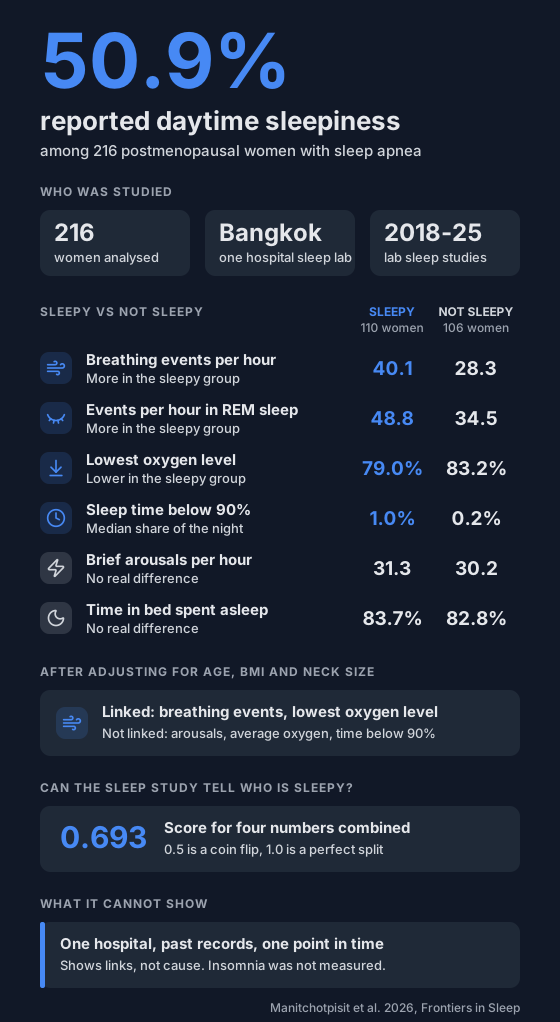
Not everyone with sleep apnea feels sleepy during the day. A 2026 study from Thailand looked at which sleep study numbers go with sleepiness in women after menopause.
Who was studied?
- 216 postmenopausal women with sleep apnea confirmed by an overnight lab sleep study.
- One hospital sleep lab in Bangkok, September 2018 to June 2025.
- Each woman filled in a standard sleepiness questionnaire on the day of the study.
- Women with conditions such as depression, short habitual sleep, shift work or sleeping pills were left out.
110 women (50.9%) scored as sleepy. 106 did not.
How did the sleepy group differ?
They were a little younger, 60.3 against 62.6 years on average. They had a higher BMI, 26.7 against 24.9, and a larger neck, 13.2 against 12.8 inches.
On the sleep study:
- Breathing events per hour (including effort-related arousals): 40.1 against 28.3.
- Events per hour in REM sleep: 48.8 against 34.5.
- Lowest oxygen level: 79.0% against 83.2%.
- Sleep time below 90% (T90): a median of 1.0% against 0.2%.
The sleepy group also had more events on the back, off the back and in non-REM sleep, and a lower average oxygen (94.4% against 95.4%). Brief arousals per hour (31.3 against 30.2) and the share of time in bed spent asleep (83.7% against 82.8%) did not differ.
What held up after adjusting?
The authors adjusted for age, BMI and neck size.
- Still linked to sleepiness: breathing events per hour (overall, on the back, in REM and in non-REM sleep) and a lower oxygen low.
- No longer linked: events off the back, average oxygen and T90.
Can a sleep study tell who is sleepy?
Only partly. The authors combined four numbers: breathing events per hour, REM events, average oxygen and lowest oxygen. The model scored 0.693, where 0.5 is a coin flip and 1.0 is a perfect split. The authors say that limits its use for decisions about one person.
What can't it show?
- Past records from one hospital at one point in time, so it shows links, not cause.
- Insomnia was not measured, and it is linked to questionnaire scores.
- Years since menopause, hormone therapy and beta-blocker use were not recorded.
- 128 of the 216 studies measured only the first part of the night, which can undercount REM and position numbers.
- Women often report fatigue instead of sleepiness, which the questionnaire may miss.
- The model was not tested on a second group.
If you're tired during the day, tell your doctor, whether or not you'd call it sleepiness. Got overnight recordings? Here's how to share them.
Not a medical device. Does not diagnose, treat or prevent any condition. Discuss results and changes with a clinician.
References
- Manitchotpisit T, Sugkraroek P, Segsarnviriya C, Chirakalwasan N, Maiprasert M. Polysomnographic characteristics of excessive daytime sleepiness in postmenopausal women with obstructive sleep apnea. Frontiers in Sleep. 2026;5:1853970. doi:10.3389/frsle.2026.1853970