What Goes With Sleepiness in Sleep Apnea?
A 2026 study of 1,783 adults with sleep apnea found 14% were sleepy in the day. Sleepiness was more common with a higher oxygen burden, higher loop gain and a bigger pulse jump at breathing events.
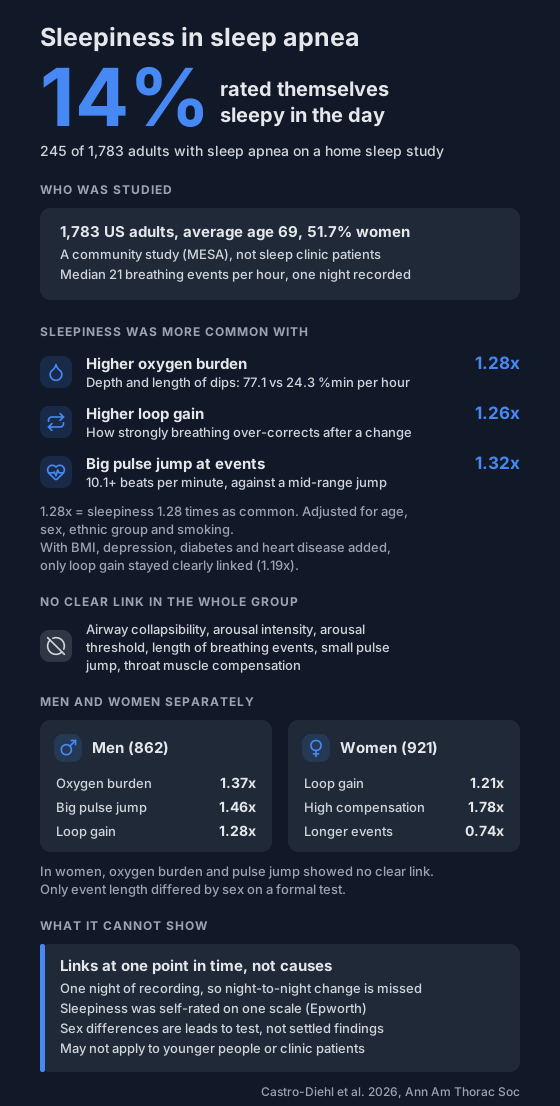
Some people with sleep apnea are sleepy all day and some aren't. The number of breathing events per hour doesn't explain much of the difference.
A 2026 study looked at what else on a sleep study goes with sleepiness, and whether it's the same for men and women.
Who was studied?
- 1,783 adults from MESA, a long-running US community health study.
- Average age 69, and 51.7% were women.
- Everyone had more than 5 breathing events per hour on one night of a full sleep study done at home. The median was 21.
- Nobody was regularly using CPAP, an oral device or oxygen at night.
- Sleepiness was self-rated on the Epworth Sleepiness Scale. A score above 10 counted as sleepy.
14% were sleepy (245 people). The share was about the same in women (13%) and men (14%).
What went with sleepiness?
Three traits, after adjusting for age, sex, ethnic group and smoking:
- Oxygen burden. This adds up how deep and how long the oxygen dips are after breathing events. Sleepiness was 1.28 times as common at 77.1 %min per hour as at 24.3 (the 75th and 25th percentiles of the group).
- Loop gain. This is how strongly your breathing over-corrects after a change. Higher loop gain went with sleepiness 1.26 times as common.
- Pulse jump at events. A jump of about 10 beats per minute or more went with sleepiness 1.32 times as common, compared with a mid-range jump. A small jump (under 5.8) showed no clear link.
In absolute terms the gaps were small: 3.7 percentage points more sleepy people for oxygen burden, 2.7 for loop gain and 3.6 for the pulse jump. The range for the pulse jump figure included zero.
Adjusting for short sleep (under 6 hours) barely changed the results. After also adjusting for BMI, depression symptoms, diabetes and cardiovascular disease, only loop gain stayed clearly linked in the whole group (1.19 times).
For more on oxygen burden, see long breathing pauses and hypoxic burden. For pulse swings at night, see overnight heart rate and CVHR.
What didn't?
In the whole group there was no clear link with:
- How easily the airway collapses.
- How strong the brief arousals were, or how easily a person woke.
- How long the breathing events lasted.
- How much the throat muscles compensated.
The authors called the arousal result surprising.
Was it different for men and women?
The study points that way, cautiously.
- Men: oxygen burden (1.37 times) and a big pulse jump (1.46 times) were linked with sleepiness.
- Women: neither was clearly linked. Strong throat muscle compensation was (1.78 times, top third against middle third), and so were shorter breathing events. Going from shorter to longer events went with sleepiness 0.74 times as common.
- Both: loop gain, 1.21 times in women and 1.28 times in men.
Only the event-length difference between the sexes passed a formal statistical test (P = .03). The authors say the rest should be read as ideas for future studies.
Their reading: sleepiness may go with low oxygen in men and with broken sleep in women.
Related: sleepiness after menopause with sleep apnea.
What else did sleepy people have in common?
Before any adjustment, the sleepy group had:
- Short sleep more often: 40% against 29%.
- Insomnia symptoms more often: 44% against 33%.
- Diabetes more often: 27% against 20%.
- A higher average BMI: 30.3 against 28.7.
- Slightly more breathing events per hour: a median of 23 against 20.
What can't it show?
- It's a snapshot, so it shows links, not causes.
- One night of recording. Sleep apnea numbers change from night to night.
- Loop gain and the other airway traits were estimated from the recording, not measured directly.
- Sleepiness came from one self-rated scale, which may work differently in women and older adults.
- The group was older and from the community. It may not apply to younger people or sleep clinic patients.
- No single trait explained much of who was sleepy.
The study was funded by the US National Institutes of Health. Four of the eight authors declared consultant roles, and three receive grant support.
What can you do with this?
- Not sleepy? That doesn't rule sleep apnea out. See sleep apnea without sleepiness.
- Sleepy? Short sleep and insomnia symptoms were more common in the sleepy group too, so mention your sleep hours to your doctor.
- A home oximeter doesn't report oxygen burden or loop gain. It does log your oxygen dips and pulse, which you can trend across nights and take to an appointment.
Not a medical device. Does not diagnose, treat or prevent any condition. Discuss results and changes with a clinician.
References
- Castro-Diehl C, Alex R, Azarbarzin A, Zhang Y, Wellman A, Huang T, Sands S, Redline S. Associations of excessive sleepiness with sleep apnea physiological endo-phenotypes: the multi-ethnic study of atherosclerosis. Annals of the American Thoracic Society. 2026;23(7):1067-1076. doi:10.1093/annalsats/aaoag078