Oxygen Burden and Heart Rhythm After Stroke
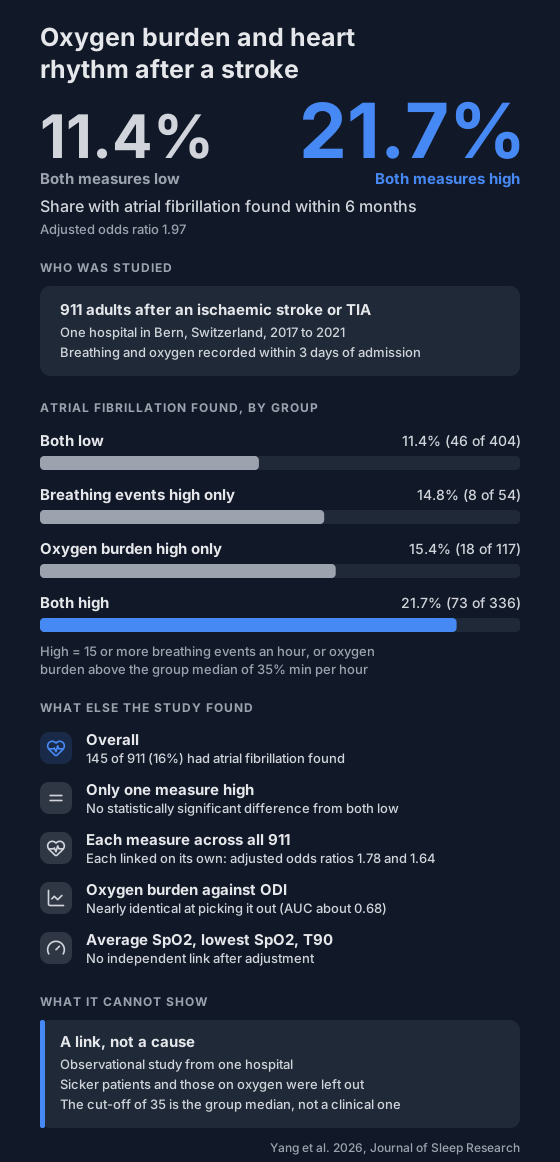
A 2026 study of 911 stroke and TIA patients found atrial fibrillation in 21.7% of those with both frequent breathing events and a high oxygen burden, against 11.4% of those with neither.
Atrial fibrillation is an irregular heart rhythm that raises the chance of a stroke. After a stroke it's easy to miss, because it comes and goes.
A 2026 study from Bern asked whether a breathing recording made in the first days after a stroke could show who's more likely to have it.
Who was in the study?
- 911 adults admitted to one Swiss hospital with an ischaemic stroke or TIA, 2017 to 2021.
- Their average age was 66, and 61% were men.
- None had known atrial fibrillation.
- Each had breathing and oxygen recorded overnight within 3 days of admission.
- Heart rhythm was then checked with up to three 7-day ECG recordings over 6 months.
What did they measure?
- Breathing events per hour. High meant 15 or more.
- Oxygen burden. Researchers call it hypoxic burden. It adds up how deep each oxygen dip goes and how long it lasts. High meant above the group's median of 35% min per hour.
What did they find?
Atrial fibrillation was found in 145 patients (16%):
- Both low: 11.4% (46 of 404).
- Breathing events high only: 14.8% (8 of 54).
- Oxygen burden high only: 15.4% (18 of 117).
- Both high: 21.7% (73 of 336).
After adjusting for age, sex, body mass index, smoking and six health conditions, the both-high group had about twice the odds of the both-low group (odds ratio 1.97). The two groups with only one measure high weren't statistically different from the both-low group.
Across all 911, each measure was linked to atrial fibrillation when modelled separately (adjusted odds ratios 1.78 for breathing events and 1.64 for oxygen burden).
Was oxygen burden better than ODI?
No. Oxygen burden and ODI were each linked to atrial fibrillation, and picked it out about equally well (AUC about 0.68 for both).
Average SpO2, lowest SpO2 and T90 had no independent link after adjustment.
What doesn't it tell you?
- Cause. It's an observational study from one hospital.
- Everyone. 5,536 patients were admitted and 911 were analysed. Most had no breathing recording, and 626 were left out because they were on oxygen. Those included were younger and had less serious strokes.
- A cut-off. The authors say 35 is this group's median, not a clinical threshold.
- Later changes. Breathing can change after the first days, so one early recording may misclassify some patients.
What can you do with this?
This hospital recording measured airflow as well as oxygen. A home oximeter doesn't calculate oxygen burden or show heart rhythm.
If you record your nights, you can share the data with your doctor.
Not a medical device. Does not diagnose, treat or prevent any condition. Discuss results and changes with a clinician.
References
- Yang X, Lippert J, Filchenko I, Horvath CM, Baillieul S, Bernasconi C, Bauer-Gambelli SA, Brill AK, Seiffge DJ, Auer E, Reichlin T, Fischer U, Arnold M, Schmidt MH, et al. Enhanced Risk Stratification of Atrial Fibrillation Detected After Ischemic Stroke and TIA: The Role of Apnoea-Hypopnoea Index and Hypoxic Burden - A Study From the Bern Sleep-Stroke Registry. Journal of Sleep Research. 2026;35(4):e70338. doi:10.1111/jsr.70338