Insomnia Plus Sleep Apnea: Heart Risk Study
A Swiss study followed 1,860 adults for about 8 years. Insomnia symptoms and sleep apnea together, but neither alone, were linked to more heart and stroke events.
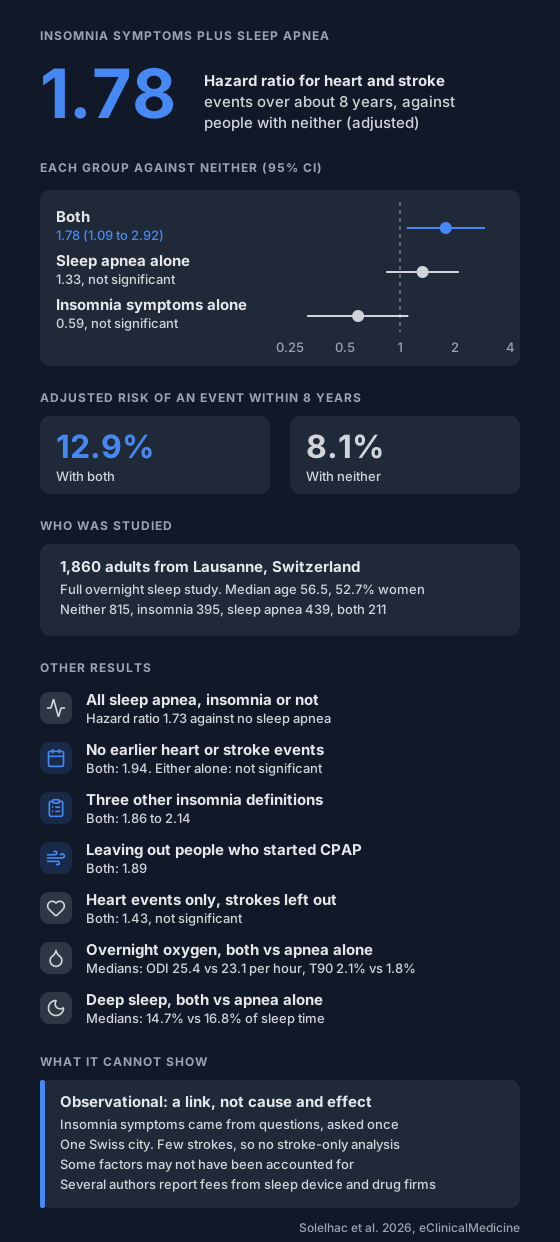
Sleep apnea and insomnia have each been linked to heart disease. They also often turn up in the same person, and that combination has a name: COMISA. A 2026 study from Switzerland followed people with one, the other, both or neither for about 8 years.
Once other risk factors were taken into account, only the group with both was linked to more heart attacks, strokes and related events than the group with neither.
Who was studied?
- 1,860 adults from Lausanne, Switzerland, picked at random from the population register.
- Median age 56.5, and 52.7% were women.
- Everyone had a full overnight sleep study between 2009 and 2013.
- Sleep apnea meant 15 or more breathing events per hour.
- Insomnia symptoms meant trouble falling asleep within 30 minutes, or waking in the night or too early, at least 3 times a week.
That split them into four groups:
- Neither: 815
- Insomnia symptoms only: 395
- Sleep apnea only: 439
- Both: 211 (11.3%)
An expert panel confirmed each heart attack, stroke, coronary heart disease event and related death over a median of 7.9 years.
What did it find?
After adjusting for age, sex, BMI, smoking, alcohol, blood pressure, diabetes, blood fats and earlier heart or stroke events:
- Both: hazard ratio 1.78 (95% CI 1.09 to 2.92).
- Sleep apnea only: 1.33, not statistically significant.
- Insomnia symptoms only: 0.59, not statistically significant.
The estimated 8-year risk of an event was 12.9% with both and 8.1% with neither.
The authors say the low figure for insomnia alone is probably down to who was in that group, not a protective effect.
Sleep apnea was linked to more events when insomnia was ignored. Looking at everyone with sleep apnea, insomnia or not, the hazard ratio was 1.73. Once the two were split apart, only the combination stood out. A statistical test for whether the pair together carried more risk than each alone was also significant.
Did it hold up?
Mostly:
- People with no earlier heart or stroke events: both 1.94.
- Three other ways of defining insomnia, including sleeping pill use and time awake in the night: both 1.86 to 2.14.
- Leaving out people who started CPAP during follow-up: both 1.89.
One check didn't hold. With strokes taken out and only heart events counted, the figure for both fell to 1.43 and was no longer significant. There were too few strokes to look at them on their own.
Did their overnight oxygen look different?
Not really. People with both and people with sleep apnea alone had similar sleep study numbers (medians):
- Oxygen dips per hour (ODI): 25.4 against 23.1.
- Time below 90% SpO2 (T90): 2.1% against 1.8% of sleep time.
- Breathing events per hour: 26.7 against 25.5.
What differed was deep sleep: 14.7% of sleep time with both, against 16.8% with sleep apnea alone. They were also awake longer in the night: a median of 77 minutes against 69.5.
So the oxygen numbers alone didn't separate the two groups.
What doesn't it tell you?
- Cause. It's observational. It shows a link, not that the combination causes heart problems.
- Insomnia as a condition. Symptoms came from a sleep questionnaire, asked once at the start, not from formal criteria. They may have changed later.
- Everyone. One city in Switzerland, people aged 35 to 75 when first recruited.
- Everything else. The authors say other factors they didn't measure could play a part.
On funding and ties:
- GlaxoSmithKline helped fund the original cohort and the sleep study recorders.
- Several authors report grants, fees or honoraria from companies including ResMed, Philips, Inspire, Nyxoah, Apnimed and Idorsia.
- Two of them say all their payments went to their institution.
The authors call for doctors to look for and manage both conditions together. They point to earlier research where insomnia-focused therapy (CBT-I) went with more CPAP use. They also suggest the combination may help explain why CPAP trials haven't shown a clear fall in heart events, which this review covers. This study didn't test any therapy.
What can you do with this?
If you sleep badly and also snore or someone has seen you stop breathing, tell your doctor about both, not just one. For another study on the same pairing, read diabetes, insomnia and sleep apnea together.
The sleep apnea risk check takes about a minute and helps you decide whether to raise it.
An overnight oximeter can't tell you whether you have sleep apnea or insomnia. It logs your oxygen and pulse, and you can share that with your doctor.
Not a medical device. Does not diagnose, treat or prevent any condition. Discuss results and changes with a clinician.
References
- Solelhac G, Imler T, Marchi NA, Baillieul S, Van Den Broecke S, Caetano G, Heiniger G, Waeber A, Ericson I, Bayon V, Lombardi AS, Haba-Rubio J, Vollenweider P, Marques-Vidal P, et al. Comorbid insomnia and sleep apnea (COMISA) and incident cardiovascular risk: a prospective analysis from the HypnoLaus cohort. eClinicalMedicine. 2026;100:104227. doi:10.1016/j.eclinm.2026.104227