Daridorexant and Sleep Apnea: A 2026 Trial
A 2026 crossover trial gave 16 adults with 30 or more breathing events per hour the sleeping pill daridorexant and placebo for 5 nights each. Breathing events and mean SpO2 were not worse by the margin set in advance, and total sleep time was 32.5 minutes longer.
Sleeping pills and sleep apnea are usually seen as a bad mix. The worry is that a sedating drug makes breathing pauses longer or more frequent.
Daridorexant is a newer kind of sleeping pill that blocks orexin, a brain signal that keeps you awake. A trial published in 2026 tested it in people with a lot of breathing events per hour. After 5 nights, neither breathing events nor mean SpO2 was worse than on placebo by the margin the researchers had set in advance. People slept about half an hour longer.
The trial was small, short and paid for by Idorsia, the company that makes the drug.
Who was studied?
- 16 adults with obstructive sleep apnea, at one sleep lab in Berlin.
- All had 30 or more breathing events per hour on two sleep studies. The average was 51.2, and the range was 30.8 to 82.2.
- 15 men and 1 woman, average age 63, average BMI 30.7.
- None had insomnia.
- None had used CPAP or a dental appliance in the previous 2 months.
How did the trial work?
- It was a randomised, double-blind crossover trial. Everyone took both the drug and the placebo, in random order.
- Each was taken every evening for 5 nights, with a break of 1 to 2 weeks in between.
- The dose was 50 mg, the highest approved one.
- Nights 1 and 5 were recorded in the sleep lab for 8 hours. The results below are from night 5.
The trial asked one narrow question: does the drug make breathing meaningfully worse? The researchers set the bar in advance at 10 more breathing events per hour, or a 2-point drop in mean SpO2.
Did breathing or oxygen change?
Not past either bar. The trial tested whether the drug was worse than placebo by a set margin, not whether the two were equal.
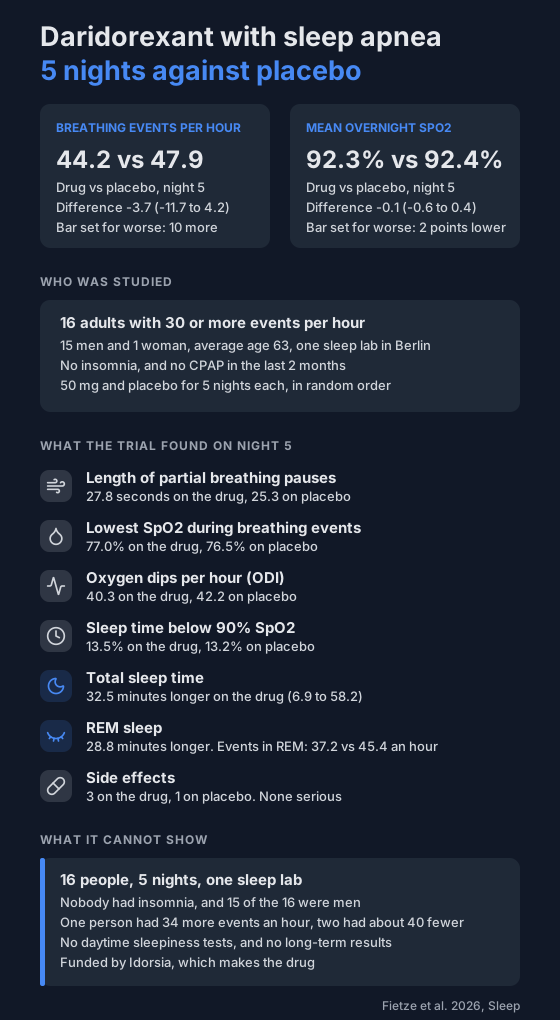
- Breathing events per hour: 44.2 on the drug, 47.9 on placebo. The difference was -3.7, with a 90% confidence interval of -11.7 to 4.2. The upper end is below the bar of 10.
- Mean SpO2 during sleep: 92.3% on the drug, 92.4% on placebo. The difference was -0.1 points (-0.6 to 0.4). The lower end is above the bar of -2.
- Oxygen dips per hour (ODI): 40.3 against 42.2.
- Sleep time below 90% SpO2 (T90): 13.5% against 13.2%.
- Lowest SpO2 during breathing events: 77.0% against 76.5%.
For ODI, T90 and lowest SpO2, the intervals around the differences all include zero.
One figure went the other way. Partial breathing pauses lasted 27.8 seconds on the drug and 25.3 on placebo, a difference of 2.5 seconds (0.1 to 4.9). That interval does not include zero, yet the paper's text lists the length of pauses among the measures with no difference. Full pauses were 24.9 against 26.8 seconds.
In REM sleep, breathing events were 37.2 per hour on the drug and 45.4 on placebo, a difference of -8.2 (-13.7 to -2.7). The trial wasn't sized to test that, so it's a lead to follow up, not a firm result.
Was it the same for everyone?
No. The individual differences in breathing events ran from 43 fewer per hour to 34 more.
- One person had 71.8 events per hour on the drug and 37.6 on placebo.
- Two people had 8.6 and 5.4 on the drug, against about 48 on placebo.
The authors put this down to night-to-night variation, longer sleep and less time on the back. With one night-5 recording per arm, the trial can't separate those from an effect of the drug.
What happened to sleep?
- Total sleep time: 32.5 minutes longer on the drug (424 against 392 minutes, 90% interval 6.9 to 58.2).
- REM sleep: 28.8 minutes longer, which accounts for most of the extra sleep.
- Time to fall asleep: 10.3 minutes shorter (-20.6 to -0.02).
- Time awake during the night: 15.2 minutes less, but the interval (-31.2 to 0.9) includes no change.
- Number of awakenings: 13.7 against 14.3, and the interval includes no change. The longest one was 18.7 minutes shorter.
- Arousals per hour and time on the back: no meaningful difference, the authors report.
These were exploratory measures in people who didn't have insomnia.
Were there side effects?
Three were reported on the drug, in 2 people: sleepiness, headache and abnormal dreams. One, sleepiness, was reported on placebo. None was serious, none was related to breathing, and nobody dropped out.
What can't it tell you?
- Long-term use. It ran for 5 nights per arm.
- Small numbers. 16 people at one sleep lab can't rule out a rare or modest effect, and three of them swung widely in both directions.
- People with insomnia. They were excluded, although insomnia is what the drug is approved for.
- Women. There was one. All 16 participants were White.
- People on CPAP. Nobody was using it.
- The next day. The paper reports no tests of daytime sleepiness or alertness. The authors say the effect on daytime sleepiness needs future studies.
- Independence. Idorsia funded the trial and the medical writing. Three of the six authors are Idorsia employees, and two others report fees from the company.
What the trial found is narrow: over 5 nights, the 50 mg dose did not raise breathing events or lower mean SpO2 past the set margins in these 16 people.
An older sleeping pill has been through the same question. See the review of zolpidem with sleep apnea.
What can you do with this?
Whether a sleeping pill suits you is a decision for you and your doctor. This trial doesn't change that.
If you track your nights, an overnight oximeter records the same oxygen figures the trial used: mean SpO2, ODI and time below 90%. You can share those recordings with your doctor. A single night can swing a lot, as this trial shows, so look at several.
Not a medical device. Does not diagnose, treat or prevent any condition. Discuss results and changes with a clinician.
References
- Fietze I, Boof ML, Lederer K, Lemoine V, Vaillant C, Pépin JL. Daridorexant in severe obstructive sleep apnea: effects on sleep-disordered breathing and sleep. Sleep. 2026;49(9):zsag145. doi:10.1093/sleep/zsag145