Zolpidem and Sleep Apnea: A 2026 Review
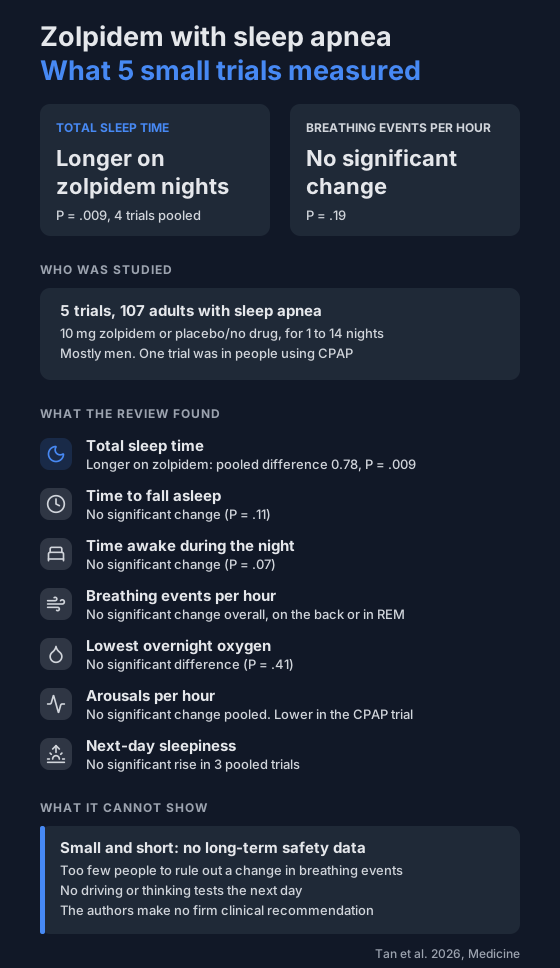
A 2026 review pooled 5 small trials of zolpidem in 107 adults with obstructive sleep apnea. Total sleep time was longer, and breathing events per hour showed no statistically significant change.
Sleeping pills are usually not recommended for people with obstructive sleep apnea. The worry is that they relax the throat muscles and make breathing pauses longer. The review's authors say human data on that is thin.
A review published in July 2026 pooled the controlled trials of one sleeping pill, zolpidem. Total sleep time was longer on zolpidem. Breathing events per hour and the lowest overnight oxygen showed no statistically significant change. The trials were small and short, and the authors say no firm clinical recommendations can be made.
Who was studied?
- 5 controlled trials, found by searching the databases up to March 2024.
- 107 adults with obstructive sleep apnea confirmed by a sleep study, going by the results section and study table. The discussion says 83.
- Only 7 of them were women.
- Average ages ran from 36 to 55, and average BMI from 27 to 36.
- Everyone on the drug took 10 mg of zolpidem.
- Three trials tested a single night, one ran for 7 nights and one for 14.
- Four trials compared zolpidem with placebo. One was open-label and compared it with no drug.
- In one trial everyone had more than 30 breathing events per hour and used CPAP, including on the study nights.
Insomnia and sleep apnea often turn up together. The review says 30% to 50% of people with sleep apnea have insomnia symptoms. The trials themselves selected people by their breathing events per hour, not by insomnia. For more on the overlap, see insomnia and sleep apnea in people with diabetes.
What happened to sleep?
- Total sleep time was longer on zolpidem, across 4 trials. The pooled difference was 0.78 (95% CI 0.19 to 1.37, P = .009). The paper doesn't give a unit for that figure, so it can't be read as minutes or hours.
- Time to fall asleep showed no statistically significant change (P = .11).
- Time awake during the night showed no statistically significant change (P = .07).
- Share of the night spent on the back showed no statistically significant change.
The CPAP trial couldn't be pooled for time to fall asleep. On its own it found people fell asleep faster on zolpidem nights.
The paper's discussion describes zolpidem as shortening the time to fall asleep. Its own pooled result, above, was not statistically significant.
What happened to breathing and oxygen?
None of the pooled breathing measures differed to a statistically significant degree between zolpidem and control nights:
- Breathing events per hour overall (P = .19).
- Breathing events per hour on the back (P = .28).
- Breathing events per hour in non-REM sleep (P = .58) and REM sleep (P = .84).
- Arousals per hour (P = .28).
- How long each breathing event lasted (P = .71).
- The lowest oxygen saturation of the night (P = .41).
The trials' results varied a lot from one to the next on breathing events per hour, both overall (I2 = 80%) and on the back (I2 = 91%). The authors think the flat overall result may hide two opposite effects. Zolpidem may relax the airway muscles, and it also makes people harder to wake, which can steady breathing. Which one wins may differ from person to person.
In the CPAP trial, arousals were slightly lower on zolpidem nights: 16.5 per hour against 19.0 on placebo (P < .05).
The review also mentions a separate study of 10 healthy heavy snorers, where breathing events per hour rose slightly on zolpidem. That study wasn't part of the pooled results.
What about the next day?
- Four trials asked about next-day sleepiness. Three used the same scale and were pooled.
- There was no statistically significant rise in sleepiness on zolpidem.
- No serious side effects were reported, and nobody dropped out.
- None of the trials used driving simulators or detailed thinking tests.
What doesn't it tell you?
- Long-term safety. The longest trial lasted 14 nights. The authors say the review can't address tolerance, dependence or complex sleep behaviours.
- That breathing is unaffected. With this few people, a real change in breathing events could have been missed. "No significant change" is not proof of no change.
- Who it applies to. Almost everyone was male, and the authors think the trials enrolled healthier patients than a typical clinic sees.
- Individual response. The review couldn't split results by how many breathing events per hour people had at the start.
- How much was placebo. The authors note that expectation can account for part of a sleep benefit.
- A pre-set plan. The review was not registered and no protocol was prepared.
What do the authors conclude?
- Zolpidem is not a therapy for sleep apnea itself.
- It should not be seen as a way to raise CPAP use.
- Cognitive behavioural therapy remains the first choice for insomnia with sleep apnea.
- Zolpidem might be a second-line option after that, for short periods, with extreme caution and monitoring.
- No firm clinical recommendations can be made from this evidence.
Those are the review's conclusions, not advice. Whether a sleeping pill suits you is a decision for you and your doctor.
What can you do with this?
If you have sleep apnea and sleep badly, tell your doctor about both.
Already record your nights? Log which nights you took anything prescribed for sleep, and share the recordings with your doctor. One night says little, so see how many nights to record.
An overnight oximeter can't tell you whether a medicine is safe for you. It records what your oxygen and pulse did.
Not a medical device. Does not diagnose, treat or prevent any condition. Discuss results and changes with a clinician.
References
- Tan B, An X, An X. The effect of zolpidem on sleep efficiency and obstructive sleep apnea severity in OSA patients: A systematic review and meta-analysis. Medicine. 2026;105(27):e49588. doi:10.1097/MD.0000000000049588